Church Politics, Spiritual Disagreement and Friendship: Theological (and Other) Differences During A Weekend With Friends

This summer, I spent a lake weekend with some friends I went to church with during graduate school. I’ll confess: leading up to the reunion there was a knot of anxiety in my stomach. I’d been watching the Southern Baptist Convention as they formally voted to bar women from the office and function of elder, which by no means surprised me. However, the rhetoric had escalated as its leaders speculated that a woman explaining a sermon on a podcast might be a step too far, which I personally find to be uncalled for. (If this topic in particular interests you, it was something covered at a recent Theology Lab with Beth Allison Barr, and adjacently, with Kristin Kobes Du Mez.)
Meanwhile, I’d been drafting writing for this blog, and I wondered if that put me at odds with this group, seeing as we were once all in a Southern Baptist church together. The last time we were all together, someone said something like, “Well, women shouldn’t be deacons.” I piped up, “I am a woman deacon!” The room fell momentarily silent until Amy burst into her signature laugh, cutting the tension and making a way for a topic change.
I wonder how many feel this way before encountering family and friends who may have known a version of you that seems to no longer exist. As life progresses, the Spirit continues to work in mysterious ways – sometimes through faith deconstruction, or simply sitting in the pew of that church you once snubbed – equal parts inexplicable, severe, and merciful, portions of our faith as once practiced can feel foreign. Perhaps, with judgment on both sides, we look at our friends and think, “They still think that?” as they look at us and think, “How did she end up there?”
I’m convinced the question underpinning both those questions, though, is this: do we still belong together? It touches on not only our deeply held convictions, but also our insecurities and God-given need for belonging in community.
1. How do faith, belief, and bias relate?
So many times, these disagreements in conviction fall along familiar fault lines: gender and sexuality issues, Scriptural interpretation, or beliefs around baptism. Trace the tree of denominational evolution and you’ll find that we’ve disagreed on just about everything – and indeed, even within ourselves and our evolution of faith we find internal inconsistencies and conflicting beliefs we’re not sure how to resolve.
(One of my favorite jokes: Rescuers found a solitary man on a desert island. He made three buildings, and they asked, “What are these?” The first, his house. The second was his church. The third? “Oh, that’s my old church. I disagreed with the way they were doing things.”)
In this cultural moment especially, due to evangelicalism’s complicated relationship with conservatism (which I wrote about earlier), political alignment often becomes a proxy for these issues. Along with the assumption of political party, one might infer a broad range of things: a person’s stance on abortion, gender and sexuality, immigration, race relations, and much more, with each of these issues deeply interrelated with theology and corresponding practice.
For a lot of really good reasons, our brains are little bias machines, not even to speak of the algorithms that are doing so much to shape our brain these days! It’s natural to pick even higher level proxies like race, region of residence, and vocation to bucket in what someone might believe.
Do this experiment with me, observing (without shame) what immediately comes to mind about what kind of things each of these Christians believe:
A white plumber in the Boston metro area
A Black minister in Atlanta metro area
A Latino teacher in Texas
A white law enforcement officer in Arizona
An Asian business executive in Los Angeles
We can’t help our biases, but we should be aware of them, and work to actively counter them, because the truth is that people and beliefs don’t fit into convenient boxes like that. Tangibly: if I tell you I’m a white, middle aged evangelical woman from South Carolina, you probably have one image in your mind; but now if I’m a white, middle aged evangelical woman in Boston, does it not shift? But if you’d sit down with me, I’m confident you’d find many surprises about what I believe, whichever lens you used.
I’m an uncomfortable blend of thoughts, never quite fitting into a single denomination in my whole life, grateful for all those churches who left room for me to affirm orthodoxy while holding the rest loosely. Upon the close examination that comes through true friendship, I think we’ll find the same about just about anybody.
2. What does the Holy Spirit have to do with our differences, biases, and friendships?
I’ve already confessed: I fell prey to these biases in my preparation for reunion with my friends. I knew most of them remained Southern Baptist, or at least close to it. On one hand I mounted my defenses, but a second tactic slowly slipped into my heart: curiosity. If I had changed in six years, had they, too? In our twenties we were young, bold, and certain, but now we had each encountered transformative life forces: moving, careers, marriage, children. Most transformative of all, the same Spirit has been working in each of us over these years. I know I’ve grown in humility, gentleness, and kindness as my own spiritual life has been reshaped through a broader lens of experiences, and by taking the time to know other people deeply, even when we hold deep disagreements.
It turns out that there are people who deeply love Jesus and who I see the Spirit’s affirming work in that believe some fundamentally different things than I do. As Jesus said, “You will know a tree by its fruit.” I see the fruit of the Spirit, so how can I say that God is not at work there? And I also know from personal experience that God is far more patient in shaping us than I’d expect. On points of difference, of course I think I’m right, but I also pray for myself and my disagreeing friend, “Lord, unify our thinking. Show us both what is right and true, and move us both to where we need to be.”
3. Does Friendship – and the Holy Spirit – Matter When We Disagree With One Another?
So how did the reunion turn out? I steeled my nerves, dropped off my kids, and set off on the drive to Lake Keowee. Little did I know in a few hours we’d be setting foot on holy ground.
We entered the Freeman home, a crowd bursting into welcome. Ashley and Collins had kept their two boys up late just so we could spend five minutes together. The first thing to meet my eyes, literally living proof of God’s faithfulness. Tears welled up in my eyes as I remembered: the last time Ashley and I were there, we sat on a bench staring into lake depths, wondering if our bodies would ever sustain a child, let alone two for each of us.
Southerners are natural storytellers; as the evening turned into wee hours we laughed together at misadventures and experiences from around the world.
The following morning I woke up to the smell of bacon cooking. (What a gift.) I poured coffee and sat on the porch with Chris and Brett; soon we were musing about AI and robotics and electricity and venture capital as it cross-cut our three worlds. I held Millie as her parents ate breakfast after a sleepless night; I met Rachel’s husband Michael, her toddler Noah, and was delighted to hear of another son growing in her belly. Some time outside, then a driving thunderstorm brought us all in for an early lunch.
With enough relational capital reestablished, as church people do, church talk ensued. Chris was now an elder in his Southern Baptist church (if Southern Baptist or SBC lingo is new to you, here’s what I mean), and somehow it came up that his church had women as deacons.
I took a risk. “And why not women elders?” Chris gave his justification and I listened, then took another risk as the topic turned towards the centrality of scripture. “What would you make of scripture that encourages us to welcome the foreigner, given today’s political climate?” I posited.
The answers after that don’t really matter for the sake of this writing. There was listening and talking, disagreement and discomfort—interjected with the gift of Amy’s ever-present humility and laughter to de-escalate and gently reshape the dialogue.
What matters is: there were probably eight different people on that porch with strong opinions, and we all left as friends, even after we said our piece. My thinking changed a little; maybe theirs did too, even if just an understanding of where someone was coming from and why cultural context might distort one’s point of view.
Afterwards, Chris said, “Hey, I really appreciate that you’re willing to push back.” I said, “Me too, and thanks for letting me push. I hope it’s gently. I just feel like, if there’s anything that we can’t talk about and still remain friends within the church, then we’re in trouble.” He nodded. We talked some about his home congregation in Texas and the diversity of views there, even in an environment saturated with churches; I exchanged my own observations of churches in Boston which must be more broad simply to survive.
Indeed, the conflict arose a couple more times but got resolved again and again by grace and wit. A heated discussion on the merits and dangers of raw milk evaporated into laughter when David sat down in the middle of it with a glass of (pasteurized) milk and Oreos.
A comparison of church security policies started among our friends, then escalated with my reflection of (the lack of) gun culture in Massachusetts and how an armed security guard made a proportion of our congregation feel less safe. Eventually this transformed into a peaceable discussion on church demographics, culture and communities, and a shared desire to keep the people in our walls safe.
Over and over again, our conversations drifted between the ordinary and the sacred, the unity and the diversity.
We had decided to forego formal church in favor of a small “service” together that Sunday morning. On one point of order, we all surprisingly agreed: let’s sing hymns. “Victory in Jesus” rang out as we all huddled around cell phone screens to squint to read all the verses. David opened “My Utmost for His Highest” and read the entry for that day:
“…until we all reach unity in the faith and in the knowledge of the Son of God and become mature, attaining to the whole measure of the fullness of Christ.” (Ephesians 4:13)
Tears welled in my eyes again as we together listened and absorbed the call to unity and maturity, the goal of seeing the church thrive together, reconciled to God and to one another instead of torn apart. You can’t tell me the Spirit didn’t choose that passage for that day.
Megan suggested we conclude by sharing brief testimonies, and the stories poured out again, with laughter and tears as we leaned in and listened to one another—stories of broken families healed, of deep loneliness still unresolved, of prodigal sisters yet to come home, of lost bets leading to church visits leading to lives of faiths, of miscarriage or marriage or griefs and joys between—in other words, the steady beat of lives walked in faith.
With sincerity we spoke of the debt of gratitude owed to one another, of how our shared investment in one another the handful of years we lived nearby and then in the decade following have made us better, stronger, more compassionate, more faithful.
4. Does Christ Matter – and Friendship – When We Disagree With Another?
I walked in with the question, Do we still belong together? And the answer is, from any pragmatic lens, absolutely not.
There are so many differences between me and the thirty others I broke bread with. We live in different places and each holds different values. We school our children differently, manage our finances differently, might vote differently, definitely live differently. Even in the religious domain, I don’t know if we could all affirm the same creeds, given the Southern Baptist commitment to confessions over credalism! If we sat in one another’s churches for a Sunday there’d be things that would raise each of our eyebrows. So many things, so many things threaten to divide us.
Yet:
Blessed be the tie that binds our hearts in Christian love;
the fellowship of kindred minds is like to that above.
Before our Father’s throne we pour our ardent prayers;
our fears, our hopes, our aims are one, our comforts and our cares.
We share our mutual woes, our mutual burdens bear,
and often for each other flows the sympathizing tear.
When we are called to part, it gives us inward pain;
but we shall still be joined in heart, and hope to meet again.
This glorious hope revives our courage by the way;
while each in expectation lives and waits to see the day.
From sorrow, toil, and pain, and sin, we shall be free;
and perfect love and friendship reign through all eternity.
We belong together, forever, because we forever belong in Christ. We’re closer to one another as we draw closer to Him. If nothing can separate us from God’s love, then let nothing separate us from loving one another, either, with the help of God.
(The just quoted hymn: Blessed Be The Tie That Binds)
Theology Lab episodes:
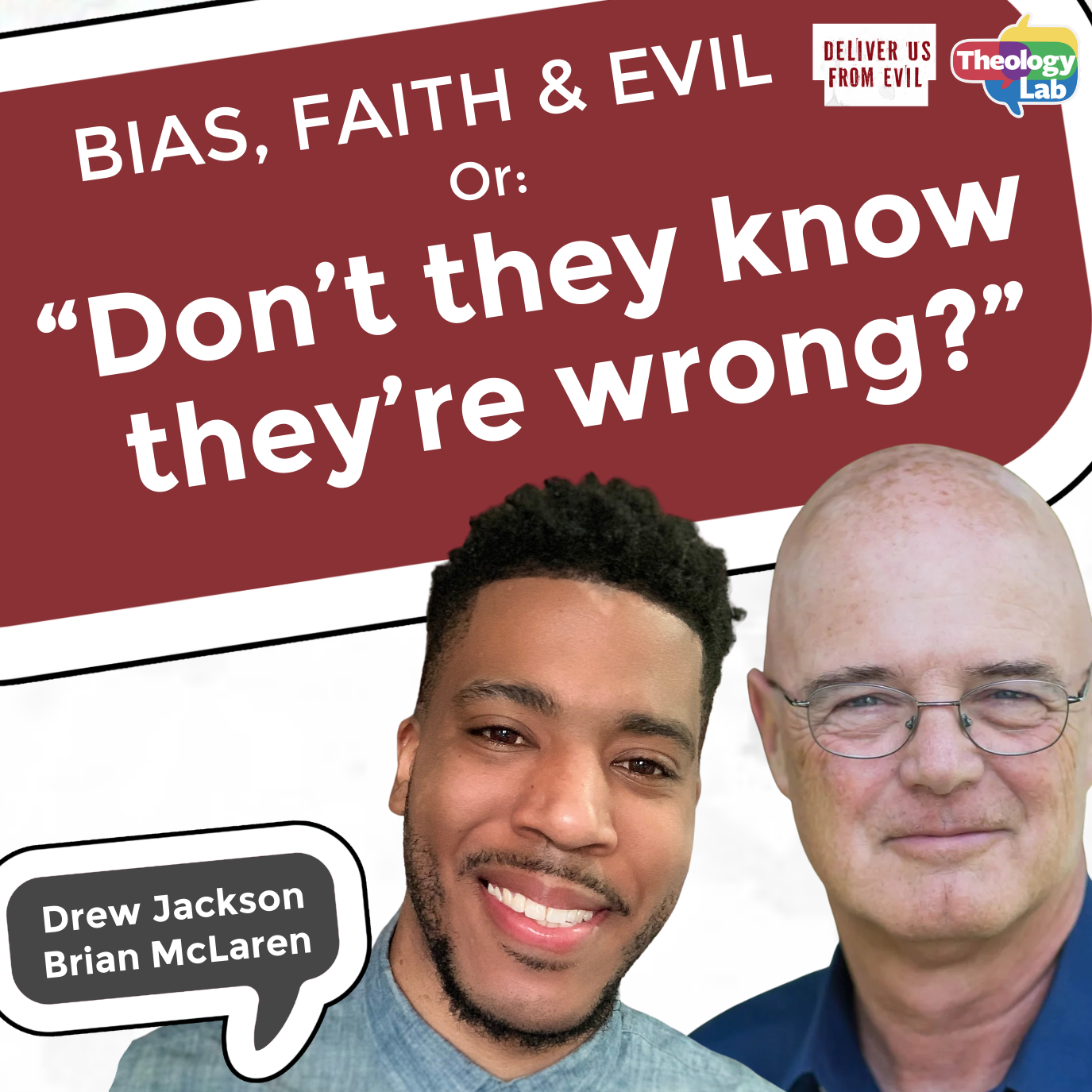
Brian McLaren and Drew Jackson take us into their deliberations on discerning and resisting the power of evil. Check out the episode page here.
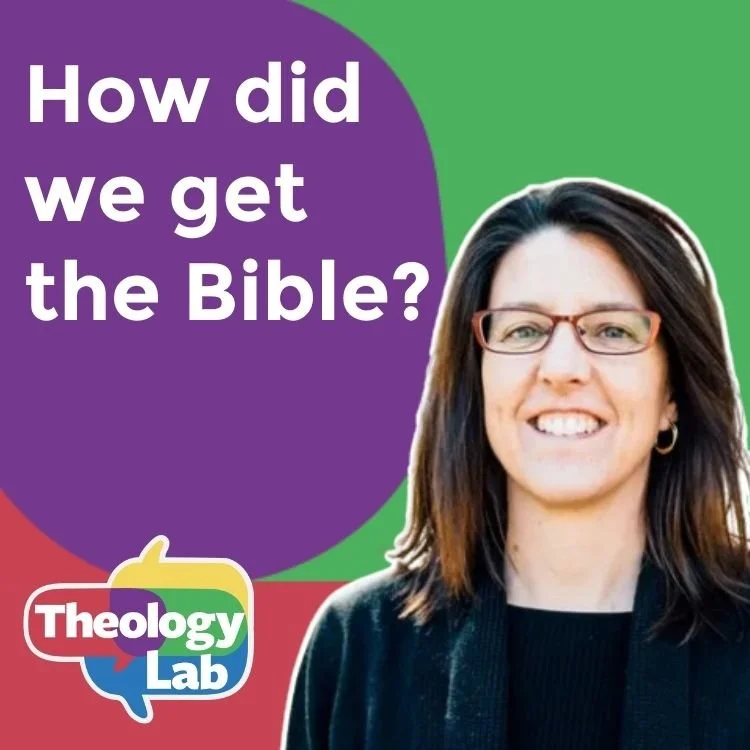
Biblical scholar Karen Keen shares how we got the Bible, and how that can help us interpret it! Check out the episode page here.