The Good Place is one of my all-time favorite shows. It’s a comedy about the afterlife that weaves together philosophy, religion, and ethics in hilarious ways. (Yes, that’s possible!) In Season 3, Judge Gen, the ‘god’ figure of the show, is informed that life on earth has become so complicated that even the task of choosing a tomato is now laced with multiple decisions. She’s told, “Buying a tomato means you are unwittingly supporting toxic pesticides, exploiting labor, contributing to global warming. Humans think they are making one choice, but they are making hundreds of choices they don’t even know they’re making.”
Her response: “Your big revelation is ‘life is complicated?’ I mean this guy chose this tomato. Those are the consequences. You don’t want the consequences? Do the research. Buy another tomato.”
This is often what we are left with when faced with difficult decisions and complex issues. Just do the research and make the right choice. As a Christian, I’ve rightly been instructed to go to the Bible to find my answer. But the Bible doesn’t say anything about global warming or toxic pesticides; at least not that I’ve found. It doesn’t have any explicit passages on abortion, or democratic politics, and it certainly doesn’t give us a guide to navigating AI. The Bible does talk about exploiting labor, and it does talk (a lot) about money. Still, it’s not always entirely clear what it is instructing us to do. The Good Place seems to agree with Theology Lab’s aptly named series on exploring difficult questions; sometimes simple answers simply won’t do.
So, how do I know which tomato to buy? Turns out people have been asking this question for quite some time.
1. How do most people approach difficult questions?
For ages, many intelligent people have sought to discover and categorize our moral systems. At risk of oversimplifying, they have found three main ethical systems that most of us utilize each day, even if we are unaware of them.
The first is a deontological system. This is a way of making ethical or moral decisions based on duty or obligation. When we look to something or someone with authority to define our actions, we are acting out of duty or obligation to that authority. Deontologically inclined persons are rule followers, and they like it that way. It makes things clean, clear, and repeatable.
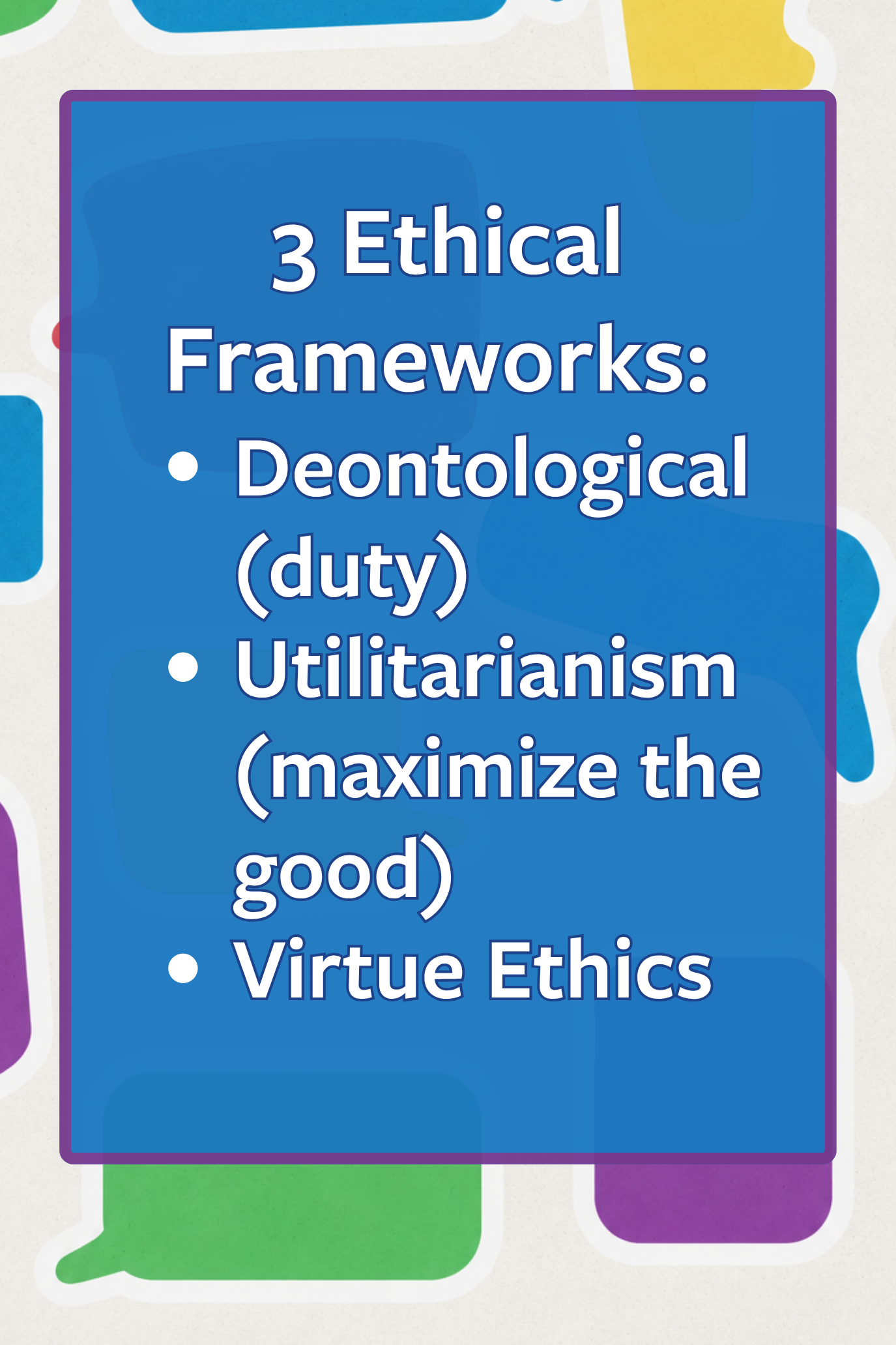
A second is a utilitarian system. This system instructs us to consider which choice will bring about the greatest benefit to the most number of people. It’s a bit of a majority rules system, though it can also be exclusive to an individual. This system looks to optimize happiness, and is very prevalent in our democratic context.
The third is virtue ethics. Instead of looking to an authority for duty or utility for happiness, virtueists look at the character of the actor. This system is less concerned with right or wrong and more concerned with how that response is made (with or without virtuous intentions) and how the response contributes to the virtue of the actor.
2. Which of these is the right way or the Christian way to respond?
Most of us utilize all three systems at different times and in different ways, but we probably each have a primary system. Yet, none of these serve as the Christian ethic. The Bible supports aspects of all three but also reveals downfalls of each. We have a moral law in Scripture to guide us in many circumstances, but not all. Duty can be done with humility, but it can also be harmfully elevated above love and kindness. Utilitarianism helps us consider inclusiveness, but it has nothing to offer the minority when a choice is made. Utilitarianism helps us consider good outcomes, but it doesn't account for the negative consequences those outcomes might bring. Virtue is highly valued in Scripture, but it doesn’t always lead to action. Virtuous behaviour should be beneficial for others, but it can also lead to pride.
On their own, none of these satisfies the Christian ethic, but they all contribute. So what do we do when we are trying to make good, moral choices but our systems fail and Scripture is unclear? In short, we improvise.
3. If none of these work, what are we to do? Improvise?
Improvisation can be a scary term. For one, it conjures up images of being put on the spot and that can be uncomfortable. It can also be scary because it implies making things up as you go along, which can feel dangerous when we’re talking about Christianity’s holy Scriptures. But improvisation is actually a skill that can be learned and utilized confidently.
In his book, Improvisation: The Drama of Christian Ethics, Samuel Wells invites us to imagine our Christian ethic as one employed by talented improv actors. Borrowing from N.T. Wright, Wells imagines our current age as the fourth act of a five-part play. Over half of the play has already been performed and can be roughly grouped into three acts: Creation, Israel, Jesus.
Fortunately for us, much of the “script” of the opening three acts has been recorded in the Bible. What we are missing today is a script for Act IV; the act we are currently inhabiting. This is both problematic and intentional. It’s problematic because we may be unsure of what we are to do in this act. It’s intentional because it gives us the freedom to improvise. But—and this is important—this is not the final act. Act V has already been written; the end of the play has already been decided by God in which he will sort everything out, even the parts we may get wrong.
This construct gives us the freedom and responsibility to perform Act IV as best we can. With no script, we instead must look back at the first three acts and learn from them. The best improv actors are those who envelope themselves in the story, and we should do the same. By immersing ourselves in the first three acts, we can learn how to act out our part with both innovation and consistency knowing that God has written the ending in which his goodness and love will ultimately prevail.
Good improv actors don’t just repeat the narrative. Instead, they keep the story moving, and so should we because we know how the story ends. Act V is already secured by the living God, which means we can look back at Scripture through reading, mediation, study, and community while walking forward with confidence. We do this by accepting the difficult questions rather than declining them. We do this by moving through challenges rather than deflecting out of fear.
And in those moments where Scripture is unclear, we do our best to act wisely in alignment with the arc of the narrative, narrowing in scope some issues while widening others. This requires more than knowledge; it requires wisdom.
4. How do wisdom and improvisation lead to right outcomes?
Wisdom is simply good improvisation lived out in our lives. Wisdom is taking what we know of Scripture and acting it out so that the story remains ongoing for people to experience.
Practically, this means we have to reject simple answers. Simple answers shut down a story; they tend to leave too little room for response. On the other hand, rejecting questions also shuts down a story. Wisdom can be found in doing the work to formulate the best possible response while remaining humble enough to admit you could be wrong.
We see improvisation in Scripture and we call it wisdom. When King Solomon was confronted with two mothers each claiming a child as her own, Solomon had to improvise. Deontological ethics left him no clear authority by which to decide. A utilitarian approach could not guide him to an outcome that was charitable. And Solomon’s virtue still left him having to act. He had to take what he knew, read the story/situation as best as he could, and trust that God would work it all out in the end. And then he had to act; act without knowing for certain that it was going to turn out the way he imagined.
This is improvisation, wisdom in action.
Another example comes from 1 Corinthians 8-10. A moral question is raised to Paul among the Corinthians: are we allowed to eat food sacrificed to idols? This question may seem irrelevant to our modern context, but Paul’s moral imagination here is worth paying attention to.
At one point Paul instructs them to “not eat,” and as a religious authority, this deontological answer gives them their duty. But he also indicates that in other circumstances, they should eat without question! He goes on to tell them to be considerate of others and their consciences. This utilitarian approach encourages the listeners to weigh the benefits before deciding. And of course, do it all with love. Be virtuous, Paul says.
It’s like Paul offers an answer from each category. So, what are they to do?
Paul intentionally avoids a simple answer. Instead of saying “yes, it’s ok” or “no, it’s not okay”, Paul improvises.
He holds tightly to his own conviction (that it’s ok) while leaving space for the conviction of others. In doing so he instructs his readers to navigate the complexity with wisdom. This requires nuance—a sometimes unpopular word, but a fitting one when it incorporates the leading of the Holy Spirit with wisdom and humility. Nuance takes Acts I-III into account, understands God will work it all out in Act V, and then allows Paul and the Corinthians to walk with humble confidence through the complexity of their world.
5. What does improvisation look like today?
We improvise today by not offering simple answers to complex questions. We improvise by being humble in our positions while also immersing ourselves in the narrative of Acts I-III to become deeply trained in their meaning and their trajectory.
This is what we do, for example, when we take part in a church community that balances biblical knowledge with humble interpretation. It’s what happens when we read and study the Bible in community with others. Remember, we are immersing ourselves in the first three acts, but we may have slightly different interpretations of those acts. Improvisation means we are seeking to wisely discern their trajectory with others. This inevitably means disagreements will arise, but those disagreements don’t end the story; they help us faithfully keep the story going by leaving room for correction, for insight, and for growth when we look at the text with sincerity and humility.
A man I deeply respect once told me that he ends most of his responses to difficult questions with, “This is what I think, but I could be wrong.”
These small words of humility coupled with conviction are examples of wisdom-inspired improvisation. He lives out what Paul describes and what Solomon acted on. Practically, this is how he approaches politics and elections, especially when the bible isn’t clear. He says, “I go into the voting booth having done my research about the choices before me. Then, before making my mark, I pray and thank God that I live in a time and place where I can participate in our democracy. I give thanks, I vote, walk out, and then I immediately repent. I confess to God that I just cast my vote for someone or some law that is broken, sinful, and flawed. It’s not perfect, nor am I, and I likely made a mistake. So, I confess my sin and then I move on to try again to make the next wise decision.”
6. Act V is coming, so improvise
After being confronted with the tomato dilemma in The Good Place, Judge Gen decides to visit earth to better understand the complex nature of human life. She snaps her fingers, vanishes, and then reappears having spent years on earth. When she returns she says, “Oh brother, that was rough! Earth is a mess, y’all!”
She gets it. The world is a mess and we’re missing the script. But it’s also a beautiful, wonderful stage (something the Judge later admits) on which we get to act.
It’s our scene, Act IV, that we inhabit and perform—a sometimes challenging, complicated scene. Still, God has called us, his troop of improv actors, to immerse ourselves in the story of God with us, to pursue wisdom, to do our best to keep the story going while faithfully playing with the circumstances we’ve been given.
We improvise—because Act V is coming! So, let’s take the stage together with hope and action.
Q&A section:
1. How do most people approach difficult moral and ethical questions?
Most people rely on some combination of rules, consequences, and personal character when making moral decisions.
2. What are deontological ethics, utilitarianism, and virtue ethics?
Deontological ethics focuses on duty and obligation, utilitarianism considers the greatest good for the greatest number of people, and virtue ethics emphasizes the character of the person making the decision.
3. Is there one distinctly Christian approach to ethics?
Not exactly. Christians, like non-Christians, often draw on elements of all three systems, but none of them fully captures what it means to live faithfully as a follower of Jesus on their own.
4. What should Christians do when the Bible doesn't provide a clear answer?
We learn to improvise. Drawing on Scripture, Christian community, and the wisdom of the Holy Spirit, we discern how to navigate difficult questions with both conviction and humility.
5. What does improvisation have to do with Christian ethics?
We can think of our present age as the fourth act of a five-act play, with Scripture providing the first three acts and God securing the fifth with his promised return. Our role is to live out our part in the story today through thoughtful and faithful improvisation.
6. How do wisdom and improvisation help us make better decisions?
Wisdom is the ability to take what we know of Scripture and faithfully apply it to circumstances we encounter. It requires that we resist easy answers, embrace complexity, and act with both humility and conviction.
7. What are ways we improvise in everyday life?
We improvise by taking Scripture seriously, engaging difficult questions rather than avoiding them, and learning to act with the hope of God’s promised ending in mind. We do this by striving to make wise decisions while remaining open to correction and growth.
8. Does the Bible provide clear answers to all our questions?
Unfortunately, it does not. Scripture does provide foundational truths and guidance for faithful living, but it doesn't explicitly address every situation or question we might encounter today. Instead, we do our best to keep God’s story going through faithful improvisation.
9. Does improvisation mean Christians can make up their own rules?
Not at all! Christian improvisation isn't about abandoning Scripture or doing whatever feels right; it's about faithfully applying the story of Scripture to circumstances for which we don't have a clear script.
10. What role should humility play in Christian decision-making?
Humility allows us to hold our convictions without assuming we're always right. It creates space for listening, learning, disagreement, and the possibility that we may need to change our minds.
If you enjoyed this post, check out one of Theology Lab episodes:

Andy Crouch on how our relationship to AI, and the world, requires something like the wisdom of improv! Check out the episode page here.

Biblical scholar Karen Keen shares how we got the Bible, and how that can help us interpret it! Check out the episode page here.