
What does ‘evangelical’ mean today? Some challenges, problems and opportunities for a changing Christian identity

I live in New England. I earned a Ph.D. I work in Big Tech. Put together that trifecta, and suffice it to say I’ve observed my share of startled reactions from my colleagues when it first comes up that I go to church. I see the sudden anguish in their eyes, sifting through their memory of the conversation to figure out whether they’ve said anything offensive. (Even if they have, I’m not easily offended.) A split-second later, if they don’t change the topic, they might find the presence of mind to ask a polite question: “What kind of church?”
Now, my turn for the flash of terror. For the past decade I’ve attended churches with the word “Evangelical” in their name, in their denomination, or as a framing tagline. I cough and sputter, hoping they aren’t paying attention, or maybe if I’m feeling especially vulnerable, I utter something like, “Oh, uh, Protestant.” or “Covenant,” in shorthand for my denomination, and they wrinkle their brow. Or sometimes, I sigh and say, “Well, evangelical… but not that kind of evangelical.”
Turns out, this awkward conversation plays itself for other folks, too. Jim Wallis and David Brooks talked about navigating the murky waters between evangelicalism and politics in Theology Lab a while back as experts in the subject. As for me and you, though, what shall we say to our friends and neighbors?
1. What does it mean to be evangelical?
Anyone in any technical discipline begins by defining their terms. To ensure agreement on a plan and lockstep execution with one another, there can be no room for ambiguity. My squirming out of an answer has to do with the mismatch I perceive between my definition and the definition of my conversational partner. To many of my colleagues who aren’t around a lot of people of faith, “evangelical” is a proxy for Republican. Living in the bluest state, that assumption threatens to turn me into a pariah before I can utter another word.
I can’t blame my friends for being educated by the zeitgeist. In fact, many folks adopt the label of evangelical due to their political alignment and not their faith-based lifestyle, and the presstakesnotice. In places where the right politics and the right faith translates to social currency, there’s plenty of motivation to apply the right label and reap the benefits. If you say you’re evangelical in my homeland of South Carolina, no one bats an eye. Yet, where I live in greater Boston, the near-opposite holds; it is generally no social advantage to be associated with churchgoing, and maybe even a demerit in the books given our prestige-driven, academically rigorous setting. I could have dropped the label on that flight north eleven years ago and no one would be the wiser, yet I still claim it: why?
In short, I’ve found evangelicalism to be wide and flexible enough to hold me through my decades of faith and all the ways I’ve changed my thinking, while holding firm on the things I haven’t wavered from, either. The National Association of Evangelicals begins by saying “Evangelicals are a vibrant and diverse group, including believers found in many churches, denominations and nations,” reflecting its broad appeal, then names four distinguishing characteristics that historian David Bebbington identified:
Biblicism: a high regard for and obedience to the Bible as the ultimate authority
Crucicentrism: a stress on the sacrifice of Jesus Christ on the cross as making possible the redemption of humanity
Conversionism: the belief that lives need to be transformed through a “born-again” experience and a life long process of following Jesus
Activism: the expression and demonstration of the gospel in missionary and social reform efforts
2. How did evangelicalism become politicized?
The book that immediately comes to mind for me is Jesus and John Wayne by Kristin Kobes Du Mez — or if you’re pressed for time, I also really enjoyed the series on The Holy Post that summarized it through interviews (catchy theme song, too). For a broader but briefer perspective, I enjoyed this article from the Organization of American Historians which featured four historians answering questions about evangelicalism and politics.
In very short summary, the historians tell a cohesive story. Though the roots of religious involvement in politics go much further back, cultural and political shifts in the late twentieth century accelerated the political interest of self-identifying evangelicals, as these shifts were a perceived threat to “traditional” white evangelical values, such as the Sexual Revolution, desegregation of schools, increased immigration, and legalization of abortion. In 1979, Jerry Falwell Sr. and other leaders founded the Moral Majority, which coalesced hundreds of thousands of evangelicals behind Republican presidential candidates, insisting that the Republican party would preserve the morality of the nation that was evidently decaying. That movement kicked off a (seemingly) symbiotic relationship between the Republican party and white evangelical voters; when Reagan won 61% of the evangelical vote, politicians took notice and evangelicals became a de facto voting bloc, to be tracked alongside other demographics in political analysis.
Now, in the lead-up to every election, and its post-analysis, there’s chatter about the “white evangelical vote.” It’s unfortunate, really; what is, in its original form, a broad theological framework capturing a wide array of people, beliefs, and practices is now flattened in the public perception into a single way to vote. And the converse is also unfortunate; people who self-label as evangelicals seem to be using it as shorthand for a vague political-religious alignment instead of agreement with the theological tenets. Even some typically conservative pastoral voices no longer believe “evangelical” is a useful label, seeing as folks identifying as evangelical no longer hold core evangelical beliefs.
3. Why are some Christians leaving evangelicalism?
I’m sure there are as many reasons as there are individuals leaving, but we can imagine some. I have to imagine that a great number of people leaving evangelicalism are something like me--agreeing to the theological meaning of evangelicalism, but uncomfortable with the political label of “evangelical.” In my own experience, if you’re in this bucket the sword cuts both ways.
Trying to find a church that is not evangelical yet holds the same ardent belief in the traditional tenets can make it feel like you have to compromise on your theology to belong in community. On the other hand, remaining in an evangelical church can make you feel like a different kind of imposter. If you are part of a congregation where a particular political view comes from the pulpit and permeates through the congregation without protest, you might feel like you’re the only one disagreeing. There’s a level of cognitive dissonance required for either of these situations--and also, probably, the avoidance of a great number of potlucks and prayer gatherings in October and November of election years.
What I’m describing is an example of a broader problem that can happen within individual churches. The goal can easily become uniformity that flattens differences to keep the peace, instead of unity that preserves differences and promotes peacemaking for the sake of a shared life together. Without proactive work from leaders and congregants alike, it’s easy for churches to turn into a collection of people just like us. Even if not explicitly rejecting others who behave differently, our conversations and sermons and even the resources we use and their authors signal who belongs and who doesn’t.
Other exemplars of the same pattern include churches where there is an overly dominant cultural expectation where someone might feel uncomfortable if they break the norm or identify with people who do. I know I’ve felt out of place in churches where the majority of women stayed home with children, given that I have a terminal degree and work full time while raising my two children. Or, it might be that the church has a set of intellectual statements that one must assent to, such as specific interpretations of certain portions of scripture. In all these cases, the church makes the same mistake as the culture--flattening out the broad beauty of evangelicalism into a single thing.
Most thoughtful people instead value diverse thought and diverse presence shaping the life of the community and themselves individually, welcoming more and more people to the table. From there, we can see more nuance to every perspective, matching up with our own experiences that say that life is a lot more complicated than one flat categorical statement. Acknowledging life’s complexities and our own individuality paves the way for cognitive consonance, where beliefs, values, and behaviors exist in harmony.
A second broad category of people who are leaving: those who have been harmed by evangelicalism. I imagine there are those who have experienced so much cognitive dissonance in their evangelical churches or as a result of “evangelical” politics that they simply cannot continue to worship under that label. For these individuals, I want to say: I’m so sorry for all the harm done. I’ve worked through my own spiritual trauma over many years with my own therapist, and have found healing on the other side. I also appreciated the Holy/Hurt Podcast as a guided way to think through spiritual trauma (though, as with every link I’ll ever cite, I have some quibbles about it!).
4. What does “post-evangelical” mean?
If “evangelical” is a tricky term, then “post-evangelical” is even more so. I find it funny that the label came out of a late night theological conversation in 1993, in which someone stated, “We’re post-evangelical…whatever that means.” Still, the name gives a clue: what happens if you retain your faith but no longer consider yourself evangelical?
One organizing group, the Post Evangelical Collective states:
If you feel ecclesiologically homeless in the larger church landscape and unsure where you fit, but know that you’re not ready to give up on the church and want to be a part of reimagining what the church looks like for our current moment — Welcome. This space is for you.
To me, this is resonant of the broad umbrella evangelicalism was intended to be. Post-evangelicalism sheds the label, and, I’m sure, for some who identify as post-evangelical, adapts, reenvisions or moves away from evangelicalism’s four traditional tenets, but it seems to me to be a place of rest and hope for many, and could be the beginning of many God-honoring things to come.
5. Where does that leave me?

I started this piece sheepishly admitting that I haven’t been able to put aside evangelicalism for myself. By the end of writing, I started to doubt: why do I hold the label anyhow? I sent the work out for review, and friends started chiming in: David and Scott. I chatted with others about it at church Sunday morning to see what they thought: Hilary, Drew, Caren, each of them adding their voice, each of them refining my thinking. And this is why I am still evangelical: for thirty-nine years, voices within evangelicalism have shaped me, mostly for the better. I’ve been a member of Pentecostal, Baptist, Evangelical Free, Presbyterian, Congregational, and Evangelical Covenant churches, spanning a wide array of traditions, beliefs, and practices.
Bits of each tradition have found their ways into my soul, and myriad women and men are still sharpening and shaping my faith from each congregation. So much could divide up these people I dearly love, yet these four values of evangelicalism, albeit imperfectly, bind us together in our journey towards Christ. Call it whatever you want, but I’m not ready to leave this source of strength behind.
Yet, I stand open-handed, knowing the Spirit is always moving in unpredictable and wondrous ways. Evangelicalism itself really only started in the 1700s, and people lived faithful and godly lives in community for ages before that. Surely, if evangelicalism fades, people who love God and love the church will continue to flourish, finding new distinctives and new labels to unite around. We should all be curious, and even excited, to see what fresh embodiments of the church the Spirit chooses to meet our current moment. The Spirit has never stopped moving, changing, and adapting just as fast as our world has, so we shouldn’t be surprised to see the Spirit continue to do new things in our midst. Lord, give us the open eyes and open minds to see it.
FAQ:
1. What do evangelicals believe?
A historian named David Bebbington identified four core beliefs that evangelicals hold: biblicism, or a high regard for the Bible, cruicentrism, or a focus on Jesus’ atoning work on the cross, conversionism, or the belief that human being need to be converted to the faith, and activism, meaning that the gospel should affect how you live.
2. Does evangelical mean Republican?
No. In its most traditional sense, “evangelical” is a theological term with no political connotations.
3. Who are the National Association of Evangelicals?
The National Association of Evangelicals is an American alliance of many organizations that work together to connect, support, and encourage collaboration among evangelicals.
4. Is evangelical the same thing as a political identity?
No. In its most traditional sense, “evangelical” is a theological term with no political connotations. However, in the past fifty years or so, pollsters and media have treated “evangelical” or “white evangelical” as the name of a voting bloc, so it’s confusing.
5. What does the word “Moral Majority” mean?
The “Moral Majority” was an organization started in the late seventies focused on having conservatives speak out on the political issues important to them--particularly those that were perceived as a threat to the general morality of our nation. It lasted for about ten years as an organization and had a large political impact. Due to its evangelical leadership, it also strongly conflated religion and politics.
6. What does post-evangelical or exvangelical mean?
Post-evangelicals and/or exvangelicals are people who have left evangelicalism in search of something else.
7. What can you do if someone asks you if you’re evangelical and you don’t know what to say?
I might ask, “What do you mean by evangelical?” Because of the conflation of the theological term with the political voting bloc, it’s important to know what the person is actually asking. From there, you can name what you agree and disagree with from their definition.
8. What does the evangelical belief in biblicism mean? According to Daniel Bebbington’s definition, “a high regard for and obedience to the Bible as the ultimate authority.”
9. Where does the word evangelical (evangelicalism) come from? Biblically, it’s from the New Testament word for gospel or good news (evangelion).
If you enjoyed this post, you might be interested in these Theology Lab episodes…
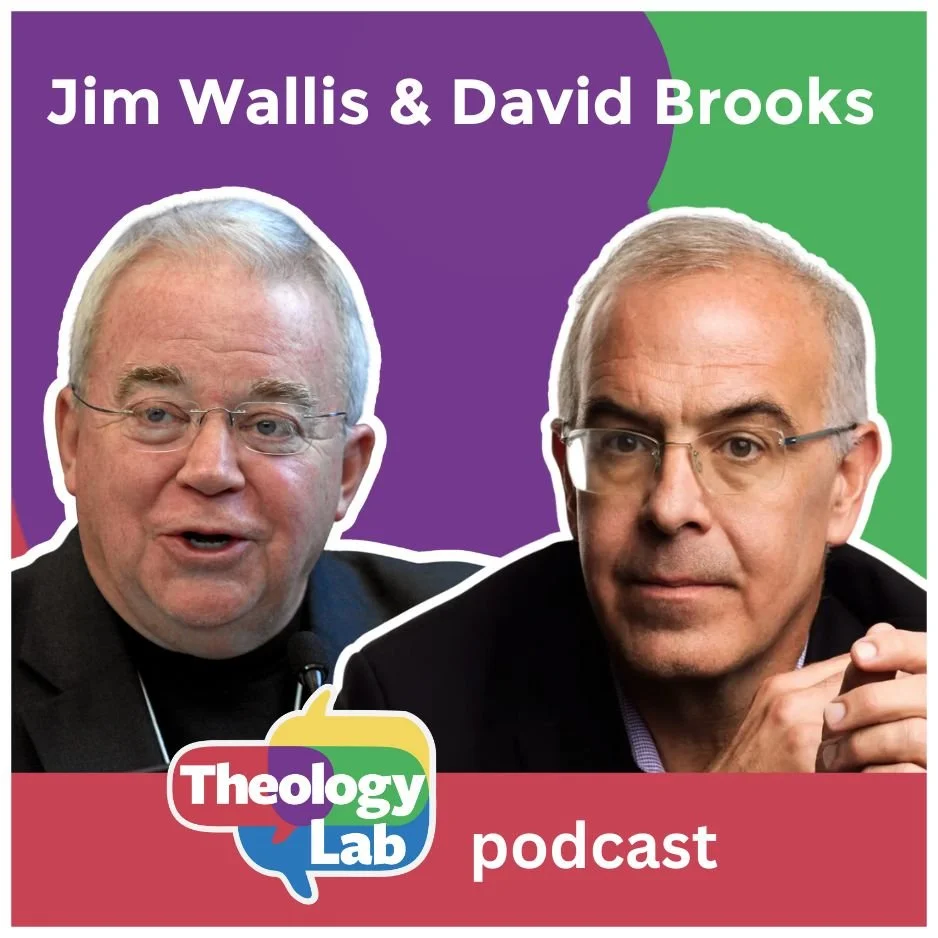
Jim Wallis and David Brooks discuss evangelicaism, politics and faith at Theology Lab. Check out the episode page here.

Beyond Simple Answers: Our series that explores a theological vision when simple answers aren’t enough.
Check out the episode page here.