What is faith deconstruction? Understanding doubt, change, and reconstructed faith

In the faith circles I run in, many people have experienced a tension between some of the things they were taught to believe about things like faith, God, and theology, on one hand, and, on the other, what it means for them to be Christian today.
The result is a kind of disconnect. The disconnect doesn’t always have to be drastic, but it can be. And it’s not just about what we believe on paper. Sometimes it comes from the disconnect that results from knowing that values like love for the stranger and personal integrity lie at the heart of our faith, or ought to, while stories about yet another scandal, cover-up, or political mishap among those who confess to follow Jesus continue to surface. Something feels amiss. For many, this leads to a process called faith deconstruction (and, as we’ll explore in a moment, a subsequent process known as faith reconstruction).
This post explores questions like, What do we mean by faith deconstruction? Why does it happen? What might a reconstructed faith look like? This is one of the key topics we reflect on at Theology Lab’s Beyond Simple Answers series.
I’ll use the words faith deconstruction and faith reconstruction throughout this post. However, I sometimes like to broaden this concept a bit to include those who may not feel comfortable with the word deconstruction, yet, for one reason or another, find themselves wanting a faith more characterized by curiosity and question asking, and resonate with much that follows. I love that!
1. What is faith deconstruction?
While there are different ways to define faith deconstruction, an understanding that I find helpful is to see it as the moment, or maybe, series of moments, when we become aware of the disconnect with our inherited beliefs and the new discoveries and realizations we have about our faith. Faith deconstruction is an experience, the experience of this disconnect.
For example, Pete Enns of The Bible For Normal People podcast is a guest at Theology Lab whom I’ve talked to about how we read the Bible in light of new, and sometimes challenging, insights in biblical scholarship and theology. He writes about how his idea of God has had to adapt to our growing awareness of an ever-expanding universe. I don’t think Pete ever thought that we could simply (physically) find God ‘out there’ if we just looked hard enough. But the common way we talk about God as ‘up there’ in heaven, alongside scientific discoveries like this, compels us to ask again a simple question about faith in a new way: Where is God?
In a moment, I’ll turn to how faith deconstruction can be a springboard to a renewed sense of faith and discovery. But before jumping ahead, it might be helpful to say more about why some folks, including myself, undergo a process of faith deconstruction (and faith reconstruction).
2. Why do people undergo faith deconstruction?
While there are underlying commonalities for why people pursue faith deconstruction, both the meaning of faith deconstruction and reasons for undertaking it often vary for different people.
A co-host at our Theology Lab series, Beyond Simple Answers, Kristin H. Lee, writes, “my process of deconstruction and reconstruction has been inextricably linked with the decolonization of my faith.” In We Mend With Gold, she tells the story of coming to realize how several features of her ethnic heritage were either marginalized or sometimes outright dismissed in the evangelical spaces that shaped her faith and beliefs. Moving forward in a productive, faithful way has meant both a careful assessment of what was amiss (faith deconstruction) for the sake of working towards something better (faith reconstruction).
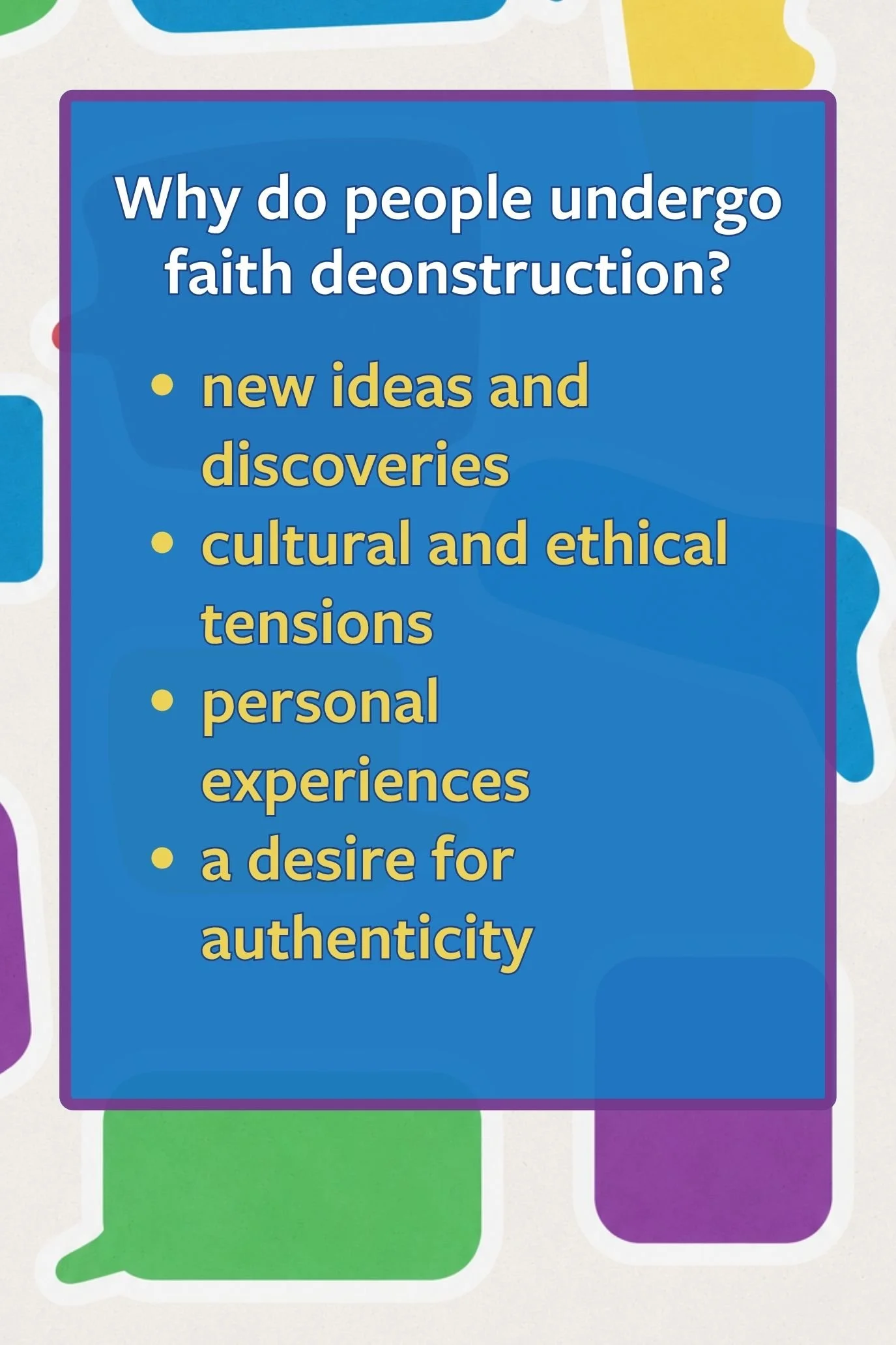
For me, it was my introduction to something called critical biblical scholarship that led me to ask new and personally challenging questions about Scripture. This scholarship, to name one example, sees many of the books of the Bible as originating not from a single author but from multiple sources, often with different and contrasting perspectives among them.
I don’t know if I held to a view of biblical inerrancy at the time (i.e., the idea that the Bible is without errors, fully coherent in at least some stringent way), but I assumed something close enough to it that I was deeply unsettled by critical scholarship’s insights. For the sake of intellectual honesty, I knew that I had questions to ask and real thinking to do about ideas like biblical inspiration. Equally difficult for me, though, was having to figure out whether the college faith and church communities I was part of at the time would be okay with me asking these questions. Would I still have a place to belong here?
My example centers on discovering and having to reckon with a new idea. But a faith/theological crisis can be triggered by experiences, too. It may be an experience of suffering, a topic we recently discussed at Beyond Simple Answers, or something as subtle as seeing an esteemed member from the faith community in which you were raised touting misinformation or thinly veiled xenophobic claims on social media. This can lead us to ask, what did we simply assume, or what never really went challenged, in the faith milieus that shaped us during our early, formative stages? What does that mean for us now?
I hope stories like these show how faith deconstruction is not about flipplantly standing over and above teachings of the church to simply get what ‘I want.’ It’s not that simple. Rather, I think it’s more like feeling a disconnect between two things I never wanted to make a choice between but which now appear incompatible. For many, it’s about a desire for a faith characterized by honesty and high regard for seeking after truth and what it means to love God anew.
3. Is faith deconstruction the same as leaving christianity?
By now, I hope it’s clear that the short answer to this question is no, or at least it doesn’t have to be. That said, the questions that prompt a process like faith deconstruction are often quite heavy, and for some they lead to something like a period of suspending faith or leaving faith altogether. Because reasons for deconstruction, which again vary very much, can involve deeply personal wounds received at the hands of one’s faith community, it’s helpful to respect and show patience with how others (and sometimes we ourselves) navigate this process. It can feel a lot like grief.
Having said that, there’s nothing about faith deconstruction that makes leaving Christianity inevitable. This is partly because the word encapsulates so many experiences, but even more importantly, because, for many, faith deconstruction is about truth seeking. It is about closely examining what hasn’t worked, or what has caused unnecessary pain, suffering, and confusion in our pasts, and asking about what an alternative theological vision may look like going forward.
This might sound like discovering or making new theological ideas out of thin air. As a theologian, I suppose sometimes genuinely new theological ideas happen (it probably depends on what we mean by ‘new’). But more often what I see is the rediscovery or new configurations of resources, ideas, and sometimes neglected voices in our theological traditions and our communities that can help us with the questions we’re asking today.
A few years ago I was part of a team that brought together gifted teachers and leaders to create a course on Black Theology at Highrock church. As just one example, testimonies on the hope and wisdom that comes through song – see Tom Basket’s lesson on the Black Spirituals – have offered me a glimpse into the enduring faithfulness of others in a way that’s breathed life into my relationship with God many times now.
Faith deconstruction hasn’t led me to leaving behind my faith. Humanly speaking (I leave room for the Spirit’s work in all this), it’s helped keep my faith intact, and certainly kept me more honest.
4. What does reconstructed faith look like?
In one way, my reconstructed faith looks the same as it always has. Of course, it depends how we’re looking at all of this, but I do the same things as I did before: I worship, read Scripture, pray and seek to live a life of service to God and others. (In future posts, I’ll say more about how some of my theological thinking has changed over time.)
In other ways, it has changed. Some of the common characteristics I’ve seen in myself and others as a result of faith reconstruction are a growing appreciation of values like curiosity, of nuance and of being part of a faith community that’s held together by not only shared beliefs (these matter) but love and the recognition that I am someone always in need of forgiveness.
Similar to what I said at the end of the previous section, values like these matter because they help us continue in faith. When a once-held answer to an important question about faith is no longer enough, curiosity helps us become more nimble in our thinking and, often enough, discover stories and ideas that energize our faith.
5. Can doubt strengthen faith?
The father of the son in Mark 9, tormented by a spirit that takes over his body, says to Jesus, “I believe, help my unbelief” (9:24). His doubt (unbelief), which sits right there next to his belief, doesn’t stop Jesus from healing his son.
Can doubt strengthen faith? Short answer, yes. Longer answer: yes, but I don’t think it’s that simple. Doubts are something we carry with us. Sometimes they fester, sometimes they go away. What matters more, I believe, is how we handle our doubts.
In the story of the father with the tormented son, I’m struck by the fact that he speaks his doubt before Jesus and in the company of others. Then and there, the father’s doubt is no longer just his own. It’s shared with others, and ultimately directed to Jesus. He has the courage to name it, and to ask Jesus to enter into his unbelief. “Help my unbelief.”
Jesus goes on to heal the child. And maybe that’s the end of the father’s unbelief. Maybe. But I wonder if it’s significant that the story doesn’t return to the father’s doubt, whether it was resolved or not. Rather, after the confession and healing, the story shifts decisively to Jesus’s saying that some healings can happen only through prayer (9:29). And prayer, of course, is the primary way that we as Christians are welcomed to share our lives, including our doubts, with God.
Can doubt strengthen faith? I think it can, especially when we don’t have to carry it by ourselves. (Allow me to insert here the important caveat that it’s not always safe to share doubts with just anyone. That requires discernment. I know at times I haven’t had ears to hear the doubts of others well.) When we’re fortunate enough to be able to share our doubts with others, we’re often reminded that we’re not alone in them. Several times, I’ve found strength in that myself.
And while doubts can lead to many different outcomes, I’ve regularly found that they can be the inspiration that sets me in the direction of grappling with questions that lead to conversations with others, further reflection, new insight, and discoveries; in short, to a lively kind of faith.
6. Faith deconstruction and reconstruction have helped my faith grow
I’ve described faith deconstruction as the experience of a disconnect between our inherited beliefs and some of the challenging discoveries that happen in our faith life. This takes different forms and can lead to different outcomes. For many, including myself, it hasn’t meant the end of belief. Rather, it’s opened up new friendships and ways of thinking, practically and theologically, about God and what it means to love God and our neighbors well.
I’m the main organizer of Theology Lab. And it’s my hope that so much of what I’ve described in this post, like the desire for honesty, the value of curiosity, or taking time for nuanced reflection, comes through in what we get to do at Theology Lab. If you’re interested in digging in a little deeper, we’ve made some of these ideas the focal points of our Beyond Simple Answers series, which got started with a set of short conversations on the problem of evil.
So, if this vision excites and animates your faith as it does mine, please know that I’m grateful to be pursuing it with you and others together. It’s better that way.
FAQ
(Questions connected to the post, along with some more general questions)
What is faith deconstruction? Faith deconstruction has to do with becoming aware of a disconnect with our inherited beliefs and the new discoveries and realizations we have about our faith.
Why do people undergo faith deconstruction? People undergo faith deconstruction for many reasons, including instances of scandals or cover-ups in a faith tradition or out of a desire for greater spiritual and intellectual integrity.
What is faith reconstruction? One way to understand faith reconstruction in Christian faith is as an ongoing process of searching for God and new responses to questions. This often follows moments or experiences of faith deconstruction.
Is faith deconstruction the same as leaving Christianity? No, or least not necessarily. This post shows how a faith deconstruction process can be paired with faith reconstruction, rebuilding our faith. It can help encourage honesty and truth-seeking in faith.
Can faith deconstruction and reconstruction go together with classic Christian beliefs? How one answers this will depend a lot on what one means by deconstruction and classic (or traditional) Christian beliefs. Speaking for myself (Scott) here, I think they often can. At Theology Lab you’ll find a lot of conversations which try to show how question asking, faith deconstruction and faith reconstruction (and the like) can go hand in hand with a strong commitment to what’s expressed in the Apostle’s Creed, for example.
What are some good resources for reflecting further on faith deconstruction and faith reconstruction? There are a lot of resources out there. This article mentions Kristin Lee’s new book, We Mend With Gold. The works of Rachel Held Evans are also often cited as a helpful resource. Here’s a link to her book on the church.
Is faith deconstruction and reconstruction the same as Christian apologetics? Not quite. Apologetics refers more to the defense (or robust explanation) or a belief system. Faith deconstruction and reconstruction typically engage doubt and questions in a more positive light. But both have to do searching for truth and meaningful and intellectual integrity.
Is doubting wrong? No. As shown in the article, the man from Mark 9 brings his doubts into the presence of Jesus. The view of faith deconstruction expressed in this post neither dismisses or praises doubt. It focuses more on how we navigate doubts that inevitably arise.
Can I believe and have doubts? Yes. The man from Mark 9 is a good example of this. “I believe, help my unbelief” (Mark 9:24).
Can doubt strengthen faith? This post claims that it can – though again, it’s not automatic. It’s more about having a safe community to process questions with and learning how to bring our questions into our spiritual lives.
If you enjoyed this post, you might be interested in these Theology Lab episodes…

Pete Enns, from the Bible for Normal People, on how to navigate biblical diversity. Check out the episode page here.

Beyond Simple Answers: Our series that explores a theological vision when simple answers aren’t enough.
Check out the episode page here.