
Deconstruction, reconstruction, and Christianity: Can faith survive difficult questions?

Can faith survive difficult questions? That is a difficult question! And it’s a question many Christians eventually ask.
As I began to write this post, I reflected upon my own journey of faith deconstruction and reconstruction. I will share some of my reflections in this post while exploring faith deconstruction and the difficult questions we ask ourselves in the process.
A simple Google search of the term “faith deconstruction” returns an overwhelming number of results from across the internet and social media. These results range from personal stories to biblical scholars, pastors, and theologians. To name just two, my search brought me to interviews with author and scholar Pete Enns, a former guest at Theology Lab, as well as Preston Sprinkle’s podcast, Theology in the Raw.
Before I get into some of the key parts of my story, I want to note that topics like doubt and faith deconstruction (and faith reconstruction) can be challenging. But I think there’s no shame or guilt in asking difficult questions, in having doubts. Rather, the opposite is the case.
This post is written from a posture of openness and out of a curiosity to explore different perspectives. As you’ll see, I still hold many of my inherited faith’s traditions and beliefs near and dear to my heart. But my journey has also required me to reflect deeper and work through what I believe and better understand why I believe.
So, with that said, let us dive in!
1. Questions that begin faith deconstruction (or, what got me started…)
One way to understand faith deconstruction is as a certain kind of disconnect between one’s inherited faith and beliefs, on one hand, and new realities that we experience in our faith life, on the other (this Theology lab post by Scott Rice goes into more detail on a definition of faith deconstruction). Reflecting as my older self, I realize that the main event that prompted my own faith deconstruction journey, an experience of disconnect, was way back when I was 10 years old.
Much of the current focus on faith deconstruction today is around evangelicalism, but my inherited faith tradition was Roman Catholicism. I loved all that the Catholic church embodied – the traditions, ceremonies, and the way I was taught how much Jesus loved me. He died on the cross for my sins and was resurrected so I could go to heaven someday. I used to dress up in my aunt’s white nightgown and pretend to say Mass for my cousins (they were good sports)!
One day my mom, who usually told me that I can be anything I wanted to be when I grew up, told me I couldn’t be a priest. The Church doesn’t allow women to be priests. Rather, I was told I could become a nun instead, but that wasn't much consolation to my ten-year-old self. My 10-year-old brain was certain that the Jesus I knew in my heart would accept me as a priest.
Eventually, I gave up on the hope of becoming a priest. I figured the church knew what God really wants when it comes to being a priest, so I must accept it.
Except… I didn’t really accept it. The disconnect I felt even as a child didn’t really go away. It remained, continuing to be fed by a lingering uncertainty. As it grew ever so slowly, it became a crack in the foundation of my inherited faith.
2. Can faith deconstruction go together with faith? Pete Enns and Tim Keller
Looking back, this was the first of many “uh oh” moments in my life. Over time, I’d also come to see these moments as actually “God moments” as well.
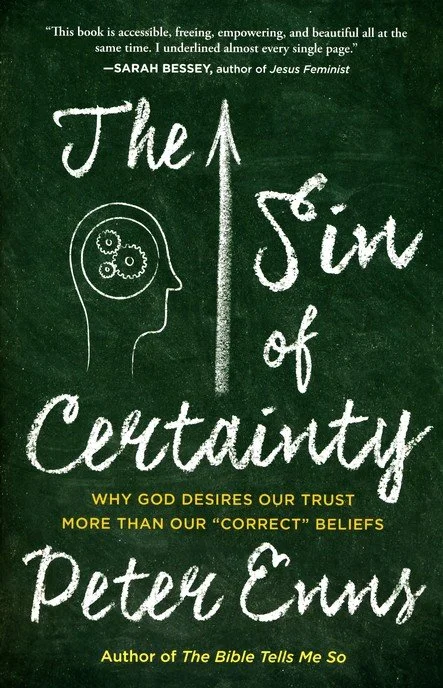
Pete Enns describes ‘uh oh’ moments in his book, The Sin of Certainty. They are often moments that pop up unexpectedly and without warning, during routine daily activities, or when something profound has happened in our lives.
The reason they can become ‘God moments’ is because they can also invite us to ask difficult questions, confront our fears, and ultimately grow in our faith.
Interestingly, coming from a more evangelical perspective, the late pastor Tim Keller says something similar. In his fall 2022 Life in the Gospel article, "Reconstructing Faith: Christianity in a New World,” Keller identifies five primary reasons for faith deconstruction:
Growing up in Christian homes while beliefs naturally develop and change throughout childhood.
Experiences of suffering or injustice.
Disillusionment with leaders or with oneself.
Difficulty distinguishing between primary and secondary Christian beliefs.
Living within cultural or theological "bubbles" that limit exposure to different perspectives and experiences.
Keller goes on to say that Christians:
sometimes go through periods of ‘deconstruction’ and yet emerge stronger. We can go through times in which discarding or altering some of our ideas results in an overall strengthening of our Christian commitment… there are a good number of situations or life transitions in which a rethinking and reconstruction of faith is called for in order for spiritual maturation to take place.
Reading both Pete Enns and Tim Keller helped me realize something important.
Despite some of their theological differences, both acknowledge that difficult questions do not necessarily signal the end of faith. Instead, they can become opportunities for spiritual growth, deeper understanding, and a more mature relationship with God.
3. What does research say about faith deconstruction?
Whatever the process or its length, many have worked (and are working) their way through a process of faith deconstruction and reconstruction. I’ll say more about my journey into faith reconstruction in a moment.
Research shows that faith deconstruction is not uncommon. According to a 2023 study by the Barna Group, “Overall, 42 percent of adults say they have deconstructed the faith of their youth. Of today’s Christians, it’s 37 percent, with little difference whether they’re practicing (36%) or nonpracticing (37%) Christians. That means more than one-third of committed, churchgoing Christians relate to the idea of having deconstructed the faith of their youth.”
In other words, approximately two out of every five American adults — and more than one-third of practicing Christians — identify with some form of faith deconstruction.
4. Can Christianity hold complexity? Can faith become stronger through, and after, deconstruction?
For many years, I just drifted along going to church occasionally, longing for a better way to connect what I was learning theologically with the spiritual growth I was experiencing.
The first difficult question at this stage became: What parts of my inherited faith will I keep?
The core beliefs of my inherited faith were still very strong: for example, my belief in the triune God, that Jesus died on a cross for our sins, and his resurrection from the dead.. If these were my core beliefs, I realized it was many of the secondary beliefs I held that I needed to reconsider.
5. What healthy faith reconstruction may look like
I had so many questions.
How should I think about theology?
What should I think about different church traditions and denominations?
Where do I even begin?
Keep in mind that my early deconstruction journey meant searching for information in a way that looks very different than it does today. This was around the same time the World Wide Web was getting underway. Google was still nearly a decade away! If I had even known enough to identify what I was experiencing as ’faith deconstruction,’ I would have needed a (physical) dictionary or encyclopedia to begin learning about it.
Today, we live in an entirely different world where information is both collected and generated. How we search out and generate information has changed. (A recent Theology Lab episode on AI and Pope Leo’s recent encyclical is a good reminder.).
As this journey continued, I knew it would be important for me to enter into my questions by interacting with thoughtful and informed resources. I had two priorities:
To learn as much as I could about Scripture and different Christian traditions.
To find a church community that aligned with my core beliefs and, hopefully, where I could further explore my secondary beliefs.
Let’s start with the original source, the Bible. Most of what I learned about the Bible came from the Scripture readings I heard during Mass growing up. Over time, I would come to find a handful of podcasts helpful for learning more about the Bible. I found several podcasts particularly helpful:
The Esau McCaulley Podcast, part of the Holy Post media (their flagship show, The Holy Post, is another great resource). I also enjoyed Esau’s book, Reading While Black: African American Biblical Interpretation as an Exercise in Hope.
The Bible for Normal People, with Jared Byas and Pete Enns.
And a personal favorite, Disciple Dojo, founded by a graduate of Gordon-Conwell Theological Seminary.
One of the most important things I discovered through these resources is how much goes into how we read the Bible, or what scholars call hermeneutics. Reading Scripture is never just reading!
6. Looking for a church during faith deconstruction and reconstruction
I was also trying to reconnect with a community of faith.
In Mere Christianity, C.S. Lewis uses a memorable metaphor to describe Christianity. He imagines a hallway that represents Christianity itself, with rooms branching off from it that represent the various Christian traditions and denominations.
I’ve mentioned the tradition I was raised in, and my journey led me to get to know many others, including the Greek Orthodox church, as well as Methodist, Anglican and other churches. Lewis advises readers not to remain standing in the hallway forever. Instead, enter the rooms. Explore them. Learn from them. Eventually, make a home in one.
This became my experience, where I learned so many wonderful things from other traditions about what it means to worship, read Scripture and be in Christian community. But I was also ready to find a home for myself.
Thanks to a very dear friend who helped me as I was journeying through my search for a community of faith, I’ve found a church, a room in the hallway that is rooted in a larger tradition. I’m grateful to feel at home here, and it’s a place where I can worship and learn to love Jesus and serve others. (And yes… women can be pastors there.)
7. Does the Bible speak to faith deconstruction and reconstruction?
There are many biblical narratives that portray people wrestling with faith, suffering, uncertainty, and God. Scott offered a couple examples in his post I mentioned earlier.
Personally, I’m myself struck by the way that Jesus often taught through questions rather than simply giving answers. (According to my Logos Bible software, Jesus is asked 183 questions. He responds to these questions with 307 of his own! Those who ask Jesus questions are often directed, by Jesus, to think through the questions themselves.
I especially think about Jesus’s teaching:
"Ask, and it will be given to you; seek, and you will find; knock, and the door will be opened to you" (Matthew 7:7). Asking sincere questions is part of what it means to follow Christ.The book of Ruth, especially the connection between two of its central characters, Ruth and Naomi, also resonates with me.
Amid their different yet overlapping experiences of loss, grief, and suffering – experiences that can easily lead to the kinds of questions we talk about today in contexts of faith deconstruction and reconstruction – Naomi encourages Ruth to start over again and return to the place from which she came (the kingdom of Moab). Although the story doesn’t tell us exactly why, Ruth decides to stay with Naomi. As it turns out, her declaration of faith (Ruth 1:16–17) eventually becomes the foundation for a story of hope, redemption, and what we might see as God's subtle, faithful presence.
Ruth’s story reminds me that periods of waiting and uncertainty, being in the unknown, are part of the life of faith. Our questions take time. But during this time, I can hope that God is also working.
8. Faith reconstruction is an ongoing journey
Today, I continue in a process of faith reconstruction.
Perhaps C.S. Lewis's hallway metaphor still applies.
Faith deconstruction and reconstruction are a journey for me, one where I am regularly learning from new perspectives and different experiences. On this journey, traveling down this hallway, I have found a room that has become home. But I am also reminded of spaces I’ve inhabited before and that I can return to from time to time. Pope Leo’s recent encyclical, Magnifica Humanitus, has me doing this with the Catholic tradition (room) in which I was raised.
I’m enjoying this journey. And there’s still so much to explore and learn in this house, new designs and projects that are underway.
I can’t wait to see what I might discover and add to this home.
FAQ Section
Can faith survive difficult questions? This post says that it can. But a lot hinges on how we respond to difficult questions. This post discusses how humility, curiosity, community and honesty factor into how we respond to difficult questions.
What is faith deconstruction? Drawing on a previous Theology Lab blog post, this article describes faith deconstruction as experiencing a disconnect between our inherited faith and new experiences we have.
How does faith deconstruction begin? In many ways! This article looks at the author’s experiences around the opportunities women are (or aren’t) afforded in ministry as one factor that led to a faith deconstruction journey.
What are some good resources for understanding faith deconstruction? This post offers resources from different tradition, perspectives, and figures, including the work of Pete Enns, Tim Keller, and Holy Post media.Is there any research available on faith deconstruction, Christians, and the church today? Yes, as one example, this post offers findings from the Barna Group.
Is faith deconstruction something that is just happening among people who were involved in the evangelical tradition? No, this post shows how someone coming from a different tradition, in this case, Roman Catholicism, has had a faith journey and identifies with this concept in her own way.
What should I do if I have doubts about Christianity? This is a big question, but a good place to start is discussing your questions with a trusted friend who can understand where you’re coming from.
Are there stories in the Bible about doubt, asking questions, or even what we describe as faith deconstruction and reconstruction today? Yes (keeping in mind that these last terms are from our context). This article connects the story of Ruth and Naomi from the book of Ruth, to these themes, especially waiting, doubt, and God’s faithfulness.
What is faith reconstruction? This is the work we do after (and during) faith deconstruction in making sense of our faith anew.
Related resources from Theology Lab….
Beth Allison Barr joins Theology Lab for a conversation on women in church leadership, then and now. Check out the episode page here.
Tim Mackie from the Bible Project gives his take on how the Bible is simultaneously God’s word and human words. Check out the episode page here.