What do you do with differences (contradictions?) in the Bible? 2 Views, Scott Rice & Paul Domigan
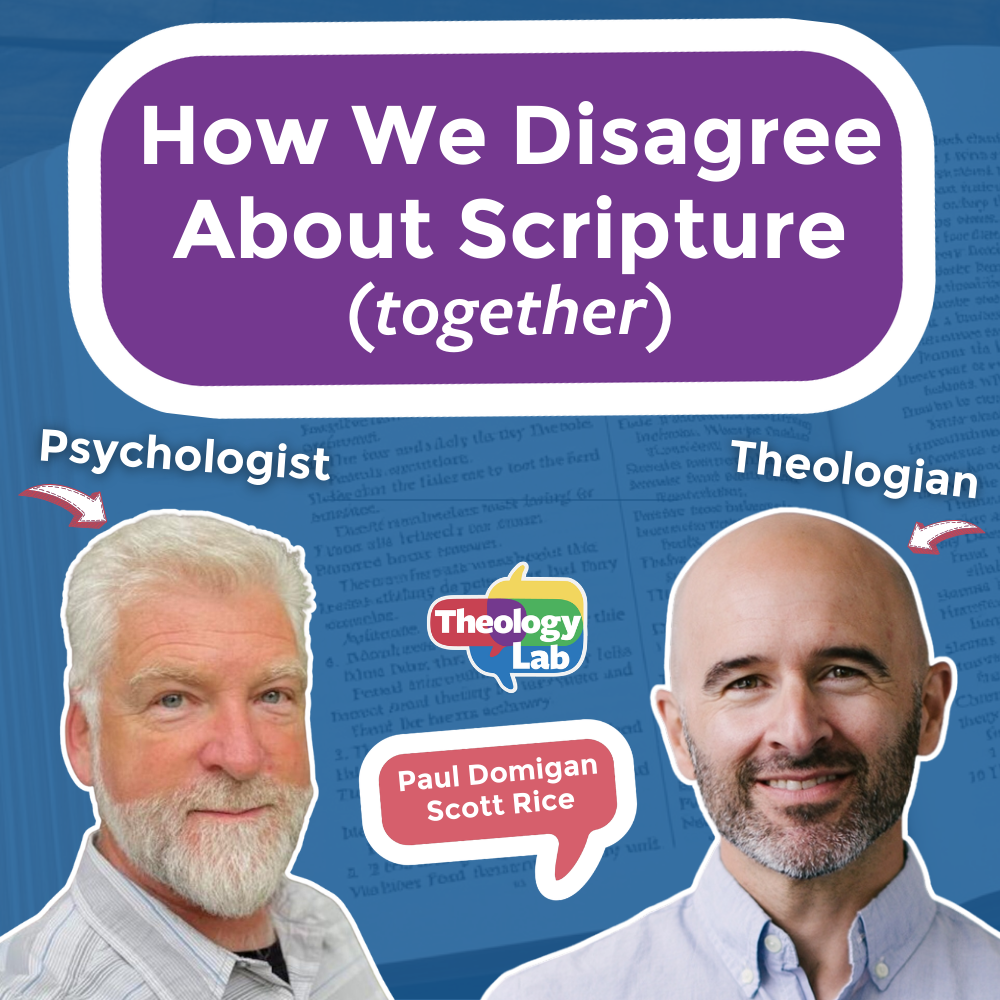
⭐ In this Theology Lab episode Scott is joined by clinical psychologist and a teacher at Gordon Conwell Theological Seminary, Dr. Paul Domigan. They talk about how they read the Bible or interpret Scripture differently, in a live, spontaneous format! This conversation focuses on tensions or contradictions within the Bible, and how two Christians engage these issues of biblical reading / interpretation. Scott and Paul bring out how they find engaging these differences not to be threats but opportunities for growth in their friendship and understanding how to read the Bible. Conversations like these try to capture what Theology Lab is about in pursuit of a faith characterized by curiosity, courage and compassion.
Description
In this Theology Lab episode Scott is joined by clinical psychologist and a teacher at Gordon Conwell Theological Seminary, Dr. Paul Domigan. They talk about how they read the Bible or interpret Scripture differently, in a live, spontaneous format! This conversation focuses on tensions or contradictions within the Bible, and how two Christians engage these issues of biblical reading / interpretation. Scott and Paul bring out how they find engaging these differences not to be threats but opportunities for growth in their friendship and understanding how to read the Bible. Conversations like these try to capture what Theology Lab is about in pursuit of a faith characterized by curiosity, courage and compassion.
Resources
www.theologylab.org
Generated Transcript
Scott Rice (00:00)
This kind of excites me talking about this. Did you hear that? You heard that? That was on camera. I'm here with Paul Domigin. ⁓ Paul, thanks for being part of this kind spontaneous experimental conversation we're going to have.
⁓ Can I give a little overview of what our goals are
have you introduce yourself? Sure. ⁓ We had a conversation a few weeks ago
We got into what it means to have a healthy relationship to the Bible and it focused a lot on areas where we see conflict or tension within the Bible itself and what we do with those differences.
And I think we notice we go in some different directions. You could say we disagree about a key point in Scripture. And we just want to kind of unpack that here in a setting like this where it's recorded and see what happens. ⁓ Okay, if you're okay with that, can you introduce yourself? Sure. ⁓ So I'm a licensed clinical psychologist. I'm also an adjunct professor at Gordon-Conwell Theological Seminary.
and I am a part-time preacher for an African congregation in Lowell.
Yeah, and this is a second career for me. So my first career was as an engineer and I worked on MRI and PET-CT development. So some pretty hardcore technical things, but it always was working with brains. So I'm still in the brain business. ⁓
fascinating background and it obviously is very different than my own background and as I serve here as a resident theologian we have some I guess overlap with service and work within the church and in the academy as well but we'll kind of try to pick it pick it how some of maybe our different backgrounds impact how we approach scripture. All right so I'm gonna I'm gonna look at three passages of scripture and there's sets of passages where we see some tensions or maybe contradictions within the text
And these can form some sort of a basis for our conversation, but these are areas where you and I would at least agree there is tension or conflict. Okay. Okay. So the first one is here is in Exodus chapter 20. This is within the 10 commandments. And the wording here is that I, the Lord your God, am a jealous God and I punish the children for the sin of the parents to the third and fourth generation of those who hate me. Here's the idea that punishment extends down to...
multiple generations of people. But then if you look at Ezekiel chapter 18 verses 19 to 20, I'll just read a selection of this. It says, the one who sins is the one who will die. The child will not share the guilt of the parent. The child will not share the guilt of the parent. That's kind of the person who does the act is responsible and carries the burden of the act itself.
Okay, another interesting, this one's even shorter, but another interesting passage here ⁓ is in Exodus chapter 33 verse 11 says that the Lord would speak to Moses face to face as one speaks to a friend, right? So Moses talks to God face to face and then verse 20, ⁓ but he said, cannot see my face. This is God speaking. You cannot see my face for no one may see me and live. Moses talks to God face to face and yet we, and then we read nine verses later, you cannot see God's face.
And if you see God's face, you will not live. And then there's the bigger comparison between the book of Job and the book of Proverbs. So Proverbs, in Proverbs 13, we read, pursues the sinner, but the righteous are rewarded with good things. That if you do well, if you do what is right, you'll be rewarded. If you do not, you will be punished. And then the book of Job just kind of subverts a lot of that. Job is righteous in God's eyes, but he goes through this extensive period of suffering. Now you can look at the last few chapters.
And there's a little bit of a turn in the story, right, where Job is finally rewarded. But those, I think it's safe to say the Book of Job and Proverbs have some tension or conflict between them. All right, let's talk about what do we do. So we agree that there's some tension or some contradiction here. ⁓ we, from our conversation, I remember we take that in some different directions. Would you be willing to get us started to say,
When you read passages like that and you see some differences, what does that mean for you, for your spirituality, for how you look at Scripture and think about relating to God? So we've talked a little bit about this. And when I think about God's purpose with Scripture, do believe, you've mentioned things, well, it's the way God has shared the good news of the gospel.
He's revealed himself over time through Scripture and that kind of thing. And I strongly agree with that. ⁓ I'd summarize it as Scripture gives us access to God's mind. So I think when you think of any kind of prayer or spiritual exercises, you really do need to be very familiar and kind of steeped in Scripture because it does reflect God's mind. So it's what he's telling us.
The other thing that ⁓ we started to touch on in our conversation is I believe that scripture strongly reflects reality. some of these contradictions I think are inherent in reality. So we talked about the effect of the fall. So we don't really want to maybe go too much down there. But when I look at ⁓ Job, for example, we have all experienced
where righteous people or seemingly good people have experienced like this inexplicable suffering, like why them? You know, that's something we've all experienced in life and it's one of the big questions. I know that's one of the big questions we have for God, why suffering? When we look at ⁓ contradictions like the one you brought up here with Moses in Exodus,
He, on one hand, he talks face to face with God, and on the other hand, if he sees God's face, he'll surely die. So that's an example of, think, that we're meant to wrestle with these things. And we have to recognize that we are still modern people. We're also postmodern, but modern in the sense of we have this Enlightenment era necessity that it's either this or that.
and I think that that is not the way that scripture is to be understood. want, okay, so I hear that as we want a certain clarity of what the text means. Sometimes scripture just does not follow those rules. right, the idea of mutually, these are mutually exclusive passages. Okay, so here's a question that I have for you. I like what you said that there are, that these
differences within scripture itself. They actually help us to see that how scripture speaks to the reality that we experience. is an interest, Job just in and of itself, not even comparison, even comparing it with with the book of Proverbs. Job is senseless, meaningless suffering and it is at least helpful to an extent that we see that in the world, that our holy scriptures don't avoid that. But here's I think the challenging part. You've also said
scripture reflects the mind of God, but it also reflects our world in the way that it is. So,
if we want to stay with Job, or maybe go to a different example, I'm wondering how do you still read a book like Job, which reflects, you know, the shadow side, the dark side of our world around us. And yet somehow the mind of God is still disclosed in that. So tell me, what do do with that?
Basically God summarizes this I think it is chapter 38 where he says something like where were you when I set the foundations of the earth You know tell me if you know so God is basically saying you're just not going to know everything God is ineffable.
Let me let me speak to how I would Have a different view than that and I want you to I don't want to you to respond to that
I'm to try to bring in some of the Exodus passage here that we talked about, the one with Moses seeing God's face. I read the Moses passage where, you know, no one can see God's face and live, but somehow Moses
to God like someone who sees God face to face. So you have this conflict within scripture itself.
there's some of the background there is that
It's possible that those are different sources brought together within a single story. I'm not going to get into that too much. it could be. But on the other hand, whoever edited that could see the contradiction. Absolutely. Absolutely. And I like to think that. is a purpose. Yes. And so the purpose that I see in that is, well, if I have these two different views, these two different traditions brought together, I think I'm invited into a conversation, to put it lightly, but in the best sense of the word.
maybe even an argument. Can I see God and all the goodness that that will entail or is God so mysterious and beyond? And there's, think, good ways to spend both of those, right? But
that difference invites me to read scripture and to think I'm not just reading this to receive, I'm also reading this to be drawn in and part of a story in hopes that God speaks to it. So let me make this a little bit more
Let me add a little more spice to this. In a book like Job, I still get to the end of the book of Job and think this book, one, is very difficult to read and understand all that's going on. I can't help but think Job still has a word to contest at the end. So God comes out and speaks, can you know my ways? Yes, God is incomprehensible. But I also think Job has something to stand on there.
And at the end, is also the second speech in Job where God says, you know, kind of affirms Job. He's the one who's spoken rightly. So it's almost like you have conflict within Job itself, right? Job has done the right thing, even though he cannot know the mind of God. And it's just not totally clear to me what the kind of takeaway is from Job in the sense of how do you live in suffering, maybe suffering, maybe faithful living in suffering, even though Job
receives these difficult, challenging words of God at the end is still to say, like,
I am being faithful. Show yourself, God. Show yourself now. Well, I think when you boil Job down, that's the lesson. But the interesting thing about Job is we're still talking about it thousands of years later. OK. Right. So the idea is we are wrestling with this. We're trying to wrestle with the question of suffering.
we're trying to, we're wrestling with the idea of God's ⁓ really sovereignty.
And you brought up before the idea of ⁓ generational transmission of sin being a human thing, as opposed to God causing that suffering. So in Exodus 20, it says the punishment is extended to the third or fourth generation in Ezekiel.
It says it's just the person who commits, who does the thing that bears the of the guilt for it.
Well one slight nuance I believe the Exodus 20 passage is talking about the consequences of the sin the punishment Yeah continues for many generations. Yeah, right. We're in Ezekiel. They're talking about the guilt remains with the guilty party Yes, yes, right. So that is a distinction. Yeah. So again reflecting reality ⁓ in ⁓ you know, psychological terms we certainly recognize that there are ⁓ There's intergenerational transmission of family dysfunction
And if you bring our tradition into this Christian tradition, the idea could be
sin, the original sin, the consequences of the original sin are certainly transmitted intergenerationally. So that is a sense in which I mean the scripture reflects reality.
Can I pause you? I think that's very helpful.
The scripture reflects this reality of family dysfunction Here's the edge for me here is in Exodus 20, God is said to be doing the punishing of it. It seems to almost be like God is molding that as it goes along. That makes me very uncomfortable. I hear you. What does it mean to you?
when we've talked about this before, we talked about, well, I brought up, here's my biblical anthropology in a nutshell. After the fall, the human created in God's image was broken and distorted.
Did God cause that, apparently? I mean, that's what Genesis teaches. It's a consequence of original sin was the fall and the curse. So, the fall, the brokenness of the human condition and the kind of distortion of reality is, you could say, caused by God. And the consequence of that is something like the intergenerational transmission of family dysfunction.
So are you saying that's caused by God? It's a consequence of something God did to punish humankind, but I don't think God is actively punishing these successive generations. Okay, and sometimes the distinction between God permitting something to happen and God causing something to happen is just put Right, but
Let's just say the consequences of the fall are consistent with intergenerational transmission of family dysfunction. And when we go to the Ezekiel passage, likewise, there are ⁓ family dysfunctions which are not transmitted. So there's some kind of
the conversion of someone, and then it is not passed down.
my point is that scripture reflects reality and those are two examples of where seemingly contradictory things exist in reality. We can observe them. Okay, okay. Can we look at this question of mystery? I feel like there is a way that you and I both believe in the mystery of God and the mysterious ways of
not throwing out that idea. But I think you and I
deal with mystery differently. ⁓ And I think when you have two passages that say conflicting things, we both point to it and say, yes, mystery, but then differently. We go in a different direction. Tell me, give me your best spin on how mystery plays a role in your spiritual life and reading the Bible.
So again, if I come back to how I see scripture reflecting reality, there are a lot of mysteries in reality.
So you could point that in physics, the particle versus wave nature of light, how do you explain that? How do you explain quantum entanglement, where the state of one particle separated from another particle seemed to be intertwined?
How do you explain that? This is interesting. I hope this resonates with some listeners. ⁓ I'm totally gone, but I'm trusting you on this. So keep going, Paul. OK. ⁓ So I guess part of my theme here is that my belief is that scripture is the way that we start to, is what God wants us to know about his mind. And it's inherently. ⁓
ineffable in a sense. I don't want to go too far in that because clearly God teaches things. know, Jesus says love God, love your neighbor. They're very clear things in Scripture. I'm not saying that Scripture is not clear, but there is mystery in both Scripture and reality. So
I see them as part and parcel. What is the link for you between seeing that mystery within Scripture as it reflects life and then movement closer to God?
⁓ Okay, yeah, that's a great question. ⁓
Do trust God.
And if you can get to the point where you can trust God, you can live with contradictions. Does God love us? Even that's a hard question.
So you would look at it, you could read a book like Job and say what that does is speaks to the moments where God's love feels distant to us in the midst of that senselessness, that experience of meaningless suffering. It still raises this question of will I still trust that God is good and that God loves me? That there's mystery to that and here's a book that reflects that, that shows that someone else has been through this journey.
and the end is still a hope that God is good and you took that that out. You brought that out as kind of the takeaway. No, but that's something you brought out from the takeaway from Joel. Ah, okay, I...
I don't disagree with anything that you've said, but I find that mystery to me, like what two passages, right, like this, that say different things, right? I mentioned before, I read those and I, what they do for me is they help me see that scripture is a conversation or even to make a stronger point in the best sense, an argument. And it's in that argument that I will experience God. And argument, I like, here's two different views.
and I'm not sure which one to land on. You know, if it's between not seeing God and seeing God and talking to God like a friend, I'll just say, I'm drawn to be like, I want to believe that it's Moses as the one who gets so close to God that can essentially see God's face.
But I mean, the main point is that I want it to be a kind of wrestling...
a deep conversation, a dialogue when I read the Bible and I find these points of conflict that I'm drawn into. And that's why I love the Bible. That's why I find it to be a tool that helps draw me closer to God, not because it has great immediate clarity about what the mind of God is. And I don't hear you saying that, by the way, but
but in that it draws me into a process that is very similar to the world around me, which is not, it's not always clear. How do I discern God's will?
But there is a path. So tell me. ⁓
Who's the conversation between? ⁓ This is great. The conversation is between me and the Bible. It's me and the people around me who read it. And it's a conversation between me and God. Almost all these things have to be happening at the same time.
is the beauty of it though. It's like, am I just making this up? I know, I think it's happening within the pages.
of the Bible itself, right? The passage on Moses seeing God's face. It's almost like the- in conversation with itself. itself. Absolutely. I don't want to be afraid to say it's actually having a debate. ⁓ Not a bad debate, right? I we tend to think of that in terms of like it distances us as people. I think it can actually draw us closer. It can make room for different views. Now, one of the huge reasons I'm saying this, because I want us to get a little bit into our backgrounds and like why-
might we approach scripture differently? I mean, a huge reason for me is being taught implicitly or explicitly that scripture was very clear that if there were differences, they were just apparent. And I just came to a point through an upset of experiences where it seemed like that just isn't honest. And it really undermined things for me. And it has been a journey over 20 years, especially the first few years after that.
of trying to get my bearings again to say, can I still believe God speaks to me through the Bible, that the Bible's still inspired? ⁓ That experience definitely shapes how I read the Bible and see two passages that conflict with one another as a possibility, as an opportunity to grow closer to God.
That's my experience that definitely bears on this.
I wonder what that's like for you. So in my studies, I have come across the notion that I know you're also familiar with, that the way that we understand Scripture is highly influenced by the framework that we're bringing into Scripture. And we are, in our age, we are modern in the sense of post-enlightenment.
reductionist thinking, which is incredibly powerful. So the reason we have an automobile that works is because we know what these pieces do. We put them together and we can predict what the whole system is going to do. We're going to have control over something, knowing how the pieces work. Knowing how the pieces work, exactly. Right, right. And the way that the scientific method works is it looks for, well, if this is true, this can't be true.
And that's
the strength of reductionism. And that's how science and technology works. So this thing either works this way or this way. But the scripture was written in a very pre-modern way. In fact, it was compiled or however you want to characterize that over.
millennia at a very different time where thinking was different. And it's interesting in the Catholic tradition, this is less, I was raised Catholic, so I have kind of both worlds here. ⁓ So it was the idea of ⁓ going to scripture kind of devotionally or, ⁓ you know, using it in different ways is comfortable. The other thing is,
being older, we're in different life stages, I've come to terms with not understanding things. So that's not much of an academic argument, but I think that there is some psychology in here because we are at different life stages and simply accepting things without fully understanding is something I've become more comfortable with.
And I want to be able to acknowledge that in a way that says, I have to just leave that as your additional life experience and what you go through makes me want to make sure I'm listening extra closely to what you're saying
if there are points where we would disagree.
right. I want to go to one final thing, which is.
in some of the differences that we have named, right? Why do we still want to be in conversation with one another? And this is something I'll go back to our conversation a few weeks ago, right? We got into this just kind of organically, the differences and how we read the Bible. And at the end of that conversation, I thought, I want to spend more time with Paul. And with our differences out there instated,
what is the good of that? What do you think is the good of being able to engage
scripture this way in our differences? And then we're going to try to name if we can some of the limits to this too. Yeah, I think we both love scripture. And I think we both ⁓ we're both of us are a little bit ⁓ nervous about it being like misapplied or weaponized or ⁓ confusing people or pushing people away because they've been taught something that they can see clearly is not so. I think I think we both share that. Yeah.
I think we both ⁓ in our own way are seeking wisdom, seeking understanding. We love scripture. We love each other.
I will say, my response to this is that, you I am, for reasons I've shared, constantly reading scripture to figure out where is there a good argument to be had. ⁓ And when I hear you talk about engaging the differences that you see in the Bible in a way that draws you close to God, and you'll explain that in terms that I don't use as much around contemplation and mystery, it's still, it's a beautiful thing.
And I acknowledge it's a beautiful thing. I don't go there very much. I'm just not, at this moment in my
a mystical reader of the Bible.
use contemplative, and I do like that idea. I'm trying to just be a little more provocative. ⁓ But when you describe that and what that means for your spirituality, I look at that and think that is
more Christian.
when I'm reading the Bible and thinking about the arguments that can shape me in a good way alongside you who come in and say, and here's another way that I'm reading this that draws me closer to God. Yeah, you know what I just heard recently from ⁓ practicing the way that we did here in the church is ⁓ John Mark Comer said something about, I didn't catch the citation, but he said ⁓ one of the... ⁓
maybe desert fathers or early church fathers said something like, look at God and he looks at me and I am happy. That's where I want to be. That's what I'm seeking.
Are there any limits? Like where do you think that come to mind before we close this up?
maybe limits or pressure points. And I'll if it's okay I'll get us going on this.
we're trying to bring out where you where you can productively disagree about the point a point of scripture. But I do think about when this involves when the issues here involve people. You know I'm just thinking about like a question or like
like women in ministry. And I just don't even know if you and I are on the same page or that. We didn't have to go there. But like, I can see how this is an increasingly harder thing to do well when the topic has to do with the lives of real people and their involvement within the church. So that's just something I want to name here, you know, and if nothing else, maybe a name to say, all right, that's also something else that would have to be looked at carefully. ⁓
with wisdom and prudence, not just that topic, but just the broader topic of when we're talking about how people's lives are involved in these questions.
Anything come to mind for you?
Yeah, so ⁓ I think there's an important distinction between scripture and theology. And I respect different Christian traditions. I think there's something to be gleaned from each of them.
And the difficulty with these issues reflects our, again, our brokenness because we hold to a position sometimes for reasons that are, you know, as a psychologist, I'd say are more defensive than open to discussion. So I think that, ⁓ again, in our humanness, we protect ourselves.
They're called defenses for a reason because changing hurts or having a different opinion. Maybe you feel like you're being somehow attacked or it's like that. So I think that these conversations are inherently fraught because of, again, our humanness. And it's really like the Holy Spirit.
really understanding what does it mean to be loved and to love that then can open up these discussions. Maybe considering different ways of looking at it before you react, like let me understand fully. know, Paul says, I love this, I think it's 1 Corinthians, it's the chapter 13, the love chapter, he says, now it's like we look in a mirror darkly, but then we will know fully even as we're fully known.
How do we do that? So it seems like if anyone can do it, the Christian community can do it, but it's still hard. With the help of God's Spirit, and then I hear you saying this, hey, don't go try this at home. This involves a certain amount of trust and relational connection, taking steps maybe towards conversations like this. with there being enough trust between people in a community to be
get into points of contention. Does that sound right? Yeah, yeah. I want to bring it back a little bit to psychology. So there's a way of characterizing ⁓ personality traits called the Big Five. And one of them is openness. And we all have kind of a different degree of that. And I think that's something that the Holy Spirit can actually influence.
Paul, I have really enjoyed having this conversation with you. should do it again. Thank you. Thanks for joining me. I think everyone who listens will kind of see that, you the way to read scripture is not to kind of delve into the mysteries of God, but to look at it as an ongoing argument and that they'll see that I was right in that, which I think is probably pretty clear. But maybe next time, you know, the folks will come out on your side. Thanks, Paul. Great, Scott.