Nicholas Kristof and Russell Moore on the Problem of Suffering: What Can We Do?
Nicholas Kristof (New York Times) and Russell Moore (Christianity Today) join Theology Lab to discuss the challenge that evil and human suffering poses, and what effective responses look like. Their conversation also explores how we go about changing our minds. Episode published October 19, 2026.
Listen on Apple Podcasts / Spotify / Watch on YouTube
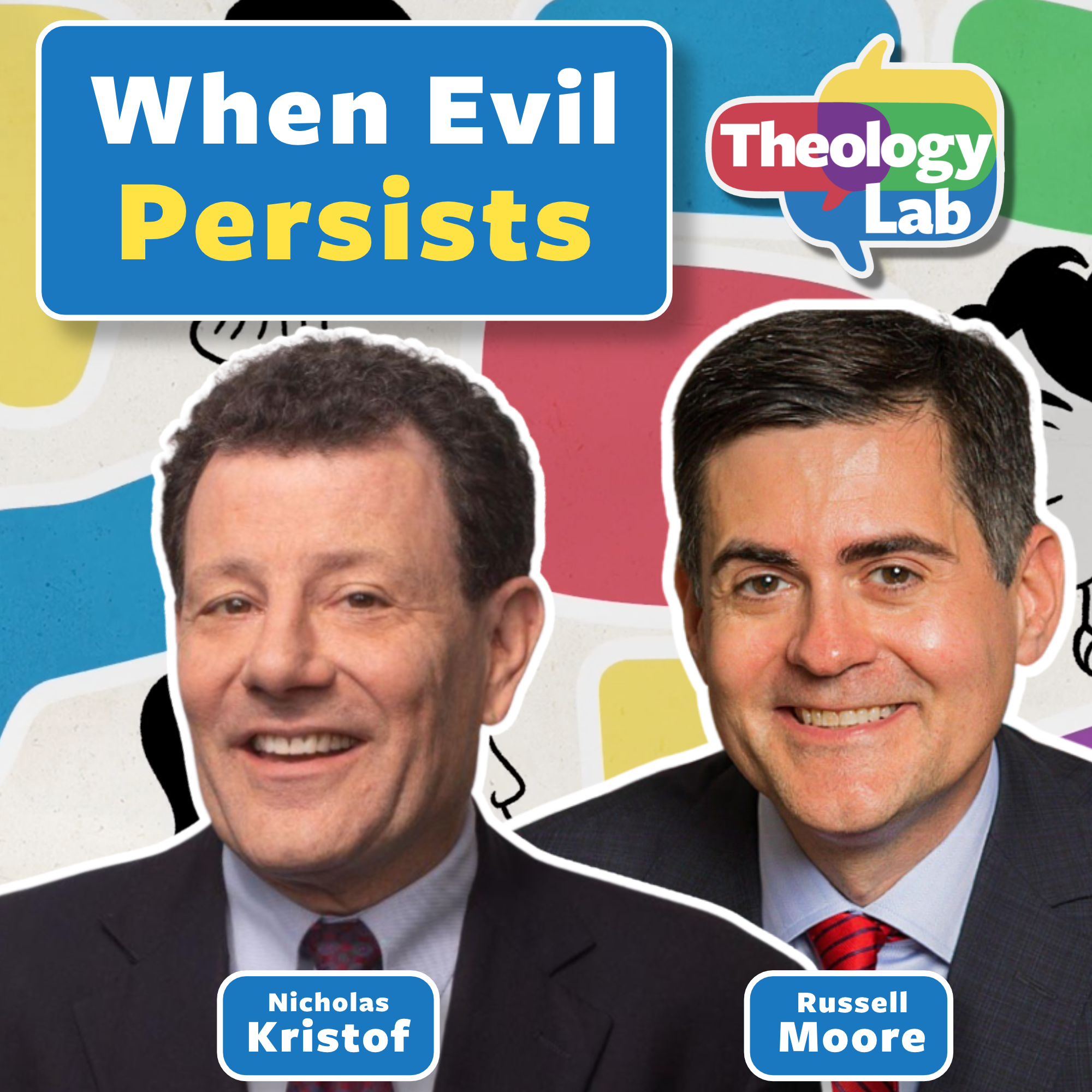
What can we do about suffering?According to Nicholas Kristof and Russell Moore, start small and specific. Kristof says individual stories move people far more than statistics, and that the Lord's Prayer should be a spur to action rather than a substitute for it. Moore adds that people act when they are shown a concrete need within reach, and that the solution does not have to be as big as the problem.
Description
Theology Lab hosts a conversation with two guests who have shown moral courage in very different arenas. Nicholas Kristof is a two-time Pulitzer Prize-winning journalist at the New York Times and the author of Chasing Hope. He has reported on Tiananmen Square, Darfur, and human trafficking. Russell Moore, editor at large at Christianity Today and author of Losing Our Religion, has been one of the most prominent evangelical voices warning about Christian nationalism.
This episode is not a philosophical treatment of why suffering and evil exist. It asks what we can do in the face of them. We planned a conversation about moral courage. About halfway through, it turned to something more personal: how people change their minds, what that process feels like from the inside, and how to hold deep convictions with humility. Along the way, both guests share stories of courage they have witnessed, what makes people care about suffering instead of looking away, and what it might mean to reflect on (and for Christians, to pray) "deliver us from evil" and then act on it.
The conversation also explores:
- How the 1989 Tiananmen Square massacre changed Nicholas Kristof's career, including the bus driver who threw his keys into the grass and the rickshaw drivers who rescued wounded students
- Why Kristof looks back on his own 1989 reporting introspectively, and what the rickshaw drivers taught him about democracy
- How Russell Moore decides when to speak out publicly, using Christian nationalism as an example
- Why Moore says changing your mind is slow and mostly invisible, not a dramatic win at the end of an argument
- What Prohibition, the civil rights movement, and Chuck Colson's prison ministry suggest about Christian influence without political power
- Why Kristof writes charitably about evangelicals around the world, including an evangelical doctor in rural Angola
- What Moore means by calling evangelicalism a "crisis" (a turning point), and why personal transformation still matters in the age of AI
- Why people look away from suffering, from the Pale Male hawks in New York to Darfur, and why one individual story moves people more than a million victims (and what we can learn from this)
- Why Jesus's storytelling is a model for helping people care
- How each guest hopes Christians will reflect on Jesus’s prayer, "deliver us from evil," as a spur to action and as a way to recognize their own vulnerabilities
- Audience questions on resisting Christian nationalism and finding hope, including Kristof's story of Mukhtar Mai, who used her compensation to start a school and enrolled her attackers' children
Resources
📚 Nicholas Kristof: Chasing Hope: https://www.penguinrandomhouse.com/books/720814/chasing-hope-by-nicholas-d-kristof/
📚 Russell Moore, Losing Our Religion: https://www.goodreads.com/en/book/show/71872910-losing-our-religion
Frequently Asked Questions:
Please note these are generated (and human reviewed) questions:
What can we do about suffering, according to Nicholas Kristof and Russell Moore?
Kristof says to focus on specific actions within reach, such as getting one more girl into school, since fixing a pair of clubfeet costs about $350 and 50 cents of azithromycin can help prevent a case of blinding trachoma. Moore agrees that the answer is not a solution as big as the problem. He says people respond when shown a particular situation they can actually do something about.
Does this episode explain why suffering and evil exist?
No. It does not take up the philosophical question of why evil exists. Instead, Kristof and Moore discuss how people face it with moral courage, humility about their own blind spots, and hope, and why people who go through or confront tragedy often have the most powerful things to say about hope.
Why do people look away from suffering, and what makes them care?
Kristof says empathy is emotional rather than rational and responds to individual stories. It falls off as victims become statistics, and people also need to believe their caring can lead to a better outcome. Moore adds that Jesus taught through stories, and that people act when shown a specific need within their reach.
How do people actually change their minds?
Russell Moore says change rarely happens at the end of an argument. It usually unfolds over a long period of private noticing and inner wrestling that others never see. He encourages listening for the experience behind someone's objections, since a person who attacks religion, for example, is often really talking about a parent or a church.
How can you hold strong convictions and still admit you might be wrong?
Nicholas Kristof says unflinching conviction and humility can coexist. Reporters learn how often they are wrong, and remembering that makes it easier to stand firm without being preachy or sanctimonious, which he says have never persuaded anyone of anything.
How does Russell Moore decide when to speak out publicly?
He generally does not respond to ideas circulating at the extremes. He speaks when something looks likely to harm real people and congregations in ways it has harmed them before. His example is Christian nationalism, which he says uses Christianity as a means to an end.
Can Christians influence culture without political power?
Moore contrasts Prohibition, pursued from a position of power and ultimately a failure, with the civil rights movement, which worked through congregations and communities and appealed to conscience. He also points to Chuck Colson, whose influence grew later from a position outside of the power he was near in the West Wing.
How should Christians reflect on the words, "deliver us from evil"?
Kristof, who describes himself as something of a skeptic of prayer, hopes the Lord's Prayer becomes a spur to action rather than a substitute for it. Moore encourages people to recognize their own vulnerabilities, since evil can show up as cowardice in one person and as quarrelsomeness in another.
-
Nicholas Kristof (00:01)
The officer pointed his sidearm at him and said, Move the bus, and the bus driver just hurled the keys in his hand as far as he could into the high grass on the side of the road. When you see people like that willing to sacrifice their lives for others, it leaves a real mark on you.
Russell Moore (00:20)
Also,
we think that when somebody does change their mind, it's immediately at the end of an argument. That is almost never how it happens.
Scott Rice (00:30)
Hey Greg. Hey Scott. Greg, we have a theology lab episode here with two pretty high-profile guests. We've got Russell Moore, he's the editor at large at Christianity Today, and then Nicholas Kristof from the New York Times two-time Pulitzer Prize-winning author. And we brought him on for a conversation in our Theology of Evil series. We talk about moral courage, but I was a little bit surprised. The conversation ended up becoming something a little bit different, about halfway through. Had a lot to do with instances.
Where we change our mind. How do you change your mind? They went in different directions around how you change your mind. R Russell Moore really got into how that internal process feels to change your mind, what that looks like. And it's different than how it's pictured in the media. And I think he's right. And that shifting of expectations, I think, is helpful for me internally to think about like how how should I pace that sort of change and also what should I expect from from other people?
So I I appreciated that. But then on the flip side, you have Nicholas Kristof who kind of takes a very different tack. How can one become much more open to changing your mind? What sort of setup do you need? And he kinda sort of briefly talks about that. Yeah, and theologically, this isn't an episode that grapples with the rationality of the problem of evil, but it does say something about why or how people who experience or even choose to face tragedies sometimes have the most powerful stories to say about hope in the face of evil.
Well, thanks for listening to Theology Lab. You can learn more about Theology Lab at theologylab.org and take a moment, if you would, to subscribe or follow the podcast from wherever you listen to it. Here is our conversation with Nicholas Kristof and Russell Moore.
Thank you for being with us at Theology Lab.
Nicholas Kristof (02:17)
Delighted to be with you.
Scott Rice (02:18)
We'll be getting into some heavier topics tonight. So let me just kind of get us started with a more kind of general question. just looking back in your lives, is there kind of something or maybe a specific person who inspired you to go into work that would require a a certain level of moral courage? And and maybe, Russell, I'll ask if you could get us started with that.
Russell Moore (02:43)
Well, I think when I think of a a person, I think even before that it was a church. So I had a c congregation, flawed congregation, like like all of them are, but really taught us the Bible. and so I think I was I was sort of inhabiting that storyline as far back as I can as I can remember. And there are a couple of other figures. A a pastor of mine as a kid was really, really instrumental.
part of it because when I kind of would when I went through a crisis, he didn't freak out or dismiss me, but he guided me through it. And then another would be a US congressman that I worked for very, very early in my life, who really took a lot of hard stands and went against his party and the other party and everybody else.
when he thought his integrity was at stake and he was a he's a huge inspiration to me to this day.
Nicholas Kristof (03:43)
I think for me, it was probably an experience as a young reporter, as Beijing bureau chief for the New York Times covering the Tiananmen democracy uprising and in particular the massacre that ended it. And, you know, a part of it is that you just never forget seeing a an army turn weapons of war on protesting students. It just sears you. And and I think in many ways that changed the trajectory of my career.
to focus much more on human rights issues, on social justice issues. and it was also just the, you know, incredible courage of those protesters standing up to people with guns. And in particular, you know, there there was a there was a bus driver if you've been to Beijing, you the the airport road that goes toward the city and toward Tiananmen Square. There was a a bus driver there looking out for
troops heading toward Tiananmen Square to massacre the students. He saw a convoy approaching. He parked his bus across the two lane road to to block the troops. he turned off the engine, stepped out, and the convoy rolled to a halt. an officer ordered him to move the bus. He said no. The officer pointed his sidearm at him and said, Move the bus. And the bus driver
just hurled the keys in his hand as far as he could into the high grass on the side of the road. And you know, when you see people like that, willing to sacrifice their lives for others, it leaves a real mark on you.
Scott Rice (05:28)
I know the both of you have been, you know, personal inspirations to a lot of folks around the topics we're going to talk about tonight. So it's kind of interesting to hear who the people and communities are that have impacted you. Russell, let me go to our first kind of question on this topic of responding to evil and moral courage. I'm thinking back when you were a theology lab guest, like this was a little over three years ago. Even at that point, you were raising concerns about Christian nationalism that is kind of d that's only kind of
increased amongst certain Christian leaders speaking out about what's going on there. But you were doing that early on. I'm wondering if you might be able to take us a little bit into your ethical discernment process, maybe using Christian nationalism as an example. I'm wondering how do you discern when and how to speak out publicly on a on an issue of moral concern?
Russell Moore (06:19)
Well, sometimes I if you have something that's just kind of floating around at the extremes, I'm usually not going to speak to that. it's when I see something that I think is really going to affect real people, real congregations, others in a in a negative way, and that we've seen do that over history. So look at for instance with Christian nationalism
There were theocrats and that kind of thing you know from the very beginning of my ministry, but they weren't really influencing many people in the mainstream of the American Church, and they also weren't representing Christianity to the outside world in any kind of a large way. So when I started to see this take root, and part of the problem is I've been at this long enough, I know how things work.
in evangelical Christianity. And what happens is with some of these movements is people will say, it's just a tiny group of people. They're just fringe. just tolerate them and and it will go away until it grows more and more and more. And then before you know it, it's default. And so that's what I was worried about happening. I wish that I'd been wrong. and I could have said, you know, Christian nationalism, that's so
twenty fifteen or whatever. but but yeah, I mean you could you could see usually when I look at my own life with things like this, it's usually where Christianity is being used as a means to an end, which I think is deadly for the gospel and also is deadly for democracy and for responsible government. Because if a government can say, if you're opposing me, you're opposing God.
then you have the ability not only to command complete authority, but also to destroy people's souls. And I see that often happening even with trying to talk to very, very disillusioned Christians who are saying, wait, is this what I signed up for? and of course the answer is no. So I'm I'm kind of an old school in many ways fundamentalist who
Who still believes what I I always did believe, which is that salvation cannot be coerced by the instruments of the state, but can only happen through genuine faith, and I think that's really important.
Scott Rice (08:57)
Nick, let me go to you now. Nick, I think like, you know, in I'm in reading your biography, Chasing Hope, looking at your like your work in journalism over the course of your life, there's been certain things that are just very deeply moving. You've mentioned, you know, that you were there present in Tiananmen Square Tiananmen Square. You've covered genocide, you were there in Darfur. in your work in journalism, what motivates you to do this work? And then at a very like basic level, what what do you hope?
readers will get out of the stories where you're coving you're covering human tragedy.
Nicholas Kristof (09:30)
Can I just first also just give a shout out to Russell on the kind of moral courage that he has displayed? Because you know, I mean, like I criticize people in authority all the time, but that's very easy because I'm I have a lot of friends who completely agree with me. And I think the hardest kind of speaking out is when you break from
those around you who share much of your worldview. And there have been a number of evangelicals in recent years. And I I think of Russell, I think of you know, Michael Gerson and Beth Moore and many others. And I just think that's a incredibly difficult thing to do to stand so deeply on your values and your beliefs that you're willing to to push back at those you care about, who care about you. And so Russell, I if I had a hat, I would take it off to you.
Thank you. and so in terms of, you know, what I try to do, I mean, look, there's this great balancing act where, you know, I I don't want to take undue risks. Right now I'm trying to get to Iran, for example. When the Iran War was breaking out, I applied for a visa there. but you know, I my poor long suffering wife, it's that's a real imposition on her, on my three kids.
On the other hand, I deeply believe that a reporter has to be on the scene. And so trying to balance that and where do you go? what road do you go down? What do you say at the checkpoint? you know, those are difficult issues to to balance. I don't always get it right. I've as my wife will be the the first to tell you. but basically the reason I do it is not just
No, it's not to get some great story, but it's the hope that those stories will have an impact and that people will not only read them, but then do something. They'll call their member of Congress, they'll make a donation, they'll do whatever, but that those stories will actually have an impact and, you know, hopefully save lives somewhere down the road.
Scott Rice (11:39)
Appreciate you said and also that acknowledgement of what you of the moral courage that you've seen in Russell's life. That's that's really significant. Russell, I I'm thinking there's a theme in in, you know, I might actually be more of like a specific area in the book, Losing Our Religion, that you wrote in I think 2023, where you talk about you talk about all the failed attempts that Christians have to influence culture and political power. But you talk about a couple times where they succeeded. And what's interesting is
Is that in almost both cases, they actually were not beginning from a place of cultural power? You talk about the that the significance of the kind of Christian influence on the civil rights movement. I just wonder like, do you think that there is a lesson for Christians today from movements like that, which which went forward without trying to cozy up to political power and move their agenda that way?
but worked from a kind of a different had a different impetus that drove them in their work.
Russell Moore (12:39)
Yeah, I mean just contrast the civil rights movement to Prohibition. with Prohibition you had what seemed to be a a huge majority united in bad, I mean people often don't remember that this was both right and left who were involved in the temperance movement, sometimes for very different reasons, but who who did that from a place of power.
And what was the end result? the end result was a completely failed project, even on its own terms, which is why there's there's never even any conversation or discussion about should we outlaw alcohol. It's not even a it's not even a point of debate because the the project was so failed. What the civil rights movement did, though, is you had you had people who were not alone. They were in communities and in congregations for the most part.
did not have central political power and weren't looking for it. They were instead appealing to the conscience. So i and appealing to the conscience in a number of ways. You had some Christians who were appealing to their fellow Christians to say, look, do you really believe what you say you believe? why are you sending missionaries to Africa when you would not allow African Americans to be part of your church? How is this consistent in appealing to that conscience? And then
also, speaking to Americans, religious or non-religious, to say, do you really believe that all men are created equal and endowed by their creator with certain inalienable rights? Or do you not? and so there was an appealing to conscience and also a willingness, a willingness to keep at it when what it appeared to be not working, but also a willingness to allow people to change their minds.
so you had you had many people who simply said, you know, I've never thought about this. Now I'm being confronted with these images at Selma. And the way that at least the leadership of the civil rights movement did it was not by saying, well, where were you in nineteen fifty-four? they were willing to say, Let's come on along on this project together. And it really came with a a sense of moral force.
and I think that that's one of the things that I mean, that's not just true in American history. We can see that in Christian history as well. and so long term, sometimes there are short term victories that end up being long term defeats. And sometimes there are very short term defeats that end up having a moral clarity and valence that outlasts the movement itself. And I think that was true with the Civil Rights Movement.
Nicholas Kristof (15:26)
I was just gonna say that one way of thinking about it is that I think f for pastors or religious leaders and for journalists that one danger is the seductiveness of getting close to power. And you know, when you care about access to the White House or being around powerful people, then I mean Lord Acton had it right however many years ago that power corrupts. and
So I think there is something to be said for, you know, as you suggest, Russell, you know, hewing to one's values and focusing on that, rather than that proximity to power, which, you know, is indeed seductive for all for all humans.
Russell Moore (16:11)
I'll give you another example is I mean, think about Chuck Colson, who whatever someone thinks politically about Chuck Colson, where was he the most powerful? Was it when he was Richard Nixon's hatchet man in the West Wing? No. It was when, after he'd been in prison, he was actually working in prisons and equipping churches not to forget about those who were imprisoned and their families and completely transformed
a mindset of a significant part of the American population doing that from a place of of moral appeal, not in a top down imposition of power.
Nicholas Kristof (16:51)
Great example.
Scott Rice (16:53)
Okay, so maybe we can stay here with the examples of like of people who've had it significant transformations on you. Nick, let me go to you with this question here. there's this through line in your writing. You've already kind of mentioned one of them being the the Rickshaw drivers during the Tiananmen Square massacre. I'm thinking about I mean this is like there's so many stories I can drop in your writings, but there's a you talk once about a woman, I think her name is Ambula, who showed you hospitality in the midst of the genocide in Darfur had very little and but yet
gave you what you had while you were while you were interviewing her. can you share just a little bit about the effect that these people have had on you as a person and and like the lessons you've learned from them that have stayed with you over the years?
Nicholas Kristof (17:34)
I mean, I think one of the fundamental ones is that look, we I think have a very human tendency to other ize people from different backgrounds, different faiths, different complexions. and when you travel and do these grassroots interviews, you find that people, yes, they have different backgrounds, they believe different things, they wear different clothes, but
you know, fundamentally they're driven truly by the very same things. And they and you know, I I I mean in in Congo, during the the civil war there, I you know, I had my life saved by this this English teacher who was my interpreter. and you know, I think that is one of the most fundamental things that I've that I've seen all the all the
commonality of our humanity. And then the the corollary of that is the obligation for each of us to fight back at that tendency to other rise and to fight back at the idea of some kind of hierarchy of human life. And it's hard. And you know, of course I'm gonna fight to save my own child's life in a way that I'm not gonna fight to save the life of every other child worldwide. But to the extent that we can
try to push back at this idea of of a hierarchy of life and try to support those who didn't win the lottery at birth and end up being, you know, born here in Yamhill, Oregon or in the US. I think that's, you know, that's one of the most powerful things that I've absorbed in my reporting and have tried imperfectly to apply.
Scott Rice (19:25)
just while we're sorting about some folks you've interacted with who've had an impact on you, I wonder if you could tell us, you know, you'll talk about your experiences with with Reverend Desmond Tutu. And I think you say something like he he was able to take evil and what was the suffering that was happening around him with absolute seriousness, but he also had this ability to to laugh and to be able to like like almost to like stand over some of that suffering and and while taking it seriously to still laugh. I just wonder like what what is it about?
someone that that makes it possible to do those two things at at the same time.
Nicholas Kristof (19:59)
You I wonder if it doesn't brain chemistry. because you see some people who have gone through the most difficult things and somehow they do manage to maintain their perspective and be reassured and preserve and preserve that resilience and strength. And and Desmond Tutu was, you know, absolutely one of those. And it gave him strength. And, you know, he always made the point that yes, there are terrible things going on. And he, you know, he saw that with apartheid.
And he saw the human capacity for evil. And I think sometimes in the twenty-first century we we think evil is one of these sort of archaic words that belongs in the Old Testament. And no, you you travel around, you you see real evil. But he also saw the incredible humanity, the capacity to fight back, the resilience and strength that people have. And that left him with this fundamental optimism. And I, you know, he would I think.
have made the point that it's only if you actually have that optimism that you were willing to take on impossible challenges like challenging apartheid and ultimately winning.
Scott Rice (21:07)
I mean, if it's okay, Nick, I'll stay with you for one more question. I want to go to a question about evangelicalism to you, Russell. Nick, if I can go back to the the the your experience in Tiananmen Square, I do remember you said something about your experience of seeing the Rickshaw drivers and it changed like it changed your view on who they were and how you had written on them in the past. I wonder if you could speak to that experience of like how personal experience changed what you saw in that such an intense moment of suffering.
Nicholas Kristof (21:36)
Yeah, you know, I mean I look I look back at what I was writing during the Tiananmen democracy movement in the spring of nineteen eighty nine with a certain amount of shame because I repeatedly in my writing for the New York Times, I made the point that, well, you know, these workers, these peasants from the countryside, they say that they're fighting for democracy, but they can't really define the kind of democracy that they're for. They can't describe the institutions they would create, the guardrails.
And that was all all true. But, you know, that terrible night when the troops came in and mowed down protesters, those you know, I was running for cover, everybody was running for cover, and whenever there was a lull in the firing, these rickshaw drivers would pedal out with their little bicycle rickshaws to pick up the bodies of the kids who'd been killed or injured and put on the back of the rickshaw and then rush to the hospitals. The display of courage that I have
you know, rarely seen equaled and and never surpassed. And I thought about those guys. And they might not have been able to define democracy, but they were really willing to risk their lives to die for it. And it has made me think that in fact perhaps they understood more deeply than those of us in the US the importance of democracy, precisely because they lived through
decades of a brutal dictatorship. And as democracy has been challenged in our country in recent years, I've come to think that maybe we can learn something from the determination and courage of those Rickshaw drivers with that bus driver and people like that.
Scott Rice (23:24)
Okay, actually let me then pause there and put this to either one of you wants to answer or both of it. Both of you, you know, Nick, part of hearing that story that was powerful to me was your openness about how you had changed your mind on something. Russell, I've read works from you where you've you've shared how you've deliberated over issues in ways that you're you that you would do differently now. Why do you maybe the answer to this is self evident, I don't know, but like why is it important for both of you to share with others about times you've changed your mind on issues and changed as people?
Russell Moore (23:53)
Well, for me, part of it is because I think we often don't realize how people change. especially especially now in kind of a a social media era where we assume that the way a person changes w first of all, we don't expect anyone to ever change his or her mind, because it's it's all about kind of the theater of the of the battle, whatever your your tribe is. But also we think that when somebody does change their mind, it's
immediately at the end of an argument and someone says, you're exactly right, I was always wrong. That is almost never how it happens. Instead, what I've noticed in my own life is when I've changed my mind on something, it has been over a long period of time where nobody would even know that I'm deliberating on it. But I start to then notice things and I start to
pay attention to things that I wouldn't have paid attention to before. And there's kind of an inner wrestling with that that ultimately breaks through. And so I often think when I'm in a conversation with a hostile person, you know, maybe on a college campus or something like that, I have seen cases where that person is grappling with maybe it's
Maybe it's somebody who says, well, religion is always a sham. It's always authoritarian. And if you actually talk to that person for a long time, you realize they're not actually talking about religion. They're talking about their mom or their dad or their church or whatever experience that they have had. And if you actually will kind of go beyond and around the arguments sometimes to actually connect with and hear the person.
there are people who who change. And so I think part of it is demonstrating the for lack of a better word, the mechanics of how of how minds change.
Greg Fung (25:54)
Mm-hmm.
Nicholas Kristof (25:56)
I guess I would add that one of the perverse advantages of being a journalist and writing all the time is you learn how often you're wrong. And that kind of inevitably teaches you a certain humility. And I I kind of think that especially in an age when we are so tribalized, where when our instinct is to point fingers and to demonize the other, it is
really important for us to try to try to chip away at the selection bias that leads almost all of us to try to, you know, find new sources that will confirm our prejudices rather than challenge them. And this tendency to think that the other guys are not only wrong on the facts, but also like bad people. And you know, the way I think of it is in the
In the last hundred years or so on the great international question of the world, which was kind of totalitarianism and communism, my side, liberals, basically got it wrong. There were just way too many liberals who were soft on communism. And, you know, originally Soviet communism and then and then Maoism. And they, you know, they deeply believed in that. They
were mistaken with the best of intentions, but they got it wrong. And likewise on the great domestic issues of the last hundred years, civil rights and I I'd say women's rights, then I think there are an awful lot of conservatives who who screwed up on the great domestic issue of the last hundred years. And so I just think that there is so much evidence that whoever passionately we may believe in something,
We may well later be wrong. And that's not an argument for pulling one's punches. I think one can unflinchingly stand for what we believe in at the same time that we acknowledge that we may end up being wrong. And that contradiction ideally forces us to be a little less preachy, a little less sanctimonious, and you know, preachiness and sanctimony have never actually persuaded anybody of anything.
Scott Rice (28:18)
Well, holding firmly to what you believe with humility. those two things mean a lot together. I have got two a question for both of you. there's are different questions. So my first one's to Russell. These are both about evangelicalism, but they're very different questions. Russell, in Losing Our Religion, you have a line where you say evangelicalism is not meant to be in a crisis, although it is very much it is in a crisis. It's not meant to be in a crisis, but it's meant to be a crisis.
I think you mean by like a crisis that would call us to a higher standard and what it means to follow Jesus. Now, I don't take you to be on like a a mission to save evangelicalism, but I do want to ask you, can you just sketch like if you were to s if you were to think of an evangelicalism today that could do a better job at creating a a crisis, it was calling others, other Christians to a higher standard, but what would that look like? What would be a a couple of key things that would underlie something like that?
Russell Moore (29:15)
Well, by crisis, I mean the the literal sense of the of the word, a turning point. and so if you think about there really there's no such thing as evangelicalism really, if you're talking about a a visible, palpable structure with the zip code. the way that you can talk about, say, the Roman Catholic Church or something where you you have a a a structure there. Evangelicalism is a
It has been from the very beginning a kind of murky sort of designation for various revival groups. And sometimes it's only kind of retroactively you look back and say, okay, well that was first great awakening, second great awakening. Nobody really thought that's what they were part of at the time. there wasn't a sign for the second great awakening. It it was just happening. And I I think that
Part of what evangelicalism has brought to the rest of the body of Christ is that emphasis on personal transformation, personal change. and that would be I I think that is is still needed and and needed in some ways more than ever, and will be needed more than ever as we move into if even the most
optimistic sorts of forecasts of what the AI era is going to look like. I mean, one of the key and central questions is going to be, what does it mean to be a human being? And so to be able to have a message, Jesus loves you, is is going to be a really strikingly radical sort of claim. We need a group of people to do that, to be faithful to the gospel and to the way of Christ
And I don't care what it's called.
Scott Rice (31:12)
well, hey, this is the total side here, but next year at Theology Lab's doing a series on faith and AI. So, Russell, thank you so much for our first soundbite for the series next year. Nick, you have Okay, so while noting your personal differences from Christian evangelicals, I think it's safe to say you've written charitably about them for for a long time. can you just can you tell us why you have you written, especially
evangelicals around the world, internationally outside of America. can you just tell us one? Why have you written charitably about them? And then I'm kind of curious, do you think that some of these Christians, internationally have a word for Christians in America today? It's something that that should be heard by them.
Nicholas Kristof (32:01)
you know, I think one of the reasons that I've written enthusiastically about some of these folks is simply that look, I come from this, you know, small rural farm town with four churches, and I'm kind of offended by the way my liberal world is often incredibly condescending to people of faith in ways that strike me as unfair and also if you were trying to actually win elections, just really counterproductive.
Most of all, it's because in my travels, some of the most extraordinary impressive people I've seen have been people of deep faith and evangelicals, but I must say also some you know, conservative Catholics. I mean nuns. Nuns nuns rule the world. They're incredible what they do. and I mean in Angola in a r small
Town in rural Angola. I saw this incredible evangelical doctor who'd been there, I think, 30 some years and you know, working on a shoestring. he had a boy who couldn't urinate and he needed to drain the bladder and he didn't have the tubing, so he disconnected the windshield wiper tubing from his vehicle and used that as a catheter.
you know, just it j I mean, truly incredible people, incredible devotion to to fellow humans. and in his case at a real cost to his family. His family suffered because of his choices. and so I j so when I see that kind of heroism, I it just irritates me when you know, when my tribe scoffs at people like that.
And I think that I guess also I would just say that I think people of faith like that often that their faith leads them to a certain humility of the kind that I was talking about that I really believe in. and that at its best, which is not not universal, but no, I I think that one of our failings as a society
is that we don't talk enough about public morality, about about what it is to have a purpose driven life, to you know, to re use Rick Warren's phrase or to the the notion that it's not just policy choices we make, but that behind those policies are some values. And that those I think we're often reluctant to talk about, especially especially my tribe. And I think that
whether those values come from faith or come from some other more Kantian source, that it's important to have those conversations. And I admire people of faith for their willingness to to talk about that. As for what these folks abroad would think of of you know American evangelicals, you know, I I there's a huge range and some of these folks I've seen abroad are you know
very socially conservative and would applaud, you know, the SBC and a and, you know, others are aghast at what they see as churches that are that have lost their way and are all about accumulating political power and proximity to power and kind of repeating refrains but not actually following the gospel. So I you know I'm much closer to the latter camp but but
But I think there's a huge range.
Scott Rice (35:58)
This will be my most practical question for both of you. it actually comes out of something that made me laugh in your book, Nick. You talked about in the aughts. There's the the hawks. I think it's pale, pale something, the hawk in New York.
Nicholas Kristof (36:10)
Pale Male.
Scott Rice (36:12)
And there's a great deal of media attention. Mary Tyler Moore got on board with it. And you're writing here on genocide and saying, why isn't anybody reading about this or responding to this? so my my question for you, and this is for both for both of you.
Is you know, w when you're when you're trying to address issues of tragedy and human suffering and you want people to respond, just do you have experience with things, tactics that have helped? What what helps people not look away?
Nicholas Kristof (36:41)
I'll since you mentioned Pale Male and the hawks, let me start. Yeah, this was incredibly frustrating in the in the early two thousands. I was, you know, going off to Darfur, I was seeing villages burned, people slaughtered, and my columns just felt like were just disappearing without a trace. And meanwhile, all of New York is up in arms about these two homeless hawks, that the building had dismantled their nest. And so clearly New Yorkers had compassion for homeless hawks and
You know, why couldn't I connect with them? What was wrong with my writing? And that I couldn't generate the same kind of empathy, for hundreds of thousands of people being slaughtered and and left homeless. And so that led me to the work in social psychology and neuroscience about what makes us care. And it's fundamentally about two things. It's first about it's not a rational process, it's a it's a emotional process, and it's about an individual story.
And we all, I think, know that, you know, as the numbers of victims go up, then it becomes a statistic, not a, you know, not a not something compelling. But the research shows that the empathy diminishes. It's not when n equals one million or n equals a thousand, it's when n equals two. And so that's, you know, an individual story is really powerful. There was a d during apartheid, the origin the original slogan was free South African political prisoners.
And that got nowhere. And then they change it to Free Mandela. And, you know, that had a real power. And the other thing is that people want to be part of something positive where they they think that if they care about it, there can be a a better outcome. And so if you just focus on all that is gloomy and terrible and make it seem hopeless, you know, that's not going to be very effective at getting people to care to have your story resonate with them.
Russell Moore (38:36)
And I mean, if you want to see somebody really effective at this, look at Jesus of Nazareth. when when the the question is put forward, you know, what's what's really important here, love of God and love of neighbor, that can be really abstract and everyone can say, Yeah, I nod my head to that. What does Jesus do but tell a story that is able to actually put this hearer
in the place of someone who's confronting an actual person in front of him who's been wounded and on the side of the road in order to crack that crack that open to be able to actually speak to him. I think and I think we we see that I think Nick's exactly right. Sometimes it is showing people the personal element. Sometimes also I think it is showing people where they're right about something. Sometimes you have people
who actually do have well formed moral intuitions. They just don't know how to how how to how to direct redirect it or direct it toward someone else. So coming in to say, you actually you actually know that this is right because you're taking up every year Christmas boxes for kids overseas that are in poverty. So you do care about this.
Here's a specific situation that you actually can do something about. And I think that's another key part of it. Is sometimes there's a sense of, well, Wendell Berry used to say talking to environmental activists, the problem is you think that the solution has to be at as at big a scale as the problem. And that's almost never the case because you can just look and say, the environment abstractly, and you're going to say, Isn't this awful?
But when you say our river right next door to me, then you actually can have people who are involved and that cultivates consciences that ultimately then can change things. So showing people how they actually can do it, I think is important.
Greg Fung (40:49)
Hmm.
Scott Rice (40:50)
Yeah, there's a I I hear I hear a lot of wisdom in the things you're sharing. I'm thinking of a friend who had he told me like you know when Jesus was transforming the the bread and the fish to feed the five thousand, he didn't just do it all at once. He broke them down into small individual groups to do that in order to affect something at a large scale. so I don't know what to make of that, but it seems like there's something there. one last question from me before we go to a couple of questions from the audience. I've asked
All the guests in this series, the series called Deliver Us from Evil, to share a reflection on that little prayer that Jesus instructs to to pray deliver us from evil. I want me let me tweak the question just a little bit for both of you. what's something if if there's a Christian who's praying deliver us from evil, and you could just kind of say, I I hope when they pray that prayer, here's something that could come to mind for them in a helpful way. I wonder what that might be.
Nicholas Kristof (41:46)
Yeah, so I mean I so I I guess as somebody who is, you know, who is if you will, something of a skeptic of prayer, then I guess what I would focus on is not making the Lord's prayer a substitute for action, as I think it sometimes becomes, but rather a spur to action. And you know
JFK said in his inaugural address something about that here on earth God's work must truly be our own. And so what I would like is for that to be a spur and for the person to recite the Lord's Prayer and then actually go out and, you know, tackle one of these myriad evils around us in the world. And, you know, and I you know, I think Russell is absolutely right. The scale of the problems is immense. We're not going to solve
human trafficking, we're not going to solve all the girls who should be in school and can't go. But it is completely within our power to get one more girl in school somewhere in ways that are going to transform her life or to support you know an effort that is going to keep one more girl out of a brothel and, you know, deliver her from slavery. so that, you know, that is something, you know, we read the Bible and
We see these miracles of curing the blind or making the lame walk. That is something that any of us can do. You can if there a lot of people who are lame around the world, it's because of club foot. You know, you can fix a pair of cl club foot for about three hundred and fifty dollars. and if you do that, that you know, that's gone. and fifty cents of azithromycin can help prevent a case of blinding trachoma.
so we we have that in our hands and it's just a question of whether we are committed to actually walk the walk.
Scott Rice (43:48)
Nick, I'm I'm not a skeptic of prayer and I give a hearty amen to everything that you just said. Russell, help you.
Russell Moore (43:56)
I say one of the one of the aspects I think that's important in deliver us from evil or deliver us from the evil one is recognizing one's own vulnerabilities. because there can be evil in multiple different directions. And so sometimes there's someone who thinks the only problem is cowardice and they become quarrelsome, or someone who thinks the only problem is quarrelsomeness and so they become cowards.
And so to say where in terms of my own life have I been the most vulnerable and the most susceptible and then to be able to shore that up and to correct that and to give attention to it. I mean, and that's that's one of the things I think that's critically important right now is the question of attention. When I'm talking to young Christians right now, it's usually the the first question that's being asked.
How do I pray? How do I read scripture when my attention span seems to be diverted in so many different directions and I can't even I can't even focus? Well, in some ways the diagnosis is the cure there. simply to know that this is the case is the first step to actually addressing it. So I would say pay attention and to watch the ways that you're uniquely susceptible and then and then you'll be able to to
pray more effectively and also to to work.
Scott Rice (45:28)
Well, appreciate your responses here very much. Let me go to a few questions here that are coming in from the audience. we've got a couple of questions here that have to do with Christian nationalism. Someone was asking this question. What what are some of the most important ways that you might ask people who identify as Christian to take action in resisting the Christian nationalism movement in the United States? Russell, maybe I could ask you just speak to that first, and then Nick, if you want to comment on it.
Russell Moore (45:57)
Well, I I define Christian nationalism as the use of Christian symbols, identity or vocabulary for the as a means to an end, an ethno nationalist sort of end. It's not something unique to the United States. We see this happening all over Europe right now, where Christian is being used, what it really means is French or German or Dutch or
or American and in in opposition to whatever the outside group is defined to be. And so what I would say is that the most the most significant way is to is to recognize that and to realize that and to see sometimes I mean I honestly think the reason that Christian nationalism has ignited in the places that it has is because of boredom. people have become
bored with the actual gospel of Jesus Christ, the actual transformation of people through new birth. And what what becomes more attractive is to take what they are already passionate about. And I I mean I think of Walker Percy used to say all the time, it talked about in The Moviegoer about this guy who would go to the library to read the progressive and conservative magazines at the time in the sixties
Not because he was a progressive or conservative, he didn't know what he believed, but he thrived off the hatred they had for each other. There can be an adrenaline hit that can feel almost like life, to say we've got all of these enemies and then there's us standing against them. That is a really attractive thing and it also is is really dangerous. So I would say if you actually are spending time with what is authentically
Jesus defined Christianity, rather than simply using that as a means to some other end. That's the most important thing for Christians.
Nicholas Kristof (48:03)
This is a little outside my bailiwick, but I would just say that look in the you know, in the eighteen fifties or eighteen sixties, when there were debates about faith and slavery, and there were some people who said that you know, the the gospels that that slavery has a divine stamp of approval on it, you know, what was needed for though for among abolitionists was not so much a theological argument about who was right, but it was actually to help.
African Americans and escaped slaves. And so, you know, in the same way when we have Christian nationalism used to to persecute people, you know, I think it's fine to, you know, to challenge crackdowns on refugees and say, well, in the Gospel of Matthew, you know, Jesus was kind of a refugee in Egypt. But it's but more important is actually to
Go and provide, you know, support for refugees or others in in your own community who are in need of that to to model your values, to model your faith.
Scott Rice (49:10)
in recent events over the last say a few weeks, is there anywhere you have been surprised to find hope in the midst of challenging situations, whether that's on like world events or something that you've seen within your own communities?
Nicholas Kristof (49:24)
look, I'm I'm the hope guy. you know, I cover war and poverty and human trafficking and genocide, but I I do I do see hope and and you know, it is astonishing the improvement in the human condition, the enormous increase in literacy, the enormous decline in child mortality. And just I guess the other thing that
is side by side with the worst of humanity, you always see the very best. And do I can I tell you a brief story? Do you have a moment? So you know in in rural Pakistan I once covered this horrific situation where a local village council had condemned a local woman to be gang raped as punishment for something her
brother supposedly had done. And then they carried out that sentence. They gang raped this woman. Her name was Mukhtar, and their expectation was that she would then kill herself out of shame. And instead Mukhtar reported the crime. she prosecuted her attack or sent it to prison. Then she used compensation money to start the first school in her village because she believed that education was the best
way to fight back at the kind of misogyny and cruelty she had suffered. And then she enrolled the children of her attackers in her school. And when you see that kind of courage and resilience and strength and magnanimity, you just think we humans are an incredible species. When tested, we are capable of extraordinary things. And I think we are being tested now. I think we can pull through this and and pull it off.
Russell Moore (51:18)
Usually when people ask me for signs of hope, I simply quote the Apostle Paul, hope that is seen is not hope. and and and so I think often we don't often we see the signs of hope when we're not actively looking or depending on them. And I've seen a lot of that recently. And and one of the ways I've seen that recently is in people who previously were demoralized.
and cynical who are finally exhausted with that. I've had that conversation at least ten times over the last month of people who are saying, I'm I'm exhausted and I don't want to live this way anymore. that actually is a that that actually is a hopeful sign and I'm seeing it at scale right now.
Scott Rice (52:05)
Russell and Nick, thanks for being guests at Theology Lab. We invited you here because in very in different ways you've been examples of what moral courage has looked like. So thank you for coming and for sharing with us. and for some pointers, I think, on what it looks like to to think and reflect on and do the prayer, deliver us from evil and and to move that into action. So you've been terrific guests. Thank you so much for being here at Theology Lab. Thank you.
Nicholas Kristof (52:30)
Honored to be with you.
Scott Rice (52:32)
That wraps up our conversation with Russell Moore and Nicholas Kristof. You can learn more about Theology Lab at theologylab.org. At Theology Lab, we host conversations on faith, curiosity, and pursuing a theological vision when simple answers aren't enough. This is Scott. Thanks for listening. More Theology Lab episodes will be coming out soon.