Immigration and Refugee Resettlement Today, with the President of World Relief, Myal Greene
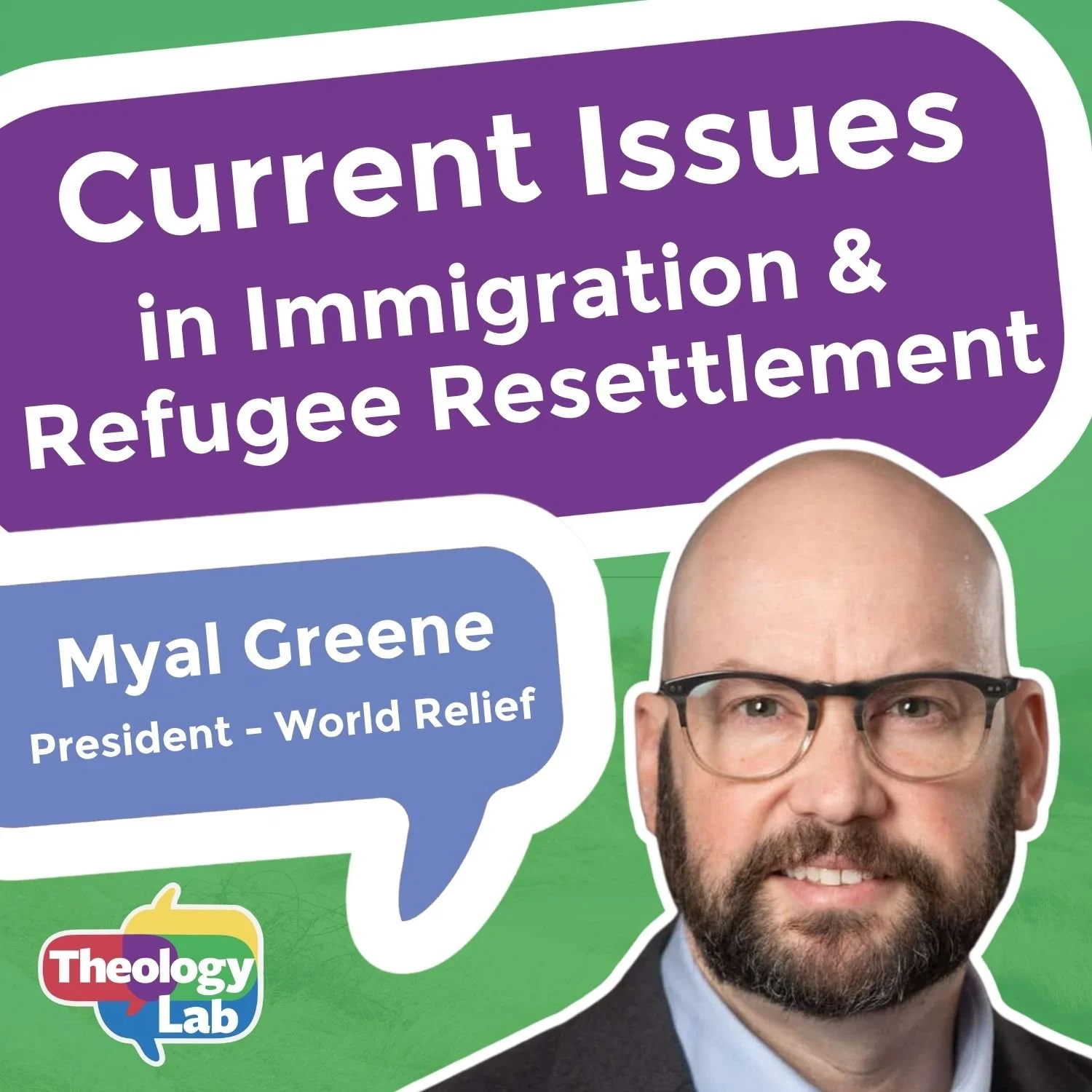
⭐ In this Theology Lab interview Scott talks to Myal Greene, the president and CEO of World Relief, an international humanitarian organization on the topics of immigration, refugee resettlement, and current issues. Their conversation covers how immigration and refugee resettlement connect to faith, spirituality and how Christians read the Bible. Myal offers a thoughtful perspective on not only World Relief's response to the immigration and refugee issues of our time but also how everyday Christians can think with nuance and theologically about these important topics.
Description
In this Theology Lab interview Scott talks to Myal Greene, the president and CEO of World Relief, an international humanitarian organization on the topics of immigration, refugee resettlement, and current issues. Their conversation covers how immigration and refugee resettlement connect to faith, spirituality and how Christians read the Bible. Myal offers a thoughtful perspective on not only World Relief's response to the immigration and refugee issues of our time but also how everyday Christians can think with nuance and theologically about these important topics.
Resources
🌎 Learn more about World Relief at: www.worldrelief.org
🎙️Curtis Chang's interview with Myal Greene: https://tinyurl.com/42ah93u5
🌎 The Center for Public Theology and Migration: https://www.theologyandmigration.com/
Generated Transcript
speaker-0 (00:02.882)
Welcome to Theology Lab. I'm here with Myle Green. He's the CEO and president of World Relief. World Relief's mission is to boldly engage the world's greatest crises in partnership with churches. Do I have that right? Okay, great, great. Let me say at the outset here, there is another interview you might be interested in with Myle by Curtis Chang on the Good Faith podcast. A lot of the questions that I ask here are gonna compliment the questions that Curtis puts to Myle.
You got that.
speaker-0 (00:31.298)
I'll put a link to Curtis' interview with Miles in the show notes to this episode. Miles, thanks so much for being a guest at Theology Lab.
Yeah, it's awesome to be here. I'm real excited.
Let's get started with basics here. We're going to talk about refugee resettlement and your role as a Christian leader with World Relief. Tell us really quick, what is a refugee? And then what do things look like on kind of the bigger view here with refugee resettlement going on worldwide?
Yeah, absolutely. So a refugee is an individual who has fled their country of origin because of a credible threat to their safety because of violence or persecution and
there's that well-founded fear for their safety. And so there's a couple things there. One is establishing that well-founded fear for their safety. The second is they've actually crossed the borders of their country and fleeing. It's a little bit different than some other categories of folks. You'll have internally displaced people who might have fled one part of a country to another country seeking safety because of war and conflict. so oftentimes, X number of people are displaced because of this conflict. They're not refugees unless they cross the boundaries of their country. And then you have people like asylum seekers who meet many of the same criteria.
speaker-1 (01:42.65)
Yeah.
The issue is that they have not been certified as a refugee until after they've entered another country and are in that process. And so there's some distinctions there that come up in these different perspectives. But the reality is today right now, there's more displaced people in the world than ever before in recorded history. So there's 124 million people who have been forcibly displaced from their homes. This is result of violence, persecution, warfare, other threats to people's safety.
To put that in perspective, because those are just numbers, I've been doing humanitarian work for 20 years. It's four times the number that it was 20 years ago. And this is at a season when we've seen the number of people living in extreme poverty rapidly decrease, the number of people dying from preventable health issues decrease. But this issue of displacement continues to be a growing area of concern in a lot of parts of the world.
Give us a sense of how world relief approaches refugee resettlement.
So a couple things about World Relief's work. We do work overseas in a number of countries of the world where there are refugee populations and displaced people. And so we're in some of the places with the largest number of displaced people in terms of Sudan, South Sudan, DRC, several other countries where we work. But in the US, World Relief has been a refugee resettlement agency dating back to 1980. And really, the birth of what is refugee resettlement in the US came about in response to
speaker-1 (03:12.112)
the crisis that happened in 1980 when many Southeast Asians were coming to the U.S. Fleeing issues in Southeast Asia, many Vietnamese predominantly, but others from the region came. In churches...
stood up, helped to welcome these people. World Relief was one of the organizations that began that. Catholics, Lutherans, others were also part of that response. And so we've continued to implement refugee resettlement for four and a half decades. It's been a really vital part of our work. And in the US, we play a really meaningful role in recent years welcoming refugees when they come to this country and connecting them to churches. In your intro, you talked about World Relief's mission
to boldly engage the world's greatest crises in partnership with the church. And so the work that we do is stand right alongside churches in welcoming refugees that have come to this country through a resettlement process where they have been cleared and screened and approved for entry into this country and
We as a nonprofit and the churches as our local partners help to create welcome for these people, help them get into their first apartment, help them find their first job, begin acquiring language, get to know the community, build some community connections and network.
Let me go to a question. This is a theology lab. I am wondering, not so much about like a biblical framework for how you approach refugee resettlement, though that's incredibly important. I'm a little bit curious to know what has stuck with you, something about the content of your faith, an aspect of engagement with the Bible that has stuck with you and compels you to do this work.
speaker-1 (04:58.272)
When I came to be a believer in Christ, was a young adult, through a lot of challenging things and that's maybe a story for whole other podcast there. But I remember coming across the passage in scripture, Psalm 31 verses seven and eight, and it says, I'll be glad and rejoice for you in your love, for you've seen the affliction of my soul and you've not turned me over to the enemy, you put me in a safe place. And I remember reading that scene, like this is what God has done in my life, in my own redemption story, in my own work.
through individuals that have had to go through fleeing a crisis, some of the most traumatic events that you can imagine people experiencing. And what does it mean for us to say in deep relational commitment inspired by the gospel What does it to come alongside people and ensure that they feel that they're once again in a safe place? And what does that look like and how do we overcome that? And so like for me that is just at the heart of this concept of
refugee resettlement or welcoming other immigrants or serving people who have fled a warfare. with our work in Africa and what that looks like is what does it mean to kind of create that sense of belonging and safety and connectedness again?
powerful. I just think like the world is not as it should be. The world is not a fair place. But the way you talk about Psalm 31 and the power of this saying, God desires to put people in safe places. I could see how that would carry you and the work that you do and maybe that should speak to us as well.
Thanks for watching this theology lab video. If you're enjoying it, you can subscribe to the channel below and you'll get more theology lab videos as soon as they're released.
speaker-0 (06:48.3)
This is where I think I want to ask a question that dovetails with what Curtis Chang asked you about speaking up on issues of immigration, refugee resettlement, asylum seekers. Within our faith communities, you have talked a lot about a crisis in leadership. And here's how I understand this. Tell me if I have it right. It's that.
The issue of immigration, refugee resettlement, is so charged that faith leaders, pastors, are hesitant to speak about it upfront and to really dive into the issue because it's so electric. But there's research that folks in the pews are actually more open than we think to wanting to hear about.
immigration and how it connects to their faith. So let me ask first of all, do I kind of have that right when you think about a crisis of leadership? And then I have a question I want to put to you.
Yeah, I think to be fair, I don't want to put all the blame on pastors and church leaders in this space. I think in this season, the burden that church leaders carry is very heavy. We saw post-COVID, how many clergymen left the pulpit and left ministry and...
that was a charged situation. We live in a politically very charged environment right now. And then you add in this complexity of a topic like immigration to things, which is a highly political, it's on the front page of the newspapers every day right now. It was at the heart of the last presidential election. So it's a highly political issue of the day. people approach that conversation, how do I talk about this without, you
speaker-1 (08:34.698)
splitting my congregation or losing my job. And that's a real reality here. I just want to keep the church together and keep them moving on. At the same time, I think that there's this piece where there may be some fear in that space at times because the voices that are opposed to...
immigration or have some of the less welcoming views in society are very loud and a of pews. And I think to your point that you were raising there, we've done a lot of research and done a lot of polling of folks and seen that most evangelicals have a very open mind to these issues and actually are yearning for this. And we've polled on where people are predominantly getting their views and the most formative information they're getting in their views on these issues. And they regularly say, news,
my friends and politicians more so than the Bible or my pastor. And I think, you know, what other social issues today would you say to pastor like, you want your congregation to learn about human sexuality or how to use your money and commercialism from news, politicians and other friends, or would you rather say like, you want them to learn that from the Bible and from, you know, a well-equipped teaching pastor and whether it is. And so I think that's a dynamic that we sit in there that
what is the church willing to engage on and in that space and to do that. I think the other thing that's interesting is in some of the research like basically four and five evangelicals said they would like to hear a biblical message on immigration but only one in five had ever heard one. So this is like an incredible dynamic here of where people are yearning for information. But then I think you know how to do that in such a way that doesn't come across as some sort of partisan.
engagement is a really tricky thing because I think a church leader doesn't want to bring partisanship into their congregation and cause those divisions that come along with that. And so I think it's a tricky place that they come from but I think that at end of the day, know, are we willing to speak out about a deeply biblical issue? Ninety-four times in the scriptures, Old Testament to New Testament, we see
speaker-1 (10:48.436)
scriptures speak about God's heart for the poor and commandments and that's what but God's heart for immigrants, excuse me, 94 times and this commitment and commandment to care for them and that's crucial and that's central to the biblical narrative and I think it's there because in society we're so apt to forget that message and I think that this is a time when we need to be reminded of that afresh.
So this is where I would want to especially plug the curse your interview with Curtis Chang because he put the question to you then what would you say to preachers? What's the kind of language you would give them to speak to congregations on this issue on this issue? Well, and you and you give some wonderful examples. Let me ask this question. Yeah, let's put the question now to folks who want to hear more about this ordinary Christians What actually can they do to make it easier for this to become a broader conversation?
to become a more public conversation where we can talk about immigration and refugee resettlement. So if you're just like someone in a community and you know the people around you want to talk about this, what might you say to them?
I think two things are really crucial in a situation like this. One is going back to the scriptures and being conversant and knowing well those scriptures. To put a plug for the evangelical immigration table, we have a 40-day...
Bible study of Versa Dei on immigration and it's a great place to start and go from Old Testament to New Testament and learning those scriptures and seeing the pattern that we see. And so I think learn the scriptures and be ready to speak from them. Second is talk about why it's important to you and relationally why it's important. And I think that actually has to supersede the policy discussion because regardless of what public policy is we as Christ followers have a responsibility to be
speaker-1 (12:41.644)
welcoming to immigrants in our community, welcoming to the stranger in their distress in that space. And we can debate the public policy side again after that. But if we're not willing to relationally reach out to someone and say, hey, you're new in this community, you have some vulnerability.
How am I ready to connect with you? And so I think that has to be at heart of the issue. And so being biblically grounded in that, but also having kind of relational credibility in terms of why it's important to you and what you've done in the relationships that you've made, that's a really crucial, crucial thing.
Let me turn here to a sensitive topic here in current events. November 26, 2025, there was a shooting in Washington, D.C. It's been all over the news. It was the shooting of two National Guards members, one of whom has died at the time of this conversation as a result of that shooting, took place by an Afghan national. And I want to ask this from two different sides here. But the one side is, you know, saying this person should not have been allowed into the country. There should have been a firmer vetting process in place when they came in. I'm just kind of curious.
to know how you're responding and thinking about claims like that. And then I'll take this question from another angle.
So I think as a Christian, first and foremost, we need to think about this in terms of a recognition that violence in any form is abhorrent and something that should break our heart. And my heart's broken and I grieve over the sadness of the loss that took place in this case. And to see one of our service members killed is a tragedy.
speaker-1 (14:18.548)
of the highest degree and something we have to be very heartbroken about as a society and as the church in that space. I think we also have to look at this from recognition of how fear is used in this case by policymakers to move things forward. And what we're seeing is a lot of the policy proposals are focused on kind condemning entire people group based on the actions of one individual. And I think that that's the most
tricky space is that fear is a very powerful tool politicians and leaders have used for centuries, dating back to the beginning of humanity, to influence public opinion. And what I would recognize is that the Afghan community, by and large, have been a very vulnerable population when they arrived. The majority of the individuals who came were individuals who had
fled the Taliban, oftentimes with targets in their back because of their assistance they provided to the U.S. And many of them have come to be.
very valuable contributing members of society. People that I've gotten to get to know, that welcomed in their homes, and really wonderful individuals, and really grateful for the contributions that many of them are making in society today. So think we have to be real careful not to attribute blame for an entire group of people to the actions of one person in this space, and that's crucial. I also believe that we can lean into and prioritize national security and protection of individuals while also having compassion
immigration policies. I don't think those two things are mutually exclusive and I think that that's the challenge that we have in a situation like this is how to work through healthy meaningful vetting processes but not using a crisis like this to exploit a population or to target a population in a difficult situation.
speaker-0 (16:16.172)
So as a response to this, what we are seeing from the current administration seems to be something like a crackdown on immigration, refugee resettlement, even more broadly. How would you ask Christians to be responding to what seems now to be an increased heavy handedness in a very tense year around these topics?
Yeah, so a couple things. There's a couple of very specific policies that have come out and been proposed. So just a few days before this attack took place, the administration announced a new policy, which was for every refugee who entered the country during the Biden administration, that they would need to be re-interviewed to re-verify their refugee status. So to be really clear, this is not an additional security check that was proposed. This was, did the,
that made you to a refugee, is that legitimate? Were you really fleeing a well-founded fear? And so for anyone who's been a refugee and admitted during the refugee program, they had a conversation with the United Nations to verify they were refugee. They had a conversation with the US government to verify they were a refugee and had that as a well-documented case before they were even approved. They also had security clearance checks.
on multiple times along the process before they were brought here. So to go to that population and say, now you once again need to prove that you're fleeing a threat, that's really heartbreaking. That's really re-traumatizing for a population here that has come, many of them already have green cards. They have begun to rebuild their lives, put their kids in school, reestablish things. And so to go back and say like, wait, did you really flee something as a threat? You know, I see that as actually kind of a systemic.
plan to remove people from the country in that space. And that process has been the same process for decades here, and no president has ever gone back and reexamined those. Now that issue is kind of being conflated with this security concern issue. And so what they're actually proposing is not screening related to security in that space in that particular proposal.
speaker-1 (18:34.518)
Now I think the other question of security screening, where does that fit into the process and where are things in the space is also a very unique one. Now, many of the Afghans who entered the country did not come as refugees and that's an important distinction in this space. so.
Even the individual involved in this case came as part of Operation Allies Welcome, which was a separate program, you'll remember, in 2021, in August, September, people were fleeing the Taliban. They came on military aircraft, oftentimes spent several months at military bases, and then were assigned to communities throughout the country. And so there were some screening that took place in that season, in that time, when people...
filed for asylum, they filed for re-up in their immigration status, there would have been screening that would have been done, and additionally. But also it's important to kind of distinguish that that's a different group of people from immigration policy than the refugee population that's come under scrutiny for some of these additional screening. And so that's out there. I think the other proposal that has come up has been an indication that...
all green card applications would be paused for people coming from a set of 19 countries that are on a travel ban list already under the guise of security and some of these things. This includes people who are already in the United States.
under different immigration statuses legally and are waiting to kind of move to a more permanent status in that. So what we've seen is all of these policy recommendations have flown out of one incident involving one individual. And I think that's the really dangerous thing now is that there's.
speaker-1 (20:12.696)
policies that opponents of legal immigration would like to move forward and they're leveraging one tragic event for that purpose. And I think that that's a very dangerous thing for us to do when we use fear to influence how we think about these issues.
Let me go to one other less current event, but still within this past year. I had Matthew Sorens on for a conversation at theology lab a few months ago. And at that point, the State Department had let in the Afrikaners, a small group of Afrikaners, but as part of the refugee resettlement process, I asked Matt kind of why World Relief went along kind of with that while the Episcopalian Church
made a different decision and just had a match processing around that. So I'm wondering, can you kind of give us an update on how World Relief is thinking about its relationship with the State Department right now, especially as there's now even lower ceilings on the number of refugees that the country is letting in? Can you catch us up to speed on how World Relief is processing that?
Yeah, so we're still really monitoring where things are actively right now. As you referenced, the government announced its...
It's ceiling for refugees for the year had been at 7,500, which is the lowest number ever on record. Kind of the historic norm is between 60 and 80,000. Sometimes that's been as high as 100,000 or slightly more. The lowest year of the Trump administration was around 15,000. So that's half of that. So in this setting, the ceiling, the White House has a lot of authority in terms of setting levels and...
speaker-1 (22:02.518)
it's very much subject to kind of the whim of a president. And they're given that authority in the legislation to do that. And so think we're profoundly disappointed that the level is so low at a season when globally the needs of refugees are so high. You know, we have advocated and tried to encourage the administration to consider the...
plight of persecuted Christians, especially in this season. know that President Trump has spoken very forcefully about a desire to be welcoming to persecuted Christians and to do that. And I think the Refugee Assistance Program is the best avenue to do that. And so this is something we've advocated for and people persecuted for their faith for other faiths as well. But we know that a third of all refugees who entered the country in 2024 were Christians from countries among some of the most
the 50 countries where Christians face the greatest persecution, a third of those who came as refugees, 32,000, were coming from those countries. And so, you know, there's some really crucial things for us to think through in this space. We're certainly kind of monitoring where some of these new policy proposals have come out. So those factors will really determine what the future of our refugee programming looks like.
I appreciate you speaking to some of these issues on current events and policy. And in some ways, think it goes back to what we talked about earlier with what is the church's role? And then what can be organizations like World Relief that explicitly partners with churches to take on tasks and questions that are kind of beyond the scope of what the local church can do, but then can take up its own role and do very well in partnership with a group like World Relief. Myla, I want to get something kind of practical.
What, a leader of World Relief, would you be asking, let's say somebody who's kind of just new to the conversations on immigration and refugee resettlement right now, then what also would you be asking like a seasoned veteran in this work, someone whose family's been taking in refugees for some time?
speaker-1 (24:12.876)
Yeah, well I think how we begin the engagement in prayer is really crucial in this space. And I think we have to prioritize silence and solitude and biblical reflection in prayer at the foundation of that. So if you're someone who's confused by the issue, you're interested in how to dig deeper, you know.
My exhortation to people is read the scriptures, take it to prayer, have silent reflection, turn down the news, turn down the politicians, get that stuff off your feed, and just think about the human issues that are here and look through that. And don't let all those other opinions of the world.
that are not well-founded confuse you and look at that renewing of the mind that comes from deep biblical reflection and silence. So that's one. I think also for people who have been following this issue and who care deeply about it and are deeply motivated about it, my challenge is as well in this season, and I've challenged many of my own staff and we've been doing a devotion in our leadership team in Habakkuk of late, and that's a book that so much of that is about lament. My question is,
Where are you lamenting to? Are you lamenting on social media or are you lamenting to our Father? And I think that there's this biblical case that really we should be free to take our frustrations and our rage and those things to Him and just being free in that space of just expressing this deep frustration that so many of us that are deeply ingrained in this work have right now, even as a prerequisite to kind of praying for...
change to happen in that space. But then we take that and just complain to our friends about, you see what happened with this policy? Or just putting out this rage on social media and this frustration. I think there's a time and a place for good advocacy and persuasive talk, but we've got to take that to God first. And so how we pray about these issues and we get our hearts right on it is really crucial. And if we're not formed well in our heart, we can't engage well in society. I think that's one. Number two is I think there's a lot of really good opportunities for people to use
speaker-1 (26:25.424)
their voice and advocacy in this opportunity. And I think that that's a really meaningful time. We've got resources on World Relief's website related to that. We've got a sign on issue specifically related to this refugee rescreening issue that I talked about earlier to say, people have been established that they've fled a true fear. They shouldn't be asked to re-prove that four or five years later again, in order to stay within the country. So there's sign on letters, there's places like that to
to share their opinions, reach out to policy makers with those. But I think also ask the question, what does it mean to be a good neighbor in this season? And that's not really complicated. mean, yes, you can go and volunteer with a ministry that does this work, but you might wanna say, do I know foreign born individuals in my community?
that I can be a good friend to and that I can get to know. And if you don't know those individuals, they're probably in your life, you're just not taking that opportunity to get to know them. And so how do we really prioritize that?
Let me put one question that comes to mind about how we would engage with social media. I really do appreciate what you're saying about like make sure that you have kind of your spiritual grounding in place first. One thing I found helpful about social media right now is that there are folks out there who are offering, think, very like very holy laments about the situation going on in immigration, refugee resettlement. Shane Claiborne, he's been a guest at Theology Lab a couple of times. He's someone I just kind of look at some of his posts and I pause and I pray.
And I'm coming to know some of the folks at the Center for Public Theology and Migration who are doing incredible work and they have a great social media presence. And I'm almost looking at those as saying, make sure that when I see what they say that I receive that as kind of being taught or at least hearing from somebody that I know is coming from a trusted place who loves Jesus. And I'm trying to bring that into my spiritual life and formation. I wonder just what you think about that as a spiritual practice.
speaker-0 (28:28.432)
you
I think it's valuable. I don't spend as much time on social media as I used to in this season. think social media is designed to get emotional responses out of people and get people to reconnect and re-bring it. So you always have to be very careful with that. But I think it is knowing who are your trusted voices that you follow. And all the people that you mentioned are people who are deeply immersed in the scripture, they're deeply...
inspired by their faith and a biblical mandate for the positions that they hold and the positions that they share. And Shane is gifted in the way that he talks about these issues. And Center for Public Theology and Migration is a great organization. They have very good resources. Daniel's got written a great book. the depth of material there is stuff that I respect. And so think following trusted voices is really key. I think you just have to be very careful.
in which voices we're trusting and what does that look like and where that is. So that's my own caveat with social media because it's very easy to go down the spirals and there's a lot of untrusted material that's out there. So that's my general perspective is be careful who you follow and I think our discipleship and followership needs to be Christ and his teachings, not necessarily the teachings of...
of social media and if social media is not drawing primarily on the words of Christ or words from the word of God then I think you have to be really careful.
speaker-0 (29:57.57)
I got chance to hear you speak to a group two nights ago and then I got to debrief it with a group of people and I got a few questions that folks wanted to put to you from that group. All right, so one person said, I love the work that World Relief is doing. I think that it is incredibly important work, great things to say about it. But their question that they had was, how does the gospel explicitly come into the work that they are doing? The example they used was they're saying, hey, if I'm taking the bus to work, something happens to me and someone comes alongside and helps me.
That's wonderful and helps me make it to my final destination. How is the work of world relief different from, say, kind of the general, of the good Samaritan work of someone coming in and helping out another person?
What I talk about is the fact that we at World Relief and our staff, we're a missional community of Christ followers who are doing this work. And so it begins with our personal spiritual formation, our personal spiritual practices. We're doing this work because we're motivated by our faith and we want to use it as a public expression of our faith to individuals. And so that's the beginning of that. Throughout the course of our work, there's many opportunities to share.
why we're doing this work, why we're motivated to do that, and what that looks like. So I think that's different than the guy who comes along on a bus and just helps you change your tire or whatever that is and moves on. And so I think our motivation is key, the opportunities that we have to share that. I think also one thing that's unique is the ability that we have to bring the local church into that conversation and to be in a long-term relationship with people and leverage the witness and the power of the church to share.
relationship and life with people that just generates even more opportunities for the gospel to be shared, both indeed but also in word and creating that expectation. I can think of many times throughout my career where a client or somebody I've been working with says, well, why do you do this? And that's such a great opportunity to launch and to really explain the way that Christ has changed my life and would do the same in their lives as well.
speaker-0 (32:05.102)
you
speaker-0 (32:17.422)
you
you