
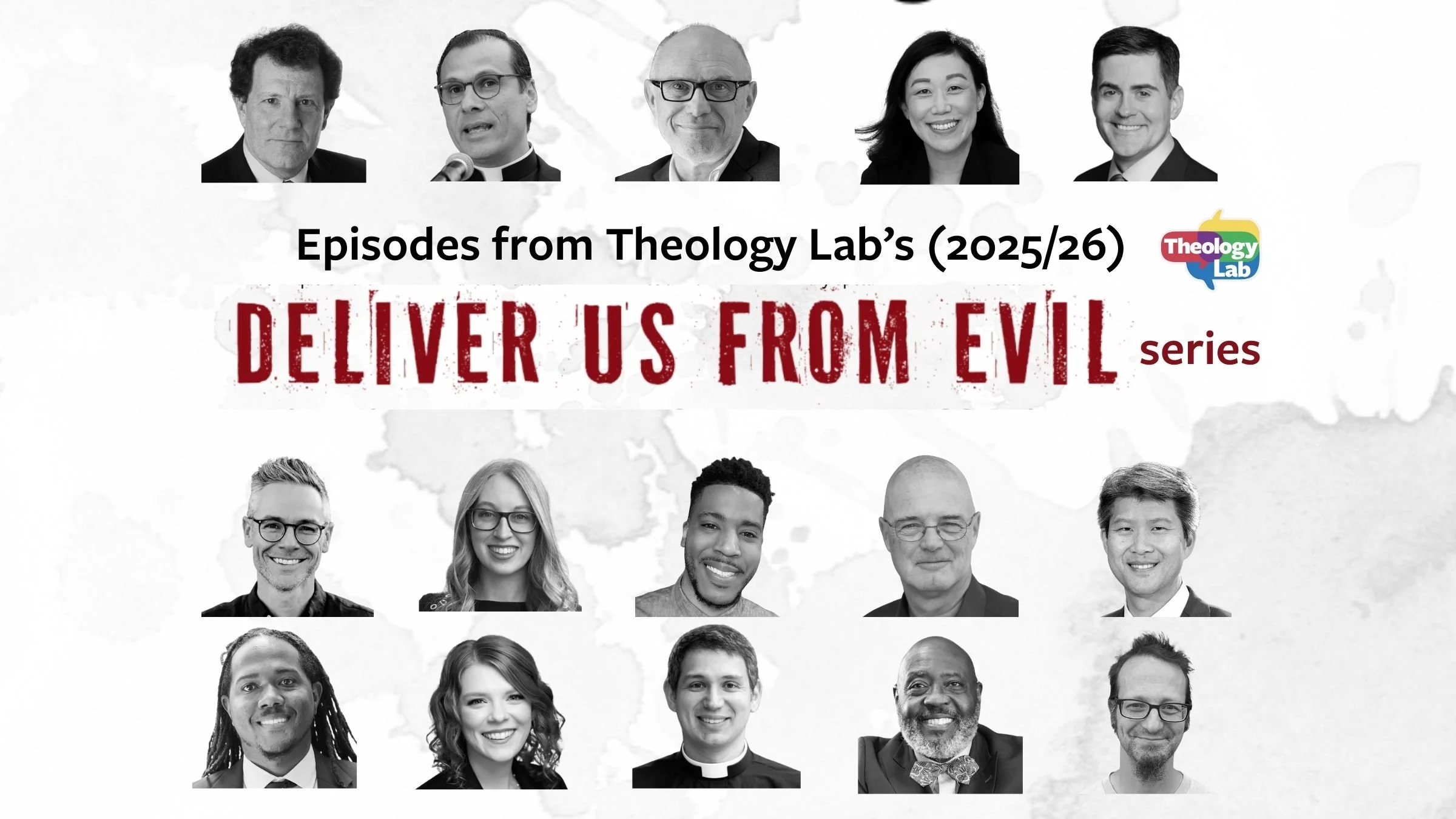
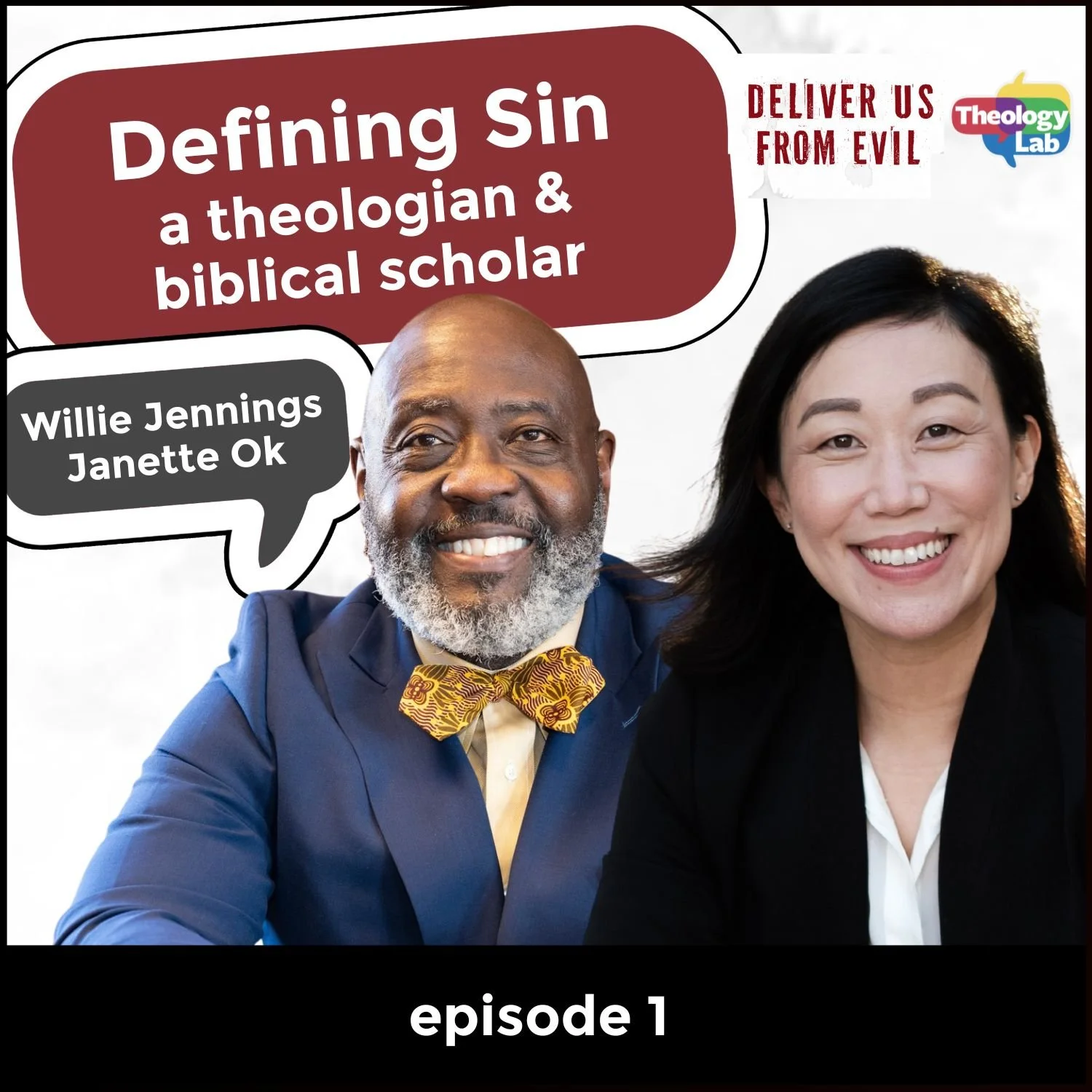
Theology Lab’s video podcast:
-
AI generated transcript
Speaker 3 (00:01)This is the first episode in Theology Lab's Deliver Us From Evil series. It's on the Bible and the challenge of naming evil. What happens when you and someone else disagree on what is evil? At the end of the video, I ask our guests, Willie Jennings and Jeanette Oak, to share what it means for them when they pray the words, deliver us from evil, right now. I've put that question at the top of the comment section below. What does it mean for you?
Pray the words deliver us from evil. If you're willing, share that in the comments. Here's the interview with Jeanette Oak and Willie Jennings.
Willie and Jeanette, thank you for joining us at the Deliver Us from Evil 2526 Theology Lab Series.
Speaker 2 (00:52)
I'm so glad to be here. What a light topic, as I was saying before.
Speaker 3 (00:57)
Yes. Willie, ⁓ thinking about the Book of Acts, Jeanette, thinking about the letters of John, ⁓ how do you see a feature of sin or evil manifesting themselves in these scriptures?
Speaker 1 (01:14)
Yeah, so in the Book of Acts, I think it's always important to start with the good news, and that is God is doing something incredible in the world. And in the Book of Acts, we see that coming, in a way, coming to fruition in the resurrection of Jesus. And so ⁓ everyone now is having to wrestle with the unprecedented.
not only has God become flesh, not only has God entered the reality of the creature, but the creature responded by killing God. rose from the dead in flesh. And this is the good news. And so, in many ways, I think it's always important to remember that we come to know what sin is. We come to see what evil is. Only in the presence
First of all, what God is doing. And what God is doing is more than just revealing sin and evil, but overcoming it. And so, in that regard, I think in the book of Acts, the first thing we see that helps us start to understand what sin is, is we see a God making an offer to ⁓ follow the new way that has been made known in Jesus.
and people resisting it. People having resisted and continuing to resist it. And therein lies the beginning of seeing sin. And then to the extent that that resistance is tied into trying to create an order of life, a social order, economic order, a spiritual order that is against the God.
that who has been revealed and offered new life. That's where we can start to get our hands around what evil is. Evil in this regard is serious resistance to what God is doing in the world. So let me stop there. But I think that's where I would want to start with the book of
Speaker 3 (03:31)
Jeanette, how about you with the letters of John?
Speaker 2 (03:35)
Yeah, in the letters of John, would say evil is describes anything that is not of God. To be of God is to originate from God, to belong to God, to share in the characteristics of God, who is described famously in this letter for the first John, at least as love. Right? So God is associated with light, love, ⁓ fellowship. So I am saying that first, because conversely, ⁓ in the letters of John, evil is associated with darkness.
darkness is like equated with hating a brother or sister. It's a quick associated with hate, which impacts action. It impacts site. It brings about blindness. ⁓ it's associated with lies and particularly lies about who Jesus is. Like the denial that Jesus is the Christ, the denial that his humanity has solidific significance. And then John also, he actually locates the source of evil with the devil or otherwise known as the evil one.
Like we have the use of the term devil ⁓ used in the letter and this devil he describes has been sitting from the beginning and opposes and rebels against God's will. And ⁓ what's interesting also is that we're told that the son of God was revealed to destroy the works of the devil and to keep us from those oppressive cycles of sin. So while we don't really know what these works refer to, John gives us clues like the devil sows,
hate, he spawns children who hate, he provokes murder, he dwells, abides in the home of death. So he's pretty explicit.
Speaker 3 (05:13)
It pause here for a moment, Jeanette, can I go back to you on this notion of the Antichrist? OK, so I'm going to I'm going try to express a modern sentiment here. Antichrist Satan for a lot of for many people, I say, including myself can be a strange, uncomfortable idea. When I'm talking to my to my neighbor, I don't bring up Satan right away. And I know, so I'd like I'm willing to I understand this in this a really abstract way. I have this image of someone with a pitchfork going around in my head.
Speaker 2 (05:33)
Yeah, rightly so.
Speaker 3 (05:42)
Can you tell me how John's use of the Antichrist compares to that modern sense of discomfort I have with that idea?
Speaker 2 (05:51)
Yeah. Well, first, can I give a little anecdote? I was at a rally in my community, ⁓ protesting ICE raids. And I saw this guy holding up a sign that said, I thought the Antichrist would be sexier or hotter. And it kind of made me, it made me laugh, but also made me think about the letters of John, because to your point, to your question, and we have very strong and tyrannical associations with the idea of the Antichrist, like you, like you had referred to.
And I think in the popular imagination, we have this idea of the Antichrist with a capital A. It's this singular, tyrannical, evil, beast-like figure associated with the end of the world events. And a lot of students and people are generally surprised to know that the term Antichrist actually occurs only four times in the Bible. The only four times it occurs in the Bible is in 1st and 2nd John. And the Johannine author uses Antichrist
⁓ in the singular and in the plural. So antichrist or antichrists, they refer to those who were once part of the community and who teach a corrupt or counterfeit Christology ⁓ that denies the flesh and blood Jesus is the Christ and God's divine son. So this, that seems a lot less intense and perhaps at first or scary than what you might think, but the central confession of this community
is that Christ has come in the flesh and antichrists negate or deny this. But the thing about them is that they do not do this in a very overt or obviously divisive ways. And they're not these other human creatures or human beings. They don't do this ⁓ in divisive, overtly divisive ways, but in more insidious ways. And this is why the author is so, like, warned so strongly against them. And he uses such polemical language
them out for the liars that they are. ⁓ Craig Kester, he I think hopefully explains that in one and one and two John, the Antichrist is not like violently persecuting believers, but he simply drains their faith of its content.
Speaker 3 (08:05)
Let' go.
Speaker 2 (08:06)
In doing so, they're draining the community of their motivation to love. If God's perfect love is really revealed in the Word made flesh, in the incarnation of Christ, in Jesus of Nazareth, as described in the gospels, then Christ followers have to love others in the flesh, in particularity, in real time, in real tangible ways. And so this is hard, and it's hard for the letters recipients as well.
And so that's what the author is also addressing.
Speaker 3 (08:38)
Thanks for watching this theology lab video. If you're enjoying it, you can subscribe to the channel below and you'll get more theology lab videos as soon as they're released. Willie, I want to go to a question, a specific question on the book of Acts. If I open up my, if I take my phone, I open up any news app, I just have to scroll down. Sure. By the third story, I will see a story about lives being ruined at times, like so much so that I can go numb to it.
There's a place in your ex commentary or places where you talk about seeing violence and not responding. How do you think that the book of acts speaks to this ways that we'd see evil, we see violence and we either stay inactive or are called to respond or move to respond.
Speaker 1 (09:27)
Well, if we think about the violence that's there in the Book of Acts, from the beginning, it has a specific focus. It's aimed at the bodies of the disciples of Jesus. Almost right from the very beginning of the Book of Acts, the people who are going to receive the violence are these disciples who will give witness to the life of Jesus. And it ties into what Jene just said so nicely. I mean, ⁓
There are two huge problems in what the disciples are saying that evoke the violence. The one is that they're saying, Jesus of Nazareth, that dude, that's the Messiah. That's the Christ. And so ⁓ the Jewish audience and the Gentiles who know a little bit about it, they're like, ⁓ that can't be the Messiah because when the Messiah comes,
you know, some big things are supposed to happen that have not happened. And so, you know, they're really upset. They're scandalized by that. And then from the very beginning with the resurrection, his connection to God, which he claimed his entire life, is now putting on the table a crucial reality. This man is God, connected to God in such a way that we can't really separate the God
of Abraham, Isaac, and Jacob from this man. And so there are two kind of crucial matters that, you know, if you're religious person and you're hearing, the response as a zillion is to say, well, we have to kill this person and kill these people. And so the violence that they are receiving because of what they believe is the first place where we see violence. And of course,
those watching think that, well, they deserve it because, you know, they're these heretics, they're these people who are on the fringe. And so to keep society safe, to keep our religious community safe, then we have to acknowledge that some people have to be disciplined, and some people are a threat to the very existence of society. And so oftentimes inactivity or our ability to accept violence
is tied to what we have heard is necessary to sustain security, stability, and safety in society. So we're willing to allow some people to be beaten, tortured, locked away, because we believe that that's what's necessary for society to be safe. And so, in the New, in especially in the Book of Acts, the disciples are often in the position
of being the people who the rest of society understands are a threat to stability, religious, economic, social stability, and a threat to community. And so such people have to be dealt with. And if they die, they die. And that's part of the legacy that we as Christians have to get our minds around, not the ones who stand on the sidelines and just kind of watch.
but the ones who are in the position of having violence done to them. And of course, we have to say this, Scott, God put them in that position. They're not there by accident. God put them. And in fact, what we're seeing in the book of Acts is that the disciples of Jesus will always be close to the bodies of those who have been positioned in any society.
as the most dangerous, the most problematic, the most fearful of overturning society and upsetting the social, political, and economic order, our bodies are often next to them, should be often next to them. And if they're not, we have to ask, where are we standing?
Speaker 3 (13:40)
Okay, I want to try to just tease out a couple of the things I hear there. You're saying that proximity will change the way that we see violence happening around us, like who we're close with and how we help respond to all of that news.
Speaker 1 (13:54)
That's a great point. Proximity does help us see violence in ways that are absolutely crucial. So for example, in the Book of Acts, the disciples of Jesus are almost always tied to the prison. Almost always. Either being arrested, being re-arrested in prison, released, being put back in prison. We are very close to those who are incarcerated.
And we're very close to always being seen as a part of the criminal element.
And so that's a very important insight that understanding where we as disciples of Jesus stand in society in relationship to the way any society works is very important. And for us to see ourselves positioned with the powerful and the elite and those who are securing society, there's often a misperception of where we should be.
Speaker 2 (16:56)
Yeah, so there is struggle, but yes, the letter of 1 John is very binaristic in flow. ⁓ Children of light, children of darkness, children of God, children of the devil. It's hard to read and not feel like condemned in some way, or confused or overwhelmed. But I think what is really important to understand is that the author is trying to
increase the confidence of his readers because they're seemingly doubting whether they're in Christ, whether they're of God, whether they're still abiding in Christ. And so when you're thinking about it, ⁓ he's trying to like separate the sheep from the ghosts. Actually, he's trying to herd the sheep. And he's trying to say, hey, you guys, you guys are part of this. You are part of this community. You are born of God. And as we love one another, we know that we are born of God.
Speaker 1 (17:27)
That's good. know, the thing about what you said, Jeanette, I think is so important. In the Book of Acts, they struggle, the listeners struggle to understand what these disciples are saying about this Jesus of Nazareth. Because from all accounts that they've heard, this dude was a criminal and died because he was an enemy of the state and the enemy of the religious community. And so, I'm listening to
you
Speaker 2 (17:54)
God's love is being perfected in us. So you don't have to be perfect in order to remain in community, but we need to make every effort, have dogged commitment to this community. And that commitment is reflective of our Christology. And so ⁓ one thing that the struggle to name evil that we see in the letter is the fact that in 1 John 4, he talks about the testing the spirits, right? Beloved, do not believe every spirit, but test the spirits to see whether they are from God.
Speaker 1 (17:54)
you disciples of Jesus tell me about Him and I'm having to think, okay, wait a minute. He was crucified and the only people that get crucified are people who have done something wrong. Okay, so first of you're telling me that He was crucified but He was innocent and I'm not sure I believe that. okay, I'm going to listen. And then now you're going to tell me that He was really the Messiah of Israel. And all the religious leaders that have trained me, that have taught me,
what it means to be
a part of this faith, say, no, he was not. And so, I have two levels of trying to think through. And so from my perspective, there is nothing, there is really nothing good about what you're saying. The only way this is going to get to me is if the spirit somehow is inside of what you're saying. And I can sense and know that the spirit, and then...
Speaker 2 (18:25)
So it's not like a litmus test that's like super nuanced. It's basically, he talks about the spirit of God versus the spirit of the antichrist. The spirit of God confesses Jesus to the Christ, spirit of the antichrist doesn't, right? Negates that. But what's implied here is the need for discernment. It's the need for wisdom. It's the importance of not being naive and gullible, easily duped. ⁓
So testing the spirits is something that I think is really
Speaker 1 (18:50)
you know, you're going to be doing some things, you're going to be living a particular kind
of life in front of me that makes it very difficult for me to dismiss it. But let's remember, this is not easy to swallow. So this is why for so many in the New Testament, when somebody starts to back away from either one of those realities, Well, maybe he isn't quite the Messiah. Maybe he was pointing to the Messiah. Well, maybe he's not really
Speaker 2 (18:54)
was needed in the situation that the author is addressing, but something we have to think about too and not be naive about. We are susceptible to being duped, to being skewed, to hearing and rehearing the things that we want to hear again and again, and not being challenged because any gospel proclamation is going to grate against our flesh. And if we start to hear and find like,
Speaker 1 (19:18)
one with God. Maybe he's just, you know, a really, really strong prophet. You know, these
Speaker 2 (19:18)
oh yes, this is me. am children of light. am walking in the light, like in the sense of
Speaker 1 (19:24)
things become very serious because then you undermine not only his claims, but his commands to you. As Junaid said, to love. To love your enemies and not just your friends. To be a disciple, to go to the stranger, to build new community with people you prefer not to build community And it gets back to your first question.
Speaker 2 (19:24)
assuming that all that is righteous is what I'm doing and all that is right and true is what I think, we're probably not being challenged by ⁓ the truth and cling to the truth in a way that we need to.
Speaker 1 (19:47)
It is the resistance to all that where we can start to see sin. So we don't get lost in the minutia of people doing this or that little thing and asking that sin. We keep in mind this larger reality within which sin is exposed.
Speaker 3 (20:07)
We've taught the word struggle has come up a few times. And I wonder if you see ways that people in the Book of Acts or what's going on in the letters of John, where there's a struggle there to even figure out, to identify what evil is that we might be able to kind of resonate with in a constructive way. Like their struggle, we can learn from the way that they struggled to try to discern what evil was.
Do see that happening in acts? you see that happening in the letters of John?
Speaker 1 (20:40)
Well, I would say that ⁓ the struggle there is ⁓ not so much trying to discern what evil is. It's recognizing how their resistance is a form of evil. And it's very difficult because it's a resistance based on what they understood God to have been doing in the past.
And so the biggest point of resistance is what God is doing with Jews and Gentiles. And they're the people of Israel, biblical Israel in the Book of Acts. They have every right to say, okay, something's wrong here because we know that God does not want us to lose our religious and cultural purity. Because Gentile ways of life are
anathema to us. And so, recognizing that God is doing a new thing, that's a real struggle. And their resistance to it becomes evil because what happens? Their resistance to it leads to violence. They want to kill Paul. They want to kill Barnabas. They want to kill these disciples because they believe that they are absolutely destroying the way of God, the way of life that God has given to Israel. And so,
in their minds and in their actions, they don't see it as evil. And that's often, especially that awful mix of the religious and the political, that you don't understand the actions as evil. You understand the actions as actually sustaining a proper way of life. And right when you bring those two things together, that means you can actually kill people and think you're doing a good thing.
It's like Saul holding the clothing of people while they stone Stephen. He thinks he's doing a good thing. ⁓ And so, you know, this is where it's not so much a question of recognition. I think it's a revelation to them on the other side of life in Jesus that they recognize as Saul becoming Paul did. As he says later on,
Speaker 2 (22:55)
Janette. The communion is a very important ⁓ remedy. I don't know if you can say remedy,
but it pushes against polarization when we explain what God is doing in our communion week after week. Because in communion, when we take the communion and share the communion, we're reminded that it's God's love for us that forges us into fellowship, right? That affirms
Speaker 1 (23:05)
I, you know, and as happened in his great Damascus experience, you know, God says to him, why are you hurting me? And he's like, hurting you? You're hurting me. And I think that's the deepest reality
of evil. Evil is often not what we say or see. It's often what others see that we don't see.
Speaker 2 (23:23)
⁓ his spiritual impact and also his human, physical and fleshly reality of his Christ and resurrection in our lives. And it means that we come
together not based on like natural affinities, like our racial ethnic background, cultural heritage, shared histories, interests, political views, just affection, right? But actually on our shared, we come together because of our shared baptism, our shared confession. And that what binds us in Christ is way thicker ⁓
Speaker 3 (23:35)
Well, let me put one follow up to you and then, Jeanette, if you could respond to this question. Does Axe have a lesson for us if we think we're doing something righteous, but it's really not righteous? That seems to be happening a lot in the Book of Axe. Does the Book of Axe give us
anything to learn about what that looks like when we are mistaken?
Speaker 2 (23:53)
way more resilient than our disagreements and our agreements.
And we're fragile, I think, in our identity as Christians often, and the author is addressing a struggling identity as children of God in the letters. But the bond that ties us as Christians is not fragile. It can endure debates. It can endure conflicts among us. And I think it's important to remember.
Speaker 1 (23:59)
Yes. And it has to do with Antioch speaking to Jerusalem and Jerusalem listening. So what is that? It's listening to the Spirit of God speaking from people who we don't realize the Spirit of God is speaking
through, but they are speaking to us. And so Jerusalem has to learn from Antioch, but Jerusalem thinks it already knows what God is about. But Antioch says,
God's doing a new thing! ⁓ So look and listen! And so what happens in Acts 15 but also in Acts 11? When they hear what God is doing, they have to pause and go, huh? We didn't know that. And so what we learn is that the Spirit of God is always speaking. And the question is...
Are we listening? And where you don't find listening, that's where you often find people not able to see the evil in their midst, the evil that they're doing.
Speaker 3 (25:14)
This is powerful, ⁓ Jeanette, I'm really interested in how you are going to respond to this question about a struggle with evil and John and first John letters of John say first John in particular, partly because one impression I get in reading first John is in some ways things are pretty black and white that the author of first John is a certain competence. And let me kind of just put that to you. I'm, very curious that where, where, if there's, if there is struggle in first John,
Speaker 2 (27:03)
You know, I think when we think about the work of the spirit, we think of the work of the spirit like bringing us together, not ⁓ when we, but we struggle to think that the work of the spirit is also allowing us to hold contrasting and diverse opinions ⁓ in this community forming, but challenging tension and staying there long enough.
for the work spirit to work. I think about like the community that in acts where the spirit came down and they were speaking in tongues and they're speaking different languages. And I'm thinking, gosh, like that's hard work. That's the Holy Spirit's work, but like it's harder to do it for a long time. And I mentioned this in our last conversation. And so what I really find super challenging about the letters of John is the emphasis on abiding.
Because I think that we're quick to leave the Christian community when there's conflict or disagreement. And again, there'll be people who say, there's, I'm not talking about violence or I'm talking about abuse. Let's take for granted, let's assume that that is a problem, super terrible and has to be addressed. But a lot of times we can't hang with one another. We can love the world and we can love our neighbor. We can love.
Speaker 3 (28:26)
I want to go into kind of our Q &A time now
⁓ as both as two people of the church. I want to I want to talk briefly about spiritual practices like worship, prayer and communion. Sometimes those can be seen as just spiritual practices. Can you speak to just be one way that you see them as means that we can use to resist evil? How can our worship life be a way?
Speaker 2 (28:29)
people who are suffering are far apart from us, but it's really hard to love those right in our midst. And I think that's kind of true, even in this community, and they're struggling to love each other close up and personally. And I think I really am a believer that the church is worth really fighting for. I don't mean using violent rhetoric and othering people, but I do think that you have to assume
that to be in the body of Christ, it's gonna be difficult.
Speaker 3 (28:55)
that we resist evil.
Speaker 1 (28:57)
That
was a great question. So, in the Book of Acts, you have all that. And the difference, though, in the Book of Acts is that it's happening with new people being together. So, we're not thinking primarily about our individual private time, but it's a question of
Speaker 2 (28:58)
And have to assume you will get offended and you will offend that you will be in the right and you will be in the wrong. And one of the interesting things about this language of antichrist that I didn't get a chance to talk about is that they're not, it's described generally, but not given specific, know, John, Tom is the antichrist, Laura is the antichrist. No, it remains nameless, but we see the effects of the antichrist.
And think the, and we also see that the Antichrist is divorcing what they say from how they live, how they understand Jesus, from how they see their brother and sister. And we, who, are we not guilty of saying we love God, but not loving our neighbor, the neighbor in our church? What the letter is encouraging us to do is to hang on to, to doggedly commit to the body of Christ.
Speaker 1 (29:26)
Who am I studying scripture with? Who am I praying with? Who am I now in community with as I do these very important things? And the amazing thing in the Book of Acts is that people are being asked to do that with people that they never imagined they would have to be required to do that. I you take Philip, who is running behind that chariot.
Speaker 2 (29:54)
and
not just to leave and quite quit, but to loudly contend together if you would have to. And I am hoping that that's an encouragement, though it isn't easy. I'm committed to this personally in the work that I do. And I feel like it makes what I'm preaching, what I'm teaching, ⁓ it gives flesh and blood to it. Because how can I say I love God? How can I say I understand this text and not have any ⁓
Speaker 1 (29:55)
And now he's sitting in a chair with somebody he would never imagine studying scripture, with somebody he would never imagine studying scripture with, as different from him as is humanly possible.
And I think that's the important thing. I one of the dangers that especially Christianity in this country has always faced, it has articulated
Speaker 2 (30:23)
commitment to the body of Christ and to the church.
Speaker 1 (30:23)
an individual set of spiritual practices that have been executed individually in ways that counteract what they're supposed to do corporately and what they're supposed to do communally. Because we've overemphasized
the individual execution of these practices without recognizing that, especially in the Book of Acts, it's not a question. God isn't concerned about who is praying. God is concerned about who is praying with whom. And that's the thing that's going on, right? So from the very beginning of the Book of Acts, they are speaking in tongues. They are praying in tongues, but they're praying in languages different from their own.
And there's something really important about that. Because it is precisely in that difference that something new is happening. And so I think that's the fundamental way to start to think about resisting evil through our spiritual practices. If those spiritual practices are imagined communally in ways that bring diversity right into the heart of our own individual spiritual practice.
Speaker 2 (31:58)
Amen.
I would say deliver us from the deceit and the allure of Christian nationalism in all of its idolatrous forms.
Speaker 3 (33:05)
⁓ For you, Willie, ⁓ someone's asked, someone asked, today we witness Christian nationalists claiming they suffer and they suffer violence when they also say they're following Jesus. Is this the same as what you were saying about first century disciples or do you see some difference?
Speaker 1 (33:25)
Yeah. So the claim to suffer is a claim that can be easily made. there's no reason to dispute that if someone says, I'm suffering. The question is, and I think this brings us right to what Jeanette said about the John letters.
Are you suffering for love of others who are different from you? And is at the heart of your suffering not the protection of your way of life, but a way of life that is actually trying to love others? And that, to me, that's always been the litmus test of saying you're a suffering community.
If you're suffering because you feel like your way of life is being attacked, well that's one thing. But if you're suffering because in the face of being attacked, you will not retaliate. ⁓ okay. That's a different thing. If you're suffering because you are trying to love, and here are the tangible ways you're trying to love tied to the life of Jesus. And that's always the key. We're suffering because
Jesus said, care for the poor. Care for those who are in prison. They need to be set free. Care for those who are without voice. Okay, if you're suffering because of that, because you're doing that. Okay, but if your suffering doesn't have these kind of fundamental Jesus Christological characteristics, then I'm not sure... I'm not sure we want to align your suffering with the life of Jesus.
Speaker 3 (35:20)
Janelle, let me put one do now. We've talked about the struggle of naming ⁓ evil. You know, maybe I'm drawing your asking for more your pastoral experience. Have you seen ways where you can help communities that are struggling to do this, having a hard time naming what is evil, some ways that can help that community stay together, help that community ⁓ have those conversations productively, anything you can speak to them.
loudly contend with one another in love for the sake of Christ. That is beautiful sentiment. ⁓ Right now, when you find yourself praying, deliver us from evil, ⁓ would you be willing to share one thing that comes to mind for you when you say that prayer?
Speaker 1 (39:33)
I would have to say ⁓ in this country, our apathy, ⁓ our unwillingness to stand up to the evil we see. When we see people being hurt now at a national level, I think about the refusal for us to
continue to offer much needed aid across the world for people who are starving and dying and who need medical supplies. And for people to simply shrug their shoulders and say, that's terrible. My prayer is that the evil of apathy that God will deliver us from that. That we know that people tonight will die because
money we said we were going to give, we're not giving. Children will die tonight. There are not more people upset about that.
Mm.
Speaker 3 (41:04)
Willie and Jeanette, have been ⁓ great guests. Thank you for what you've shared. I trust it will stick with us. And we close with a prayer, deliver us from evil, God. ⁓
-
What do Christians mean when we talk about evil, and how does the Bible shape our understanding of it? In this Theology Lab video with Willie Jennings (Yale Divinity School) and Janette Ok (Fuller Seminary), we explore the complex and often uncomfortable question: what do we call evil, and how do we recognize it in the world and in ourselves? They discuss Christian Nationalism and what Jesus's prayer, "deliver us from evil," means to them right now. We look at topics like evil, hate, evil, the anti-Christ. Looking at the gospels, the book of Acts, the letters of John (1 John, 2 John, 3 John), this Theology Lab conversation with Willie Jennings and Janette Oktrace how Scripture defines evil, how the church has wrestled with it, and what it means for believers today. This conversation is designed for Christians and anyone navigating faith, theology, the Bible in community. If you’re interested in theological learning, biblical study, and wrestling honestly with hard questions in faith, this video offers a thoughtful, contextual, and faithful approach. Check out the New Testament in Color commentary, which features work by Janette Ok (editor): https://www.ivpress.com/the-new-testament-in-color?srsltid=AfmBOooilgI5-ZAxeV24h6yrv_7vrB0R3NmnGussW9AiHgfEDBP3ELsz
Check out Willie Jennings' Act's Commentary: https://www.wjkbooks.com/bookproduct/0664234003-acts/
Video and podcast includes original music ("Imagination") written by Dean Payla, produced by PALA. #BibleAndEvil#ChristianFaith#TheologicalLearning