
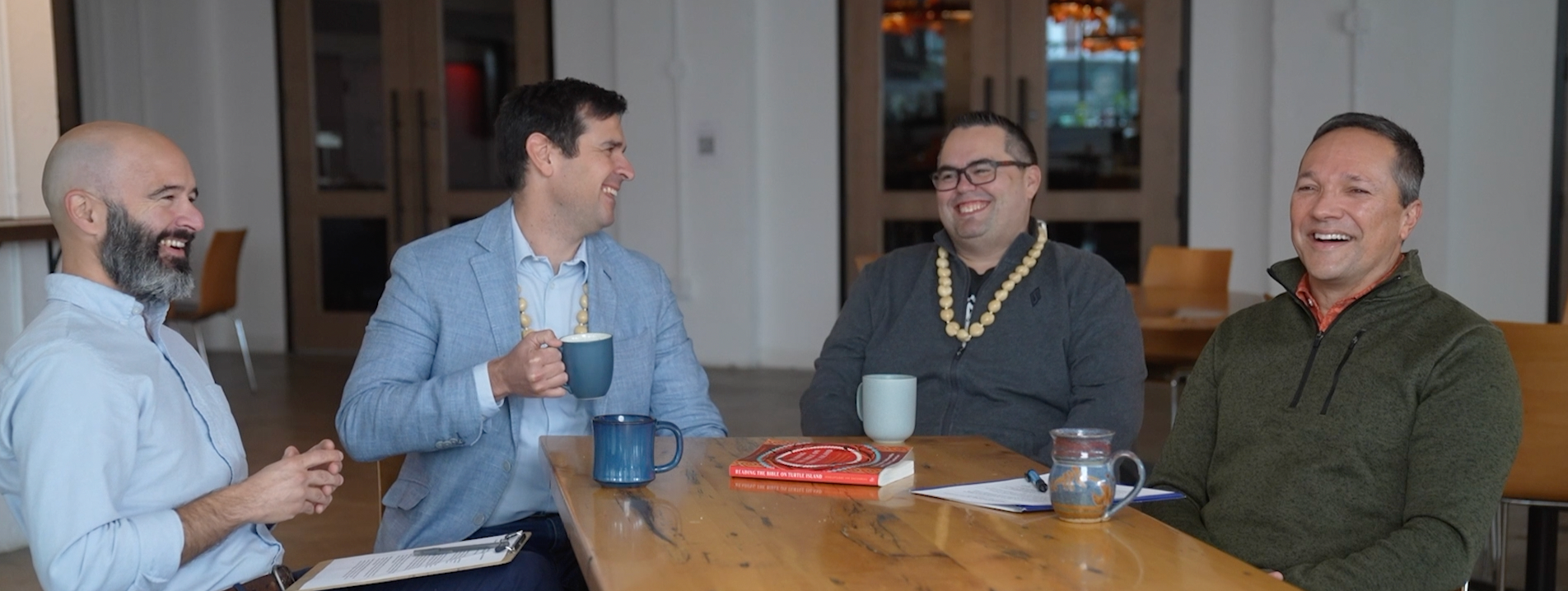
Tim Mackie: The Bible as BOTH God’s word and human words
Tim Mackie: How is the Bible God’s Word and Human Words — At the Same Time?
-
AI generated transcript
speaker-0 (00:00)one many interesting places. ⁓ I didn't set out, ⁓ well when I was a teenager I didn't really mean to set out and do anything except skateboard and hang out with my friends. ⁓ That's mainly what I did in my teens. ⁓ But there was an outreach ministry to skateboarders in East Portland, Portland Oregon where I grew up, they are, was sponsored by a church
started by a professional skateboarder who followed Jesus and he was about Jesus. He loved skateboarding and he was really good. And he was a Bible nerd. Like he just really cared about scripture. It was a really key part of his life. And so over the years that he had a big impact on me and some of the other skateboarders who ran the park. I just became compelled. There's a whole other long story.
about how and why I was compelled to become a follower of Jesus. And so when I did, it was just this really beautiful community based on sharing and living the good news of Jesus out in our skateboard community in Portland. And ⁓ there was a Bible college across the street from the skateboard park. And so the guy who started the ministry asked me to teach a Bible study to junior high skateboarders.
And I was like, I don't know anything. My family grew up going to church. ⁓ But for lots of different reasons, they didn't push the Bible on me at all growing up. And so I'd never read it. ⁓ So I went across the street, literally went across the street with three friends, and we signed up for classes.
speaker-1 (01:49)
Hey, Scott here. If you're enjoying this video, you can like and subscribe to Theology Lab's channel below, and you'll see our latest releases and what's happening at Theology Lab right now.
speaker-0 (01:58)
and I was just introduced in my first classes, in my first season of reading the Bible as a new follower Jesus to the Bible as ancient Jewish literature that is beautiful, that's profound in its historical context and its literary sophistication and the way themes and literary artistry and Jesus and the apostles constantly drew back upon the Hebrew Bible. Like this is all like my
first classes learning about what the Bible is. And it was so positive and amazing and beautiful. And my friends and I would find ways to translate all of that, those ideas to like our peers and these skateboarders at the park. So when I came to the end of that, I ended up majoring biblical languages as an undergrad. And when I got to the end of that, I began to
hear about things called like the Dead Sea Scrolls or the old Greek translation of the Hebrew Bible called the Septuagint. And I became really interested in the origins story of the Bible, like the material historical origins of the Bible. And I had a zillion questions as I was finishing. And so I didn't know what else to do with my life. So I went to seminary to pursue those questions. And then I ended up moving to Wisconsin.
entering a PhD program in a Jewish studies department, which was really cool because it was cross-listed between Jewish studies and language and it drew Jewish and Christian students. So it was a kind of a multicultural, multi-faith environment to engage in serious historical biblical studies and I loved every minute of it and I thought it was so cool. But I was also really deeply connected to the church we were part of, just teaching
⁓ Bible classes at our church. And there you go. Somehow it turned in
to becoming a pastor. And then I had a friend who I met at the skateboard park all those years ago. ⁓ My friend John, who while I was off going to school and getting in ⁓ debt for going to graduate school, he actually got a job out of college ⁓ doing editing ⁓ on films and documentaries. And he kind of built this skill set for how to make short animated explainer videos. And he started a company that did that.
And then when I moved back to Portland after finishing grad school, I was an adjunct professor teaching Bible at a seminary here in town and a pastor teaching the Bible at a church. And then he approached me with this idea of teaching through animated explainer videos. And he had an animation studio. And so we began to meet weekly and plot out, like, if we could introduce somebody to the Bible and its big ideas.
through these videos, what would we do? And there you go. So that became what is the Bible Project, which was a ⁓ project we launched almost 10 years ago now. And that's been the ride of a lifetime. So the main theme is I'm really interested in the Bible. And ⁓ I don't have Bible baggage from when I was a kid. ⁓ It's just been one curiosity journey.
speaker-1 (05:17)
Mm.
speaker-0 (05:31)
⁓ after the next and just pure joy to get to discover and share with other people what I'm learning. So I know that's not everybody's and fact that's not most people that I meet's journey with the Bible. Usually it's a lot more complicated ⁓ and runs the whole spectrum from positive to negative but that has been that's been my journey.
speaker-1 (05:54)
Yeah. Yeah. Well, that shows in a really interesting way. Like folks, no one's born a Bible scholar, right? And over a lifetime, you become one and a lot of work. ⁓ So looking at the kind of ways of reading the Bible, some of the things that are at the core of what the Bible project is about, you offer this paradigm series as a podcast a couple of years ago, and it gets it kind of this.
core way of trying to read the Bible, understanding what's at the heart of the biblical text. Before we go into that, can you just kind of tell us, like, what do you mean even just by the word paradigm? You know, what is a paradigm and why is it important to know what a paradigm is for reading scripture?
speaker-0 (06:36)
Yes, paradigm is definitely a fancy word I learned at graduate school somewhere along the way. So it's a word that refers to the framework of ideas that we take for granted in how we engage and live and talk and think about the world so that they're actually the thing ideas that we usually don't think about, we think through them, kind of like glasses.
Ideally, after the first few days of having on new glasses, you just are looking through them, not at them anymore. Especially when you get new frames and then it's kind of like a new way of seeing the world. So paradigm is kind of like that. ⁓ And there can be paradigms. There are. We all are thinking through paradigms for all kinds of things. ⁓ And so ⁓ it's a way of talking about our unconscious assumptions that we operate with when we do something.
So for the Bible, ⁓ what I have noticed and has been my own experience through time is ⁓ anytime I learn something new that's either in the Bible or about the Bible that I haven't encountered before, I have to take it on board. And sometimes it's just a natural implication of something I already thought. It's just way cooler or a little more complicated. But sometimes you learn things about the Bible or in the Bible and you're like, what?
Like, I don't have a category for that. I've never heard anyone in my experience talk about that. Is that true? And if that is true, I need to rethink a whole bunch of things. And so ⁓ the paradigm series was an effort to say, what if we could recover as best as we can ⁓ the paradigm, where the assumptions that Jesus himself had and that the apostles had and that
⁓ Israelites of the second temple period ⁓ who actually wrote and shaped the biblical collection in this form that we have it. Like what were their assumptions about these texts? And especially Jesus because the only reason I read ancient Israelite texts for my job now is because I follow the Jewish Messiah. ⁓ And that's why. And so I think I really am invested in what Jesus
thought, what his paradigm was about the scriptures. And if I want to be like him and be a part of what he's doing in the world, I want to share his set of assumptions. And then that leads to the interesting question of, ⁓ well, the assumptions I have about the Bible, where did those come from? And how do they match up with what I can see Jesus's assumptions about the Bible might be? And then that, there you go. That's the whole interesting conversation that we're going to kind of have at least some of this evening.
speaker-1 (09:32)
I wonder if you could give us ⁓ just like maybe an example of a time where you were studying the Bible and you felt that there was a paradigm, a shift or change going on while you were reading it. Is there anything, has there been anything like that?
speaker-0 (09:47)
Yes, yeah, many things. ⁓ Yeah, some of them pleasant, some of them surprises, sometimes unpleasant in terms of like, well, that makes me feel uncomfortable. It challenges what I thought and I need to first of all see if it's true and then figure out how to take that on board. So I mentioned that when I was finishing college and I began to really dive into the material origins of the Bible,
⁓ Really the particular issue was about the manuscript history of the Bible, ⁓ which is the New Testament as a collection has a different manuscript history from the Hebrew Bible or what Christians call the Old Testament. And particularly for the Hebrew Bible in the period before Jesus, ⁓ the textual state of the books
manuscripts of the Hebrew Bible was much more fluid than I had been led to believe in my early years of following Jesus. ⁓ So the manuscripts of biblical books were a lot more fluid. There are a lot more variants and differences between them than is often popularized in apologetics, especially Christian apologetics. And ⁓ I had, I realized ⁓ an assumption about the Bible that
what it meant for it to be breezed by God was that for the biblical authors, their conscious minds were somehow bypassed, where they became like tools or pens of the Holy Spirit. And they just wrote down a biblical book, you know, and there it was. And then it just gets passed on, you know, verbatim or faithfully without any changes. And if there are any changes, it's just minor little differences, you know, and so on. But that's not actually what the
material evidence shows, it shows something a lot more beautiful, but a lot more complicated than that. ⁓ And so that was one of them, having to account for the very human historical processes that we can trace. So I ended up doing my dissertation. This is so nerdy, you guys. So I did my dissertation on the manuscript history of the book of the prophet Ezekiel. ⁓ And if you compare the medieval Hebrew manuscripts to the Dead Sea Scrolls,
other Hebrew manuscripts that precede ⁓ our main medieval body manuscripts, about a thousand year difference. And then there is a number of Greek translations that were made from the Hebrew Bible into Greek in the second temple period, a couple hundred years before Jesus was born. So we have three bodies of evidence that are distant in time and place and social group for Ezekiel. And when you compare them, there are significant differences between them. And so I wanted to understand
Why did those differences arise? What do they mean? And what I discovered, I mean, I'm turn on to a lecture on my dissertation, which is true if you ask any PhD student, that's what almost any topic turns into, right? But what I found was that the manuscript differences weren't random. The majority of them were efforts made by scribes who were themselves students of the whole collection of the Hebrew Bible.
And what the scribes were trying to do often by introducing a word or a phrase is either clarify something ambiguous, but instead of writing a separate commentary, they just wove the clarifying comments into the text itself, or even cooler. ⁓ Like if you look on a web page and you see words glowing in blue, typically that's a sign for a link, like a hyperlink that you click on, it goes to another web page.
And so biblical scribes, as they were arranging the final shape of the collection of the Bible, often did that. They would add a phrase in Ezekiel, but that actually comes from Leviticus or comes from Jeremiah because those two passages are connected in terms of ideas in a really important way. And it was their way of signaling, like cross-referencing, different scrolls in the biblical collection. So in other words, the differences weren't meaningless and they weren't ⁓
like malicious distortions, they actually served as guides for the reader of the whole collection. So that, but that challenge my paradigm because I had now to account for people ⁓ who, and then what did it mean to say that these texts are inspired if there's a history of a lot of different kinds of people who are involved in their origins and so on. So that's an example, but it really forced me to rethink what do I mean when I say the Bible
is God's word, but it's also a human word at the same time.
speaker-1 (14:44)
Well,
that's exactly where I want us to go. think there's, mean, here, you're having, this is a lecture on your dissertation. We can show how relevant it is going to be in just the sense that like, okay, ⁓ the Bible didn't turn out to be in some way what you thought it to be beforehand. But what's really interesting about this, mean, what I find really interesting is that, your faith does not come down crashing. And I think it's a great way to get us into like, I think it's the first, you called the first pillar of this paradigm, the Bible is divine and human literature. ⁓
Tell us, like, how does something like that, the Bible as divine and human, ⁓ play into this story or how you understand the Bible?
speaker-0 (15:23)
Yeah, well, it's interesting. it's it's challenged my paradigm for what it means for the origins of the Bible. But it's also been at least a growing insight and conviction for me that the biblical story itself is trying to explore for us the mystery of God's activity in the world and his action in the world in and through
human partners. So it's both about where the Bible comes from, but also what the Bible is about, is about the mystery of divine human inter-relationships. So what is interesting is if you look at clues or statements about the writing of biblical books in the Bible, and there's actually quite a lot of them, little moments where there'll be a story or a moment that'll make explicit
Like how the part of the Bible you're reading came into existence. Moses writes something down, Jeremiah or Ezekiel, that kind of thing. ⁓ And what you find are people having experiences where they are described as being fully in their right mind. They're like not under possession. There are moments where people, minds are, as it were, overwhelmed by the presence of God and where they become like a mouthpiece for God.
This happens to numerous biblical prophets, ⁓ but what's interesting is none of those stories ever mention writing. They're about the prophets having their experiences, ⁓ and if mentions of writing is made, it's always much later or apart from those experiences, which means that for the biblical authors, it's not scandalous to them that ⁓ Moses wrote down the first time Moses is mentioned as writing.
right after ⁓ they just barely escaped alive by a fight they had with the Amalekites in the wilderness. ⁓ And then Moses writes it down to be remembered in Exodus chapter 17. And there's no like vision, there's no glory cloud that takes over him. It's just like, man, God saved us today. We need to never forget this. And so he writes it down. So ⁓ for the biblical authors, they have a more sophisticated way
of thinking about God's action in the world, that it's not separate from human action, that one of the primary ways that God does work in the world is through people and through human agency. And that shades into then what the biblical story is about, which is the fundamental premise of the biblical story, is about how God provides this well-ordered world full of potential and beauty
And then the culmination is God installs images of God to represent God's rule and wisdom and presence in the world so that God's rule takes place in the world through humans ruling. And the whole thing is about a divine human partnership. Of course, it goes wrong and humans end up being pretty unfaithful partners. ⁓ But then the culmination of the story, if you're a Christian,
is ⁓ not about again God acting independently of humans. It's about God binding himself even more tightly to the human story by becoming the human that we are all made to be but we failed to be. ⁓ And so in a way the incarnation of Jesus as divine and human is really tightly connected to the origin of the Bible as divine and human and it was really important to the first few centuries
of early church leaders ⁓ to clarify that the humanity and the deity of Jesus are not mutually exclusive. They're distinct, but they implicate each other and you can't pull them apart. You can't say, that was like the God part that did that. And then that was the human part that did that. They're fully bound up. And for me, that
has become a helpful way to think about the Bible itself. I met a lot of people in graduate school and then in church ministry throughout the years where they would find out about the complex manuscript history of the Bible. They would take a class like introduction to ⁓ biblical literature and they find out about the complex human history of the Bible and it would just scandalize them or their whole faith would fall apart. And I at first I was so fascinated with that because that's not what happened for me.
⁓ And as I began to pull, usually what I began to discern is that the person in question had an assumption that if God is active in the world, it's independent or has to be exclusive of human agency. And therefore the Bible, we have to prove that the Bible came into being in this miraculous way that can't be explained by normal human beings or processes.
And that and a lot of apologetics energy goes into making that kind of case about the origins of the Bible. And I think I just want to step back and say, but why do we feel like we need to provide that kind of the Bible is remarkable. But I think the way that it is remarkable is maybe even more sophisticated than our assumptions might might lead us to. So that's kind of a first pass at that question. There's more to explore, of course.
speaker-1 (21:02)
I have to say, I just love the way you can talk about this, you know, like the multi-layered origins of the Bible and then see this as like a way that can draw us into the text itself, ⁓ that it's actually like a sophisticated understanding of how God works ⁓ instead of it just like being scandalous or leading to just like the end of one's faith. ⁓ This can actually be
Invitational. I'm curious to if there's any part of like ⁓ of this that has drawn is that it's changed the way that you see like the task of studying the Bible. I let me try to clarify that question a little bit, but just seeing like how. Involved. We as people, you know, as people are in the formation of the Bible itself and the way that God speaks, I think in the paradigm series, you say that the only time that.
God works in the world apart from some medium in creation is Genesis one. Every other time God's working most often with people like us. Is this like when you're studying the Bible, has it changed how you relate to God and think about how you might experience God in the work of studying the Bible?
speaker-0 (22:20)
Yeah, they have that. That's right. The comment you're referring to ⁓ is that of all the times God's spirit is mentioned, God's spirit is one of the main ⁓ words the biblical authors use when they want to talk about the direct presence of God within creation, but in a way that it's not like you can identify God as a thing somewhere, but rather it's a pervasive presence under everything.
but it's a personal presence. And God's the spirit, which is the Hebrew word ruach, which means breath or wind or personal presence. And apart from before humans entered the story on days one through five of creation, ⁓ every time God's spirit is mentioned throughout the rest of the Bible, it's always in connection with a human who is acting under the prompting guidance, influence of that presence.
The way God acts in the world is through humans acting in the world. Those aren't different. So has it affected how, mean, yes, ⁓ I was a loser when I was a teenage skateboarder. had no, I had really not truly not a lot going for me. And ⁓ it was really my discipleship to Jesus that woke me up to ⁓ the existence of other people.
as being as important as myself. I know that sounds silly, you know, was a teenage boy. It's been the Bible that has led me on a journey of intellectual growth, but also, Lord willing, you have to ask my wife, I suppose, of personal and character growth. Like all of it has been led ⁓ by my discipleship to Jesus through just reading and studying and learning.
scripture a lot, especially on this point, ⁓ that the way God is acting in my own life isn't independent of my own ⁓ action and choices and will and desires. it could be like this, there's so many hard places where this is perfectly obvious in the Bible, like maybe I just didn't have eyes to see it because it's not where I was at in life, you know, in my first, you know,
30 years. But now it's so clear to me that Bible really isn't about anything else except about the mystery of God and creation and God and humans and the way God is present in the world. So it's transformed everything for me. ⁓ But it's hard for me. It's a paradigm now. So it's hard for me to think about it because it's more something that I think through. But that's a slow
slow process for most of us.
speaker-1 (25:17)
I think that there's just something really compelling and really good to see in the way that you navigate these, the way that you and your team at the Bible Project show that, there's this complexity to the Bible, but it's actually this invitation. And we might see God working in new ways, having our assumptions changed, but maybe our faith strengthened at the same time. Because a lot of folks are asking big questions around this, and I think it's a really good testimony.
speaker-0 (25:42)
Well,
just one quick thought on that. As the years have gone by, I think I'm able to see that when I hit questions or issues that bother me that are raised by the Bible, there was a season where I saw them as problems. Like that's a problem in my way that I need to solve so that I can have like a coherent view of reality. And I've really come to reframe that.
see that every time I hit what I feel like is one of those roadblocks, that I should equally assume that the problem is some deficiency in how I live in the world or how I see the world, and that what I'm encountering is reality, and that it's a chance for the metamorphosis, the growth and transformation of my mind. And that has just tended to be my experience, but that doesn't mean that it happens quickly.
And I still have many unresolved questions raised by the story of the Bible. And I'm just moving towards them as I can. But I also know that I'm a finite human. And there are going to be lots of things that I still am wondering about when I meet Jesus. And we'll have a lot to talk about. And I can't wait for that.
speaker-1 (27:07)
⁓ so we won't be able to get to all the pillars of the paradigm here, but I do want to make sure we touch on some of the, think some, you know, some ones that get brought up a lot, in Bible project things. And, so the second and third pillars. Talk about the Bible as a unified story. the third one talks about the Bible is Messianic literature. ⁓ these are super important.
to the Bible project's understanding of scripture and how it approaches scripture, right? The tagline of the Bible as a unified story that leads to Jesus. ⁓ Can you just kind of give us like a broad view of why is understanding the Bible as a story, as a unified story that points to Jesus ⁓ so important or so helpful for reading the Bible?
speaker-0 (27:55)
Yeah, well, ⁓ one simple way to respond is ⁓ what we think something is and what we think something is for. Well, even before we come to it, we'll predetermine how we use it, what the experience is like. ⁓ My boys love to use my tools. I have two little boys actually now they're in
preteen phase, they're not so little. But when they were very little, they loved to use my tools. And I'll never forget the day I went out and found my four year old son at that time, using my hammer as a pickaxe, like the claw of the hammer. So not the pounding part, but the claw. And he would dig deep holes with it and leave it in the mud and it got very rusty. But now I can't part with it because it's attached to that memory. ⁓
He had the right intuition that this is a tool. ⁓ But he didn't fully understand what it was for. And it was kind of like a double problem then, because not only did he not get to experience the benefit of what this thing is made to do, so he misses out on that, but then he's using it for something it wasn't quite designed to do that way. And you can make it do that. You can make it as a pickaxe, but it doesn't function very well. So ⁓ in my...
⁓ experience, ⁓ what many, the habits that many people develop in relationship to the Bible is based on a good intuition but poor execution or poor method. ⁓ And for lots of different reasons, ⁓ in some parts of the Christian tradition, especially ⁓ in the modern West, a set of mental habits has become attached to how we think about the Bible as like a reference book. ⁓
whether and whether that's like a theology encyclopedia. So because what I'm really after is like doctrine or a philosophy or a worldview and where are the parts of the Bible or the sentences the chapters and verses in the Bible that answer this question or that make this point that supports this doctrine or this ⁓ idea. And then we that's how many people learn the Bible is as a handbook of doctrine. ⁓ And that's fine actually.
It's actually really important to provide clarity about the ideas that are being set forth in the Bible, but that's a very different experience than actually reading the literature from beginning to end the way that it's designed to. ⁓ And so when you actually read it the way it's designed, like the way the hammer is designed to be used, you'll notice that the first words of the whole thing are in the beginning.
The second, the last paragraph of the last book of the Christian Bible in the Revelation ends with, and they reigned forever and ever. And just even on that level, you're just like, I'm pretty sure that that's how big epic stories work. In the beginning, forever and ever. ⁓ And in between is a whole lot, a huge cast of characters, but a unified story. And so what I find is that when people's primary relationship to the Bible is,
as a reference book. ⁓ They just go to parts of it and they don't sit down and take it in in big chunks or see any little part in light of where it comes in the bigger story. ⁓ That's where this the complicated often sad history of misuse or abuse of the Bible tends to come from people with a reference book paradigm. And what I what I find is that when you see
where certain parts of the Bible, where things that God says to people, and you see them in the context of that time, or where it comes in the story, ⁓ it helps you understand both how to understand those parts of the Bible, how they can function as God's word for me, but also to recognize, like I'm not an ancient Israelite standing at the foot of Mount Sinai, and so the hundreds of commands that God gave to Israel and the Torah,
I have a different relationship to those commands than the people in the story itself. But yet that is still part of God's word for me, is to hear God speaking to those people at that moment in the story. There's wisdom for me there, but it's not the kind of wisdom like, well, God told me to do it because it's a command in the Bible. So narrative context. So that's one piece. think the other piece is of such a unified story. But the messianic part is that Jesus claimed
that the whole story of why God called the people of ancient Israel the vocation and partnership that God entered into with them, why it ended in such a disaster, ⁓ and then why God chose not to abandon those covenant partners, even in the midst of that disaster, led to a lot of suffering. Jesus said he was bringing that
story to and carrying it. I want to understand who Jesus is and care about him. I should at least care about what he thought was important to understand him and that means understanding the story that he thought he was he was carrying forward. So that kind of speaks in a very brief way to the unified ⁓ and messianic parts and I found that just those simple ideas they'll have huge implications for how you read and take in different
different parts of the Bible.
speaker-1 (33:49)
So I think that this ⁓ this idea of a unified story, it's like this huge appeal to folks wanting to get into the Bible project material. I'd say it's done like wonders for my own understanding of the Bible. A lot of us, a lot of the folks kind of here in this audience ⁓ were shaped to love the Bible as devotional literature. And I wonder if you have given any thought to how those two can be.
like increasingly connected, right? Like how reading for this larger picture and view can be part of a devotional reading of the Bible.
speaker-0 (34:25)
Mm-hmm. Yes. Yeah, that's super important. ⁓ Yeah, I have thought a lot about it. Because in a way, it is the way of engaging scripture that scripture is inviting us into. ⁓ So these, especially the Hebrew Bible, which is the first three quarters of a Christian Bible, and then especially the Gospels and Acts, which is like half of the New Testament. ⁓
These were all written in a particular mode and style of ancient Israelite literature that's super different than how we think about narrative and poetry ⁓ and take it in today. So we're talking about a family history, traditional literature that was ⁓ designed for a lifetime of reading and rereading in personal and communal settings.
⁓ and it's a literature that is intentionally designed not to be clear on the first reading or even the 50th reading. ⁓ There are puzzles and riddles packed into parts of the Bible that are intentional and on purpose. They're often the parts that we'd stumble over and get scandalized by and think that there's a problem with the Bible when in fact oftentimes they're there on purpose.
and it's putting some puzzle in front of you that you're going to have to keep reading because later on in the collection there'll be a whole bunch of things that happened or that are said that are going to like back-illuminate those earlier parts which means that you're invited once you learn something new it's like you got to start all over again and then read it through and you realize you've been guided along every step of the way by the sage master who's trying not to teach you information but is trying to
form you, formation as you read. ⁓ in a way, what Christians I think typically mean by devotional reading is a moment where they hear these words as God's words speaking directly to me. And that is ancient. It's a way of reading these texts that's baked in to what they are for. ⁓ There's actually a poem. It's sort of like a meta poem.
poem in the Bible about what it means to be an ideal reader of the biblical collection that we call Psalm 1. It's the first poem in the Psalm scroll and it depicts somebody who's really devoted themselves to a life of virtue and goodness, telling you about especially the types of people that they don't associate with. And then what it describes as someone whose delight, like their actual joy and delight,
is to sit and learn the wisdom of God revealed in scripture. And the word used for it isn't just read, ⁓ it's the Hebrew word haggah, which gets translated often to meditate in English. ⁓ But it's a fascinating word. It's used elsewhere of dove, the sound that doves make when they coo. ⁓ It's used one time in Isaiah of a bear.
like moaning as it has captured its prey and it's like, we would say growling, think, something like that. ⁓ But what it refers to is a quiet muttering or reading aloud or recitation. So the ideal reader of scripture is somebody who quietly over a lifetime.
personally and communally is reading scripture aloud, precisely to hear God give them wisdom and to teach them. And so that can happen in different modes. ⁓ That can happen in the form of reading and like tracking with what's happening in the story and the ideas in it. It can also be where, especially with the book of Psalms, which is human prayers to God that have become God's words to people, which that itself is a great example of the divine and human.
come in together. People's words to God become God's words to people. ⁓ there's 150 prayers there ⁓ that from their origin and throughout history have been like a training school of what it means to pray as people adopt these words into their own prayers. So devotional reading of the Bible is actually woven. It's not really separate from studying the Bible. I don't think Jesus would have understood the difference.
For him, it's just meditating on scripture. And you might do it as you pray. You might do it as you are reading and understanding and asking God for insight. really what it is, is it's about four, these scriptures are made to form us. And whether we do it devotionally or through study, it's just kind of two different modes with hopefully the same outcome.
speaker-1 (39:35)
Yeah, I really appreciate that, Tim. I I wonder if you could actually say one more word, this big question for me, and then we'll go to the Q &A from our live audience here ⁓ about the Bible as meditation literature. I think when I'm listening to the Bible project, there's a way that there are connections made within the text itself that I haven't seen done since I was a graduate student and reading the text, the reading the Bible.
Frequently with Jewish friends who were just steeped in the Bible like it was just it was just part of who they were and I The way you talk about meditation literature, I see resonances to that So can you kind of just tell us give us a sense of what meditation literature is and how you might sell folks on? Looking to read the Bible that way
speaker-0 (40:29)
Yeah, well, ⁓ in a way, everything I said in previous response is the definition. It's a type of literature that's very dense. It's not made to be clear on the first reading. It's like reading a riddle or a puzzle. ⁓ And the reader is guided along a journey so that certain things are withheld from you so that you won't understand them on purpose. ⁓ But
precisely so that it will raise a question that will be illuminated as the story develops. And the way biblical authors do this is by cycling. ⁓ So there's a basic set of story themes and cycles that resolve through the same repeated words in the first 11 pages or so, what we call Genesis 1 through 11. There's actually three cycles.
⁓ that go through God giving someone this amazing blessing, creation, ⁓ a choice being set in front of God's human partner. They have a wrestle match of a choice with their desires and trying to discern good and bad. And whatever the test results, good or bad, they succeed or fail, resulting usually in escalation of goodness or escalation of badness that results in either people getting along and making peace and more abundance.
or a fracturing, an intensification of fracturing of relationships leading to outbreaks of violence. And then God has to get involved and start the cycle over again. So I just described Genesis one through five right there. And then it happens again in Genesis six through nine, and then it happens again in Genesis nine through 11. And then once that happens, it's sort of like going to a symphony where the opening minutes of the symphony are teaching you the core melody.
So it was just holiday season. we go every, we have some dear friends, their daughters are in the Nutcracker every year, the ballet. And so we go as a family to support our friends and see their daughters. This is year three or four, whatever. And so there are certain ⁓ melodies that appear in the beginning and then that reappear at key moments throughout. And so the biblical authors do the same thing. They just do it through the repetition of words and ideas.
And so what often happens is you'll be reading a story about Abraham or about Moses or Esther or David or Ruth. those stories have been designed with the same words and ideas echoing all the cycles that have come. ⁓ And so when stories have matching cycles that way, ⁓ I came to use a shorthand ⁓ that I
I mentioned earlier from web pages called hyperlinks, the way you can click between web pages that are related. And it's sort of like the moment of David and Bathsheba, the moment of Ruth and Boaz at the threshing floor, the moment of Rahab and the spies, the moment of Moses being found by the waters and Adam and Eve at the tree. Those are all hyperlinked through the same vocabulary and words. And that's the biblical authors doing that. Like I'm not making this up.
And so the biblical authors are wanting us to see that throughout history.
all these different people are really having the same basic human experience and that human nature really isn't that innovative and none of us are very different from each other than we think. ⁓ And we're all struggling with the same basic, how do we know what's good and bad? Why do I keep making decisions that feel stupid and short-sighted and selfish even though I know I want to do the good thing? And why is it that when you scale our
poor decisions by millions and billions, it keeps leading to these catastrophes in human history where everything falls apart. And is there any way out of this? And like, this is what the Bible's about. And then when I stop and I think about that, I'm like, this is what my life is about. And this is what this is. is like this. The Bible is about reality. It's not about something other than what real life is. And it presents the story of Jesus as the wisdom of God become human.
to be and do for us what we can't seem to be able to do for ourselves. Sorry, I almost gave a little sermon, right? But like that's what it's about. But it's precisely the repeating cycles of the stories. And then it's about the way the gospel authors, Matthew, Mark, Luke, and John, the gospel authors want to portray Jesus as carrying forward the story of Israel. That's why there's so many creative links and words
used about Jesus that are taken from stories and poems in the Old Testament. But what the story of Jesus and Israel is about is about what God is doing in response to the human problem set up from the very beginning of the story. And in a way that's the type of unity that's displayed across the whole of the story. So that is just how traditional
Jewish communities are taught to read the Hebrew Bible. And whether or not it's somebody's Jewish and they recognize Jesus of Nazareth as Messiah, many do, many don't. But one thing they'll take for granted and share the same is that the Hebrew Bible is a sophisticated, unified collection of literature that works through these repetitions and cycles and lengths and so on.
speaker-1 (46:24)
Well, I think you can just you can even sense and see what the things you're saying here about the way that that opens up this this process of like ongoing discovery while reading the Bible in the sense of suspense within the story as it continues to go forward and point forward. That's like that's a that's a really appealing way to get into the Bible and understand it. Let me ⁓ go to some questions we have here from our audience. first one here is from someone who really appreciates your work at the Bible Project. And they're asking.
Are there any features ⁓ of Tim Mackey that inform your reading of the Bible, but that we just like, we don't get to see? You told us a little bit about ⁓ your background in skating and then ventures into academia and the church and how those things brought about a love for the Bible. ⁓ Are there any other things about you that inform what you do with the Bible Project?
speaker-0 (47:15)
Hmm, that's a good question. Well, my dad was a graphic designer in the automotive industry. So his whole career was and actually still is in retirement. He loves painting so much. He just has kept doing it in his home studio. So he hand painted like sweet graphic design flames on hot rods and cool cars and all that. And so I grew up
is a garage shop in the back you built out as a studio and there's always like race cars and hot rods and like really cool stuff. But as a kid, I just, you know, thought my dad was amazing and grew up around art. And then my mom was a loved music and sang a lot. And so our home was always filled with music. It's not like even they were just trying to be intentional, but I think they modeled
for me a way of being human that was primarily intuitive and creative. And so even though I went on a ⁓ deep dive in terms of brain intellectual focus, pretty cerebral in my path, for me it's never been separate. Part of what I loved about biblical literature was its artistic beauty. And so I think ⁓ I've come to see my parents' contribution to that.
in my young age was really, really significant.
speaker-1 (48:49)
But let me go to this question here. Tim, you mentioned that you didn't come ⁓ into a life of study of the origins of the Bible with Bible baggage. Can you give us some examples of Bible baggage that you would encourage people to reconsider?
speaker-0 (49:06)
So I'll just think of examples from people, friends that I've had. So I'm thinking of a friend who grew up in the Lutheran tradition. And this isn't about anything unique to the Lutheran tradition. That's just was my friend's context. But really involved with this church, his dad was a minister at the church. He was confirmed at age 13. But for him, as I got to know him,
The Bible represented the opposite of intellectual sophistication. ended up, for him, was associated with don't question, just believe it. And so when he began to have questions about the Bible, was so I was like, yeah, man, oh, there's like, is that your question? Here's two more that are even more interesting. But over time, what I noticed was that that deep association with him
is that if you believe this, you aren't living in reality. You can't take on board sophisticated, modern, whatever about reality. ⁓ You must be checking your brain at the door. And so the Bible, particularly ⁓ violence in the Bible that God participates in or keeps committed to
people in the Bible who act in really terrible, violent ways. He just couldn't do it. So he walked away from his faith because of the Bible. But my hunch is that it actually had at least as much to do with some of those really unconscious ideas that he had about the Bible ⁓ that prevented him from leaning in to those parts of the Bible that bothered him to see, like, is there something there that I need to be challenged on here?
So I think that's one example. Other ones would be people who grew up in environments where they were taken advantage of, ⁓ they were treated poorly, they were excluded in some way, and ⁓ people quoting from or appealing to the Bible to validate why they're going to do that to another person, whether it was done to them or they see that done to somebody else. ⁓
that can be another form of Bible baggage. so, I mean, I've had friends who had to go through many years of therapy before they could go back to like a church gathering again and hear somebody read from the Bible because it just triggered their body and their anxiety. So there's a whole range of Bible baggage. There can be some that's just a lot more benign than that. Over-familiarization and just
lead to apathy. ⁓ But most of us have some pre-existing relationship to the Bible that we are at various degrees aware of. And it really shapes how we approach and read, and it's always worth getting out and tinkering with, you know, what I think my assumptions are.
speaker-1 (52:22)
Tim, do you think that understanding, like giving story its proper place when we're reading the Bible can actually be healing when you think about biblical baggage? Like, can it help us to see what's the heart of the story, what we must take most seriously in engaging in all its complexity?
speaker-0 (52:39)
⁓ Yeah, that's a good way putting it. ⁓ My experience and teaching has been that ⁓ when people catch a glimpse of what the biblical story is actually about, ⁓ not what people want to do with it, but just what do the biblical authors, what are they trying to do and say on their terms and in their way, ⁓ that when people discover that,
and discover some tools for reading that they didn't have or that don't feel very intuitive to begin to track with how biblical authors develop and work their ideas. ⁓ My experience is that the Bible itself is a key component in people's healing process if spiritual trauma is a part of their story. And it's very counterintuitive because it's precisely the Bible that is a key element in many people's ⁓ spiritual trauma. ⁓
I think that in many cases, the best medicine is not no Bible. It's a more ⁓ responsible ⁓ way of reading the Bible that's informed by the best learning and the best scholarship that we have. And that's at least been my experience. ⁓ I mean, I can just think of remarkable experiences I've had in the classroom where
⁓ students who came in agnostic or atheist and they'll finish like a class on the Torah or the Pentateuch and they still are like have a lot of questions but one thing they are compelled of is that this is amazing ⁓ and I want the one thing I cannot to do with this Bible with the Bible anymore is dismiss it as primitive or ancient or just putty in people's hands of course people do all kinds of things with the Bible they're irresponsible but
There is a way to hear what the Biblical authors want to on their terms, and when you hear it, it's just really compelling.
speaker-1 (54:48)
Well, I think that would be a good note for us to end on. Tim Ecke, you've been a fantastic guest. Thanks so much for being with us.