
Reading the Bible on Turtle Island: Chris Hoklotubbe & Danny Zacharias
Theology Lab’s video podcast:
-
AI Generated:
Speaker 2 (00:00)We spent two and a half years traveling, meeting with indigenous practitioners, leaders and ministers, just listening to their stories of where they see biblical stories impacting and helping them think about their indigenous heritage and where they see their indigenous heritage and ceremony, helping them to think about the Bible in creative ways.
Speaker 1 (00:23)
We
need to recognize that we don't, we weren't starting chapter one when Columbus was lost and then arrived on the shores. There was already a story going on and we're entering into it, which we should understand as Christians because we've been grafted into a story of the Hebrew peoples.
Speaker 2 (00:41)
Like
Jacob, I wrestle with scripture and I may feel complicated relationships with how scripture has been used, but I stay in this match and sometimes I walk out a little bruised from these conversations, but I am in relationship.
Speaker 4 (00:57)
you
Welcome to Theology Lab. We're going to be having a conversation here on the book, Reading the Bible on Turtle Island with Chris Hakwatubi and Danny Zechariah. And I think we can get our conversation going here by maybe naming a little bit, just a brief introduction about ourselves and our ancestral history, which will be very important for this conversation. And I just want to acknowledge at the beginning of our interview that we're having this interview on the unceded land of the Massachusetts people. My ancestry is both settler and traces back to Scotland.
Speaker 2 (01:31)
How you doing Jim and Jigma? Chris Hucklatubbie here in Oklahoma. It's Hucklatubbie. I carry both pronunciations, California and Oklahoma. ⁓ I'm a member of the Choctaw Nation and also mixed settler with German and Jewish and ⁓ Spanish ancestry.
Speaker 1 (01:48)
I'm Danny Zacharias. I'm from Treaty 1 territory in Canada, Winnipeg, Manitoba, where my maternal ancestors resided for millennia. I also have ancestors in treaties 2, 3, and 5. My maternal heritage is the indigenous peoples of Manitoba, which is the Cree, the Anishinaabe, and the Métis. My father was a second-generation Austrian immigrant.
I now live in a quaint little town called Wilfil, Nova Scotia, which is in Mi'kmaq'i, the ancestral and unceded territory of the Mi'kmaq peoples.
Speaker 3 (02:24)
My name is Robert Bloodworth and I'm one of the pastors here on staff and I am honored to be representing here my father's ancestral lineage lineage that is from Delaware River and that is the Nanakope-Lenni-Lenape Consortium of Tribes that remained after the Trail of Tears. Gentlemen you have written an outstanding book here and it's very title is intriguing reading the Bible on Turtle Island.
And so for viewers and listeners ⁓ who may not be familiar with that reference of Turtle Island, could you briefly explain what that means?
Speaker 1 (03:00)
Yeah, so Turtle Island is a name that's existed far longer than North America. So Turtle Island is a reference to this continent by a number of different tribes. Not every single First Nation across Canada and the U.S. use that. We acknowledge that early on. It comes from a creation story that, again, is common across a couple of tribes that tells the story of Sky Woman falling from the heavens. The animals ⁓ catch her carrier down and place her on the back of a turtle.
I won't rehearse this whole story because you'll encounter it in the book. But basically the story talks about the creation of what is now this continent on the back of a turtle. And it shows the interaction between creation, between animals, between human beings. And so we chose that title intentionally to, right from the outset, kind of jar people to the fact that the place that you live, that we've, you
wherever you are, you use the modern city, the modern state, the modern country, the modern name for these places, but there's been names of these places that have existed for much longer. And so we wanted to remind people right at the outset, because it's going to be so important for our book and our discussion, is that where we live are storied places already. Stories and peoples have existed here for a long time. And so we need to remember that because we're very future focused. We're very present focused.
And sometimes we forget all of these things and yet all of that contributes to the story and the place that we are now.
Speaker 3 (04:33)
I'm curious though as well, what compelled you to write this book or what gap or need ⁓ were you seeking to address in writing it?
Speaker 2 (04:42)
Well, I know Danny would answer this by saying how much money the gap in need he has and the recognition of how quickly those two dollar royalties add up with each book.
Speaker 1 (04:56)
That's why anyone gets into Academias. That's why. And pastors too. Yeah, exactly.
Speaker 2 (05:02)
And the display and show notes. Yeah, that's all folks. Thank you. No, the real answer to that is we wrote a book one that we wish we had as undergraduates and grad students there are amazing works on the contributions to ⁓ How we read the Bible from African American Asian American ⁓ Latina Latina interpretations of the Bible
Speaker 4 (05:04)
There's a link to the book.
Speaker 2 (05:31)
but there's nothing really on indigenous interpretations of the Bible. There's a lot of indigenous theologies that explain indigenous spirituality to Christians, but none of them are spending that focus attention on the biblical texts and even getting behind the biblical texts from a historical critical perspective. So our unique contribution to this conversation is one that it's carrying stories and interpretations that come not only from the United States, but also include Canada.
And that also show almost two fronts. the contributions that indigenous people have made and can make to helping us read the Bible better. Because if you think about it, indigenous people are much more closely aligned in their life ways to ancient Hebrews and ancient Galileans than we are as 21st century Canadians, United States people. ⁓ So their life ways have been used and can be used to help us tell better stories of what life was like then and tell.
what's the texture, what's underneath these texts that's animating them. And also we want to provide examples of how we can be better preachers when we recognize that our ceremonies, our stories, and our life ways are assets to the theological imagination and telling better stories and more compelling stories where we see ourselves in of what life at its best looks like and where God's Spirit is moving in our communities.
Speaker 1 (06:57)
Chris and I have been on individual journeys within community of reclaiming our culture, and we did this in the midst of being biblical scholars, Christians, and so part of it was saying what kind of book would have been helpful for us 10, 15 years ago as we started to step into these things, and it was difficult to ask those questions, and fortunately we connected to good people to help us through that.
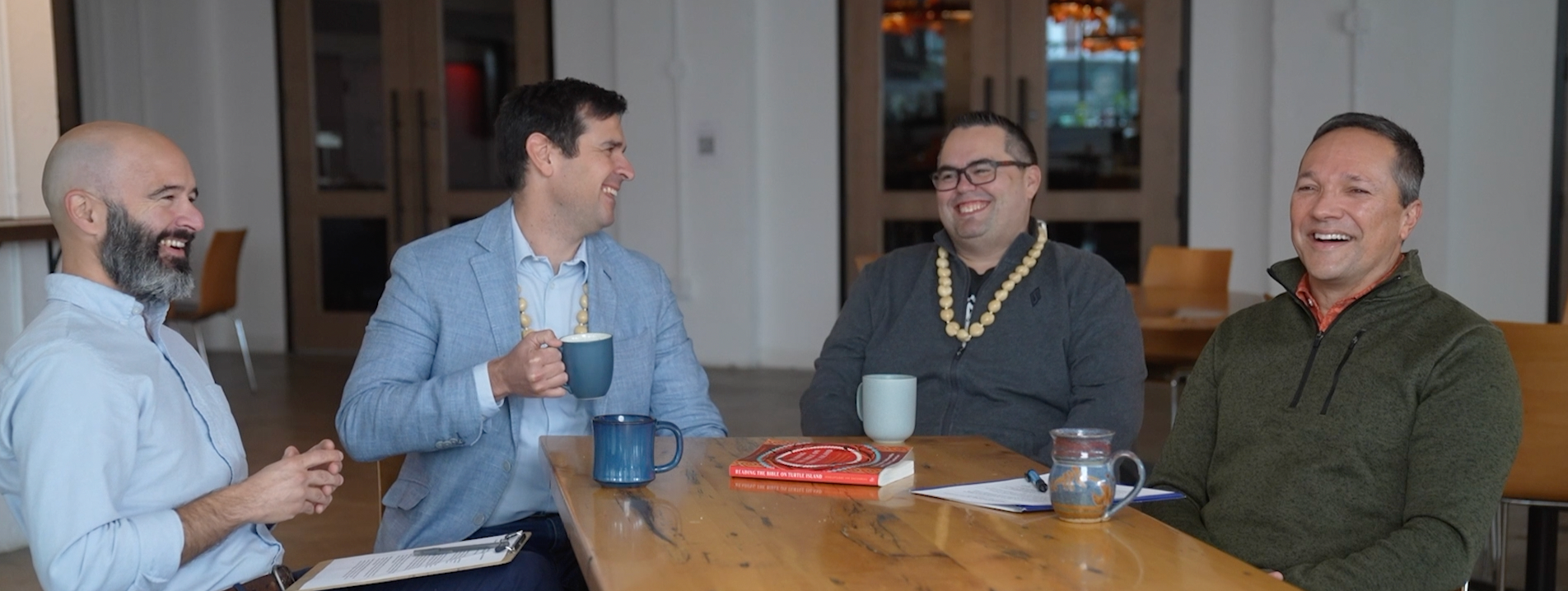
But we hope that this book will be a contribution to some of those upcoming generations of Indigenous people who are asking the same questions. What does it mean to be Indigenous follower of Jesus? ⁓ I wanted to point out, just because it's relevant, because we're thinking of next generation in a larger community that Chris and I are wearing this right now. And this was a gift from a student in the NAITES community in celebration of the book just yesterday. And so we wanted to wear it today. And it's a representation of the
upcoming generations that we're hoping to nurture.
Speaker 4 (07:59)
We'll be getting into questions around the Bible and how your book speaks to indigenous interpretation of the Bible in just a moment. Before we do that, can you say a word about all of the work that you did in traveling and the conversations you had that made this book possible?
Speaker 2 (08:06)
you
So we spent two and a half years traveling ⁓ as a result of a Louisville Institute grant, meeting with indigenous practitioners, leaders and ministers. were on farms, building teepees, sweating and sweat lodges, laughing over good meals and being on the lands of our friends and new friends, ⁓ just listening to their stories of where they see
biblical stories impacting and helping them think about their indigenous heritage and where they see their indigenous heritage and ceremony, helping them to think about the Bible in creative ways that expire them and excite them.
Speaker 1 (08:58)
Yeah, Chris primarily stayed in the States and was traveling across meeting with people. I was staying in Canada and meeting with people and not only was it kind of relationship building, ⁓ but it was the language that Chris often uses and I've adopted is we were just marinating in relationships and stories, ⁓ which really just helped to form how we think about things. It shaped our heart as we approached the project. I originally went into it
⁓ And I've confessed this a few times. I went into it I think wrong early on in that I was thinking okay, I'll kind of get just this raw data of information, right? I'll record our conversations. I'll ask the right questions and then like those will be the quotes for the book ⁓ And that was the wrong approach and I corrected along the way ⁓ because when you do that, it's it's very hollow and shallow the conversations ⁓
And Chris was a good example for me in that he just like ⁓ said, for stories instead of information. And so he did that very long. I pivoted to that so that we can, again, just sit with them, learn from them, hear their story, engage in those relationships.
Speaker 2 (10:03)
the shallow questions.
Speaker 1 (10:25)
It resulted in sometimes we're quoting those people, ⁓ but more than that, it just shaped us and in our approach to how we did the work.
Speaker 2 (10:34)
So I think that's really clear.
Speaker 4 (10:35)
I think
your biblical scholars and your own personal stories in the book are really really powerful and then you go out and you have all of these conversations and you can tell from the stories you tell ⁓ Much you listen in a meaningful way it adds such a weight to the book I'm gonna ask a high-level question here in the book you speak to how the Bible gets used to justify and in the theft of indigenous lands And yet this book is still about
ongoing nuanced engagement with the Bible. Can you tell me, given that history, the way that the Bible has been used against indigenous peoples, why you continue to go back to this book, Indigenous Christians.
Speaker 1 (11:23)
You know, indigenous peoples, the scriptures were weaponized against them and were used to justify the theft of land and were used to justify ⁓ the taking of children ⁓ for the civilization of indigenous peoples. So there is all this terrible history and it
does no good. The reflex often in church is to say, that was the past, when in fact it wasn't that far in the past, and it's still present for people. And even if it is in the past, it doesn't mean that we should ignore it. The past is in front of us as Indigenous peoples. ⁓ So there is all of that reality. And for me, ⁓ the other reality is that my maternal heritage, my Indigenous heritage, is also my Christian heritage.
⁓ that they were believers and are believers in Jesus. And so to step away from Christianity would also be stepping away from that heritage of faith that was my indigenous heritage. ⁓ The other reality is that I'm convinced by the life, death, teachings, resurrection of Christ. And so ⁓ in the midst of all that, I go back to the scripture. It doesn't mean that I
I'm always just an apologist for the Scriptures. ⁓ In fact, it's fun to complexify the narrative because we learn more about it and we engage more honestly with it. But we continue to go back to it because it's the sacred texts of Christianity. It was the texts that nurtured Jesus ⁓ and I'm adopted into his family and so it's going to be a text that I continue to wrestle with.
Speaker 2 (13:17)
Danny said everything I was going to I would also concur that the Bible has been used and weaponized against all people, not just indigenous people. And we've we've done it to ourselves across every culture. And ⁓ also, like Danny says, rather than. ⁓
pushing aside or thinking well we can never do that that's what other people do one of the things we invite people into is yes this could be us at any moment we could be the ones we could be babble on we could be the ones are harming people and so by telling the heart stories and hold me is close i think it's always important to have a check in our lives that curiosity and sometimes it's important to have multiple different kinds of friends around the table.
because they'll call you out on it when you're using the Bible in a not great way. So we hope that our book is one of the many friends along the table of church communities and individual readers as they are discerning what it looks like to walk in a good way with their neighbors. And like Danny, the Chahta people ⁓ are largely Christian. The church ⁓ was one of the major institutions
around which chaatas organized themselves post Trail of Tears. Now, lot of the missionaries had started schools with our chaatas people that we welcomed because we saw our affiliation with the church and working with ministers as a way to negotiate a settler situation. And it worked out well for us. Chaata and Cherokee used those educations to get law degrees and we became highly litigious and tried to fight back for our rights and our sovereignty.
And the church was very helpful for that. So like Danny, when we think about what is our ancestral faith, it is indigenous and it is also Presbyterian for my family. And to walk away from ⁓ my relationship with Jesus and the Christian tradition, which includes scripture, ⁓ holy scripture as ⁓ we might call it, the traditions of our ancestors that we've been adopted into is ⁓
is my calling as part of who I am. I just, I can't walk away from that. So like Jacob, I wrestle with scripture and I may feel complicated relationships with how scripture has been used, but I stay in this match and sometimes I walk out a little bruised from these conversations, but I am in a relationship.
Speaker 3 (15:54)
It's actually super helpful. So my family's, they have a ⁓ flag and the biggest symbol in the flag is the turtle. Obviously representing the land. But the second biggest symbol is the Christian cross there. So I'm curious as you write that long before the gospel arrived on these lands on Turtle Island.
⁓ Creator was already present with indigenous peoples and some guiding and revealing truth and we see that you've shared that already. So what does this mean for indigenous Christian identity today?
Speaker 1 (16:34)
Yes. Yeah, I mean, one thing to say, and this is important, as important for indigenous Christians as non-Indigenous, and perhaps even more for non-Indigenous, is that the story doesn't start when your ancestors arrive, right? You're entering into a story that's already been going on, which we should understand as Christians, because we've been grafted into a story of the Hebrew peoples.
Right? That's how Paul talks about us as Gentiles. Right? And so the same thing has happened here in that sense that there has already been a story going on in which the Creator has encountered peoples. And this would be true all over the world and true here, because that's where we're talking about. And so we need to recognize that we don't we weren't starting chapter one when Columbus was lost and then arrived on the shores. There was already a story going on and
we're entering into it. Now, because we don't tend to think that way, and that was intentional, you know, if you think back to ⁓ your school days, I certainly remember, you know, half a page on the indigenous peoples and then the rest on was on Columbus and the settlers. It's like, well, actually, that's not where the story started. And so as we think of ourselves as Christians now coming to a place like this,
⁓ to re-story it, to remember the stories that were here, ⁓ is to say, how can we come as learners, even as we're coming also to share good news, rather than saying, everything here was bad and we're starting a story for you. It has been so destructive because the result is you have to downplay, ⁓ in the harshest of terms, anything beyond the good news.
You know, our cultures were labeled as pagan, as demonic, as heathen, and all those things needed to be stripped away. So much so that in order to pass on Christianity to you, we need to take your kids right out of your homes and out of your communities and put them in these schools in order to Christianize, civilize them, right? It's that break with the past that was the goal of these places. ⁓
not how we ever see the gospel working in the scriptures. And so why was it done here? And look at the harm that has caused as a result.
Speaker 2 (19:07)
Many of the elders in our learning community of Nades often described ⁓ entering any evangelical spaces 25 years ago and having this sense that Jesus loves you, but he doesn't quite like you. And another one of our friends said in Bible study that, you know, if you asked her what God felt about her, how she felt about herself, she just felt like, I'm just a dirty Indian in this space.
And it's those stories are animating a lot of what we're doing in our book is to say that there is goodness and beauty and truth in our indigenous heritage that indigenous people didn't start thinking about. Well, what is good and what is beautiful? How do we live well with each other? How do we practice generosity? How do we practice honesty and form communities where there are checks and balances? ⁓ When Christianity came and if you think that
God only came to indigenous people when the settlers and the conquistadors came in. That's a really sad story because so much of that missionary introduction then is based on enslaved labor and taking away land and murder and smallpox and then Jesus, right? Like that doesn't sound very compelling as a story. And frankly, what we're trying to say about
the inclusion of indigenous culture into our Christian imagination is we're asking for the same openness that has been given to every dominant culture in which Christianity has come into. Christianity has never come into our world in a cultureless space. It's always been culture full. And we know this in the New Testament, it goes quickly from a Jewish culture to a Greek and Roman culture. And what we see in Paul's letters, Paul is quoting heavily from
Stoic sources and whether he's directly quoting or he's informed that he's informed by Hellenistic Jewish philosophy because In that marketplace to talk about ethics. It wasn't the religious traditions of his time ⁓ It was the philosophers and even when early monastic leaders are looking for Examples of how to frame Christian ethics and discipleship. They're going back to Cicero They're going back to the assets of their community and the wisdom of their
leaders to say, what is a Christian version? What is a more Christ shaped version? This look like, but how do we take the assets of this and continue on this pathway? So our hope is to invite and perhaps give permission to indigenous people to go back and look at the treasure trove of their traditions. ⁓ because I think at the heart of this is that we are emotional thinking people and
when we can emotionally, we mostly have bonded things that look like us. This is why it's so important for representation on screen and in books. ⁓ It just feels different when we see someone looking like us doing something and it validates in some way. We all do this, everyone does this. This is not just a racist thing or whatever, but ⁓ so to tell gospel stories that affirm
and incorporate the stories from our histories, it just sticks better. That's just how our brains are wired. ⁓ we see this with African-American and Asian-American, the fruits of what those readings have done for those communities. We hope that this generates more for our broad indigenous communities.
Speaker 1 (22:53)
It's especially true in the church. know, Chris used that language of permission. Obviously no one needs our permission to do anything, but when you're in spaces that either directly or indirectly have said for hundreds of years that your cultural heritage isn't something welcome in the church to have permission in book form or hearing it.
experiencing it, etc. is huge for people. It's what Chris and I ourselves experienced in our cultural reclamation is being invited to. And you can't underestimate ⁓ for some people how difficult that is of an internal battle, because again, it's something that has been, again, for on my side, you know, that same heritage, my Indigenous heritage was also my Christian heritage, which was also
the heritage telling us that that's what you leave behind when you become a Christian, instead of saying that's what Christ makes more beautiful when you become a Christian.
Speaker 3 (24:00)
⁓ How would you hope that non-indigenous Christians would understand indigenous faith in light of this? Maybe if you could speak just a little bit more specific to people who would be reading it from that, through that lens.
Speaker 2 (24:15)
Our hope is that when non-Indigenous readers are introduced to the beauty and goodness of lot of these traditions, that it will invite more curiosity and more openness. I think in my own evangelical upbringing, I was inculturated to see this world is constantly embattled of good versus evil and everything's black and white. And that everything that's not in my sphere of my church
is idolatrous and that does not invite any kind of curiosity of where God might be already active in the stories of others. And so if we can compel people to be a little bit more open and see how God is active in these cultures, I think that'll make a huge difference. And something our elder Richard Twist would say is, ⁓
You know, it's not that like all indigenous traditions are pure and right in their own right. there's no no tradition is pure. No tradition does not have, you know, has no skeletons in its closet. Right. Richard Twist would say, why do want me to trade in one since day culture for another? All our cultures constantly need to be interrogated and discern for what is.
Good, what produce the fruits of the spirits? So again, you know, it's not like, oh, well, because it's a native culture, you can't question it or culture trumps all. And yet though, I do want to open up that space of at least start with a lens of appreciative inquiry. Where do you see the good, the true and beautiful? Because when you ask those questions, it opens up the heart. We talk a lot about asset-based theology and asset-based approach to texts and...
people that we want to start with the good because that inspires relationships. And we'll eventually talk about the hard stories. And we do talk about hard stories. We talk about cultural genocide. We talk about the trail of tears. We talk about the removal of children from their families. But we do that in chapters five and six because we want four chapters to build relationship. And I think that's.
That's a model for how we should be living our lives that we don't always, we always go to the deficits and the challenge. So all that said, again, appreciative inquiry, I think is a model for building right relationships that we also hope settlers and non-Indigenous people take away as they encounter Indigenous neighbors, but also neighbors from other communities and cultures.
Speaker 1 (26:57)
There's a richness as we all know to the global church ⁓ and this is part of ⁓ us contributing to that global discussion. In the past, Indigenous peoples on Turtle Island, it was all mediated by the settlers, by the missionaries. And so, you know, when he talked about no culture is perfect, ⁓ we weren't allowed
to have those discussions internally to make those decisions, right? It was always people telling us what was good. It was almost always mostly bad, right? Adopt our way of being and doing and our language and all of that. And so it's a pushback against a bad missionary impulse that is part of our history.
and has infiltrated the church. The church still oftentimes feels like it needs to be the mediator of what's good and bad in people's culture. And so we want to say, give us the agency to do that.
First Nations people. And the other offshoot, and I think that's been successful from people we've talked to, not only is that we're bringing hopefully a gift and saying we hope that this is an asset for you perhaps in your journey, but also maybe it'll spark for settlers ⁓ the reality that they have a culture that maybe they haven't ⁓ digged into or haven't felt that they should.
because the Western ⁓ American perspective and it's heightened in the church is that again, none of that really matters. There's this Christian culture which ⁓ ends up looking just like American culture in the case of the States, right? And so how much richer would the church be too if settlers also were proud of their culture and heritage and brought that to their...
discipleship and how they follow Jesus.
-
A Theology Lab educational interview with the authors of Reading the Bible on Turtle Island: Invitation to North American Indigenous Interpretation, H. Daniel Zacharias and T. Christopher Hoklotubbe, looks at how to read the Bible in light of a Indigenous (Native American, First Peoples) lens. It also answers the question, what does Turtle Island mean? The interview touches on key topics like why continue to return to the Bible when it has been used against Indigenous people groups in many ways, the importance of ancestry, land, and specific rituals for an Indigenous Christian faith and reading of Scripture, and more. This is part 1 of the interview. Part 2 will look at Indigenous readings of the Bible and topics like dreams and vision (how might understanding dreams and vision, both today and in the biblical setting) connect to faith and reading Scripture, as well as focused readings that look how Indigenous Christians connect lived experiences (lifeways), both their own and their ancestors, with prominent themes in the Bible. As we see in this interview, an Indigenous reading of the Bible can open up insights and new depths of understanding for those who identify as Native American, First Peoples, and non-Indigenous readers of Scripture. ➡️ Scott is joined in this interview his colleague, Pastor Robert Bloodworth.