
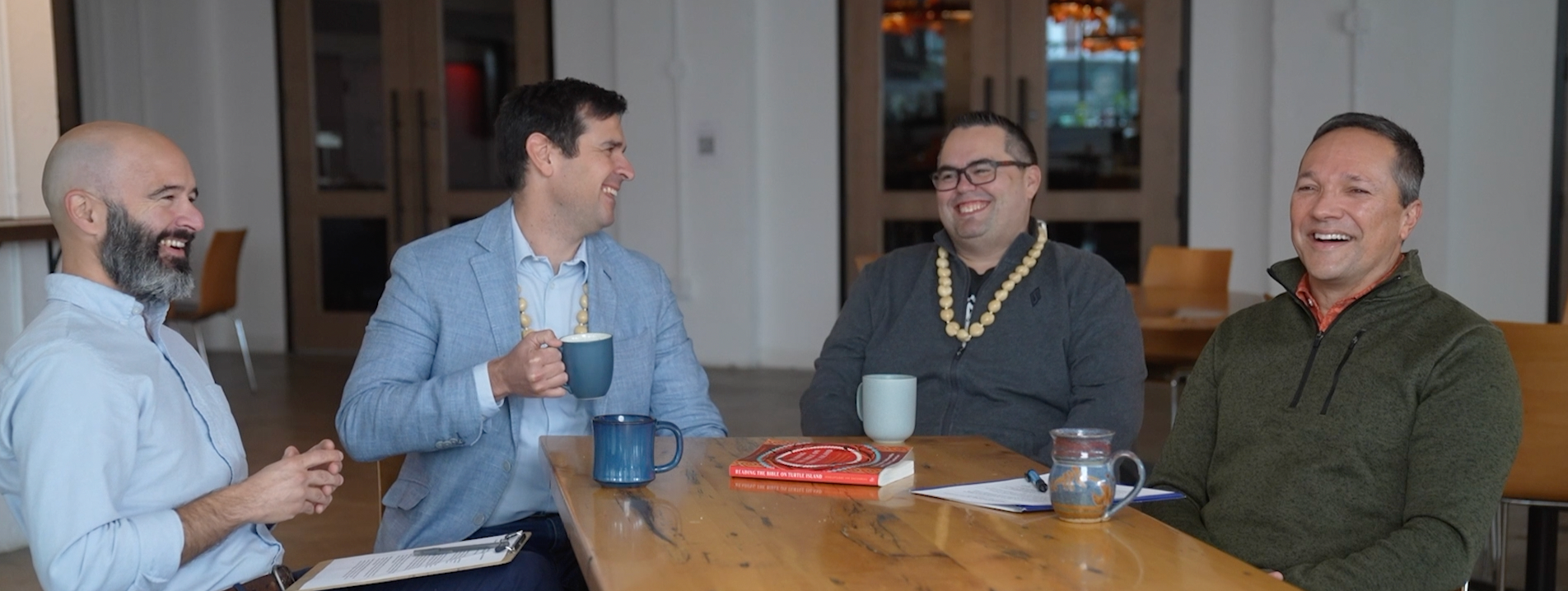
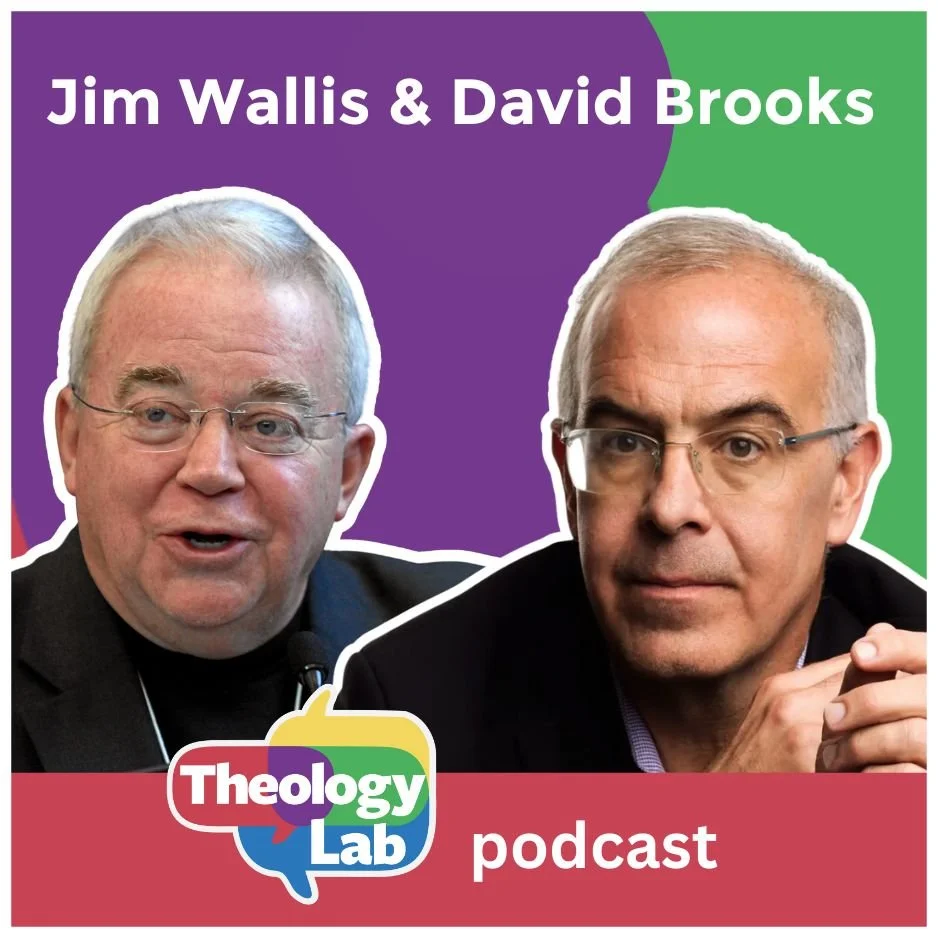
David Brooks & Jim Wallis: Evangelicalism & Today’s Political Questions
Theology Lab’s video podcast:
Recording of the American Evangelicalism Theology Lab session from winter/spring, 2022:
Davids Brooks and Jim Wallis are two widely recognized thought leaders in the areas of politics, open to bringing their faith into conversation with an array of topics. This conversation focuses on David Brooks' and Jim Wallis' relationship to evangelicalism and how to engage politics. They discuss Scripture, community formation, justice, and pubic witness.
-
AI generated:
speaker-0 (00:00)Welcome, I'm Scott Rice. serve as the resident theologian at High Rock. And then let's jump kind of right into why we're here tonight. I'm going to introduce our guests. The first guest I'll introduce is Jim Wallace. He is also well known for being the founder and editor of Sojourners Magazine, was kind of a community and then went into a long existence that's been about faith and justice. ⁓ And Jim, Jim just left that.
and he currently has the Chair of Faith and Justice at Georgetown University's Center for Faith and Justice. Jim is the author of a handful of books, the very popular God's Politics, ⁓ the recent books, America's Original Sin, as well as Christ in Crisis. If you ever read like a history of evangelicalism, you will hear about a movement going back to the 70s of progressive evangelicals, and Jim Wallace's name is always associated.
with that. So Jim, thanks so much for being with us.
speaker-1 (00:57)
Great to be here again.
speaker-0 (01:00)
The next person I'm going to introduce is David Brooks. You'll know David Brooks. is a columnist on politics, religion, philosophy, and just like life and wisdom for the New York Times. Regularly appears for the PBS NewsHour and served on editorial and commenting roles with Wall Street Journal, Atlantic, NPR, and the whole other host of news outlets. He's had a very distinguished, remarkable career in journalism.
Written a number of books, the two most recent are The Second Mountain and The Road to Character. In some of these books, David will take faith concepts and introduce them into public discourse. ⁓ So David, thanks so much for being with us tonight at Theology Lab.
speaker-1 (01:45)
Pleasure to be with you.
speaker-0 (01:48)
And lastly, let me introduce our moderator, Walter Kim. Walter has been with us twice this year, so you'll recognize him. He has served as both the moderator for our conversation with Russell Moore and then as a conversation partner for our session with Kristen Dumay. He was the pastor at Park Street Church, historic church in Boston for a number of years and then
went down to pastor at Trinity Presbyterian in Charlottesville. And now he is currently the president of the National Association of Evangelicals. Walter, it's great to have you with us tonight. And it's been a joy to work with you this year. Grateful for the work that you're doing and thanks for being with us. I'll pass things off to you. Thank you, Scott. Appreciate the introduction. Appreciate the conversations that you all have hosted. They really have modeled a principal set of discussions, contentious, difficult issues, but done with
a tremendous amount of civility and I deeply, deeply appreciate the sets of conversations that you have arranged. And tonight ⁓ we have the distinct pleasure of being with David and Jim, both who represent such ⁓ insightful figures, ⁓ able to contribute to the life of our country, both in insightful critiques, a hopeful vision of what life could be, represent different
perspectives, but perspectives that I think across the spectrum, whether shared or not, are deeply appreciated. So thank you for being with us this evening. So I'm just going to begin, because the topic is evangelicalism as a whole in this ⁓ conversation, what is your own relationship to evangelicalism? Jim, we'll begin with you.
speaker-1 (03:35)
Well, it's good to be here again. I was born into it, raised in it. I remember a fiery revival preacher on a Sunday night pointed his finger at me and said, if Jesus came back tonight, your mommy and daddy would be taken to heaven and you'd be left all by yourself. Got my attention as a six-year-old. I knew I'd have a five-year-old sister to support. So that was my first conversion.
But later on as a teenager, I was in Detroit, my home city, listening to my city, reading the papers and hearing the news and having adult conversations. And I remember something seen very big and very wrong in my city about race. And I began to ask questions that just wouldn't go away from me. And I remember an elder in my church, said, son, have to understand
Christianity is nothing to do with racism. That's political and our faith is personal. And that was a night for me of really kind of leaving it all and joining the sort of social movements of my time because the thing that was turning me upside down, ripping me up inside, he said, I had nothing to with my faith. And I didn't have words for that back then, but I do now, which is God is personal, but never private. But I still in that...
in that evangelical world. So think of myself as a person who believes, but my faith is not just personal, it's also public.
speaker-0 (05:11)
David, how about you?
speaker-3 (05:13)
Yeah, I have a weird story. I'm a babe in the woods and this I grew up in a Jewish home. Kept kosher for 27 years of adulthood, send my kids to Jewish school. But I also happened to.
speaker-2 (05:18)
⁓
have been up in
lower, lower Manhattan and.
speaker-3 (05:29)
I also went to a church school.
speaker-2 (05:31)
Episcopal Church, a mainline school. I was part of the choir and we
speaker-3 (05:34)
part of the church because it was lower Manhattan.
We were 40 % Jewish in the choir. And so we would sing the hymn to square with our religion. We wouldn't sing the word Jesus. So the volume would go down in the church and then come back. And so, but I grew up with these two stories, the stories of Moses and the stories of
speaker-2 (05:42)
PIM
when we're done.
Jesus.
And it didn't matter to me at all. Believe in God. And then in middle age came to believe in God and I came to believe in the God of Jesus. And so I became a Christian, though I. Because I came to believe that the Old Testament is actually.
speaker-3 (05:57)
All because I didn't. And so they were just good story.
Hey, it's
felt more Jewish than ever before.
true.
Not just a story, but actually true. But so I became a Christian, I became a Christian. ⁓ One does, which is you search. And when I as I was searching for the
speaker-2 (06:18)
In the way. ⁓
faith
that was inherent within me, I've learned that Christians give you books.
speaker-3 (06:36)
And so in about six months, only 350 were, which were different copies of mere Christianity by CS Lewis. And so I was like on a journey. I started going to church and I had thought Christianity is Keller CS Lewis and Henry now Eugene Peterson. And I went to a church, which I later learned was an evangelical church.
speaker-2 (06:37)
months, people gave me about 600 books.
Alright.
And I came, I've all these friends and I welcome people who read Tim Kramer and Alan.
that meant. And I ⁓ had they happen to be cool. And the the economy. People I admired.
speaker-3 (07:09)
A lot of friends who were Christian, eventually...
category evangelical didn't mean a lot.
It was a pastor I admired. It was ⁓ a series of co-believers I
speaker-2 (07:22)
⁓ And
The admired,
but the cat-
speaker-3 (07:29)
Or evangelical was just not important to me,
but that was the group I happened to fall into. And I confess this was about 2013 and I best become in 2013. Sometimes think it was like stock market in 1929. was maybe not the best thing to do, but, uh, but it's worked for me. I've since endured, um, or endured an experience.
speaker-2 (07:34)
happened to be inspired by.
I confess, becoming an evangelical, I started investing in the service in 1929.
and I've
all the things that have been through the evangelical movement in the past decade.
speaker-0 (08:00)
Hey, Scott here. If you're enjoying this video, you can like and subscribe to Theology Lab's channel below and you'll see our latest releases and what's happening at Theology Lab right now. Also, the description and comments have a link to our podcast that features folks like David Brooks, Kristin Kobus-Dumay, and others. Enjoy the video. Thank you both for sharing your stories. mean, they're shared both in very winsome.
somewhat humorous, but pointed ways. And I think that sets up our conversation really, really well. Before we launch into things, I wanted to note that if you have questions, please pass them along to Scott Rice, and he will be able to capture them at the end of our conversation. We'll take some of those questions up and I'll ask them to ⁓ Jim and David. But go ahead, we'll just jump right into it. ⁓
So we talked about the religion part of your own ⁓ journey a bit and have alluded to the difficult nature of the relationship between religion and politics in general, people of faith, particularly the Christian ⁓ version specifically. ⁓ Give us a ⁓ more principled lay of the land. How do you see ⁓ the role of political engagement for
people of faith? Why is it important? What are some common pitfalls that might occur? And David, I'm going to begin with you.
speaker-3 (09:32)
And so I, had the unique or not unique, but unusual experience of coming to really late in life.
speaker-2 (09:36)
faith or
relatively late in my fifties, early fifties. And. ⁓
speaker-3 (09:40)
Uh, I
have to tell you that my coming to faith did not affect my politics. And I'm a political pundit, so I'm in politics a lot. spent all my days with politicians. And I think that's in part because I had been raised in and even in the secular world.
speaker-2 (09:46)
particularly.
the Jewish elder and the
the biblical metaphysic with the night I know come to
speaker-3 (10:04)
the certain ideas that now believe
are divinely true, just thought were common sense before, which is that people are made.
speaker-2 (10:09)
for the
image of God and we should die to those who ⁓ are the least among us. ⁓
speaker-3 (10:14)
or antarsis.
And so Jim and I.
Shared love of Dorothy Day?
speaker-2 (10:28)
And my belief in Christianity and God, I knew today someone who lived before and lived with the poor, seeing some piece of moral beauty. And that became ⁓ normal. And knew that when I'm looking at beauty, whether it's artistic, fine.
speaker-3 (10:30)
The love of Dorothy Day proceeded. that when I saw Dorothy Day, the poor surrendered to the poor. I was.
part of the center of my life. And I knew that when I was
sticker device.
speaker-2 (10:57)
I'm looking in a way that is attentive and not egotistical. And I'm trying to see people into the face of God when I'm
speaker-3 (11:05)
trying to be people who are, you know, I'm looking and I see a person.
And so my politics were really oriented around that even before I came to faith. It's interesting, Jim and I came into that in radically different ways. So I for most of my life, I'm conservative and Jim is, but I interpreted my conservative.
speaker-2 (11:19)
and
Cripper.
anything about
as a
speaker-3 (11:36)
Defense
of a moral order.
speaker-2 (11:38)
that would ⁓ give dignity to each individual. And I think Jim.
the fact that we both are of the individual person who Jesus died for. And we may have different
speaker-3 (11:52)
person who was so important that.
interpretations
of how we serve that person.
speaker-2 (12:02)
I'm pretty
confident that's the end to which we see politics. And faith and art as pre-political and of how that the goal ⁓ commanded to live out reason that to us, but the goals are commanded to us. so to me, the pre-political nature of human life and the orient
speaker-3 (12:06)
And so I see that religion and art and culture
our interpretation of goals that were
That's that's re that's a bus
orientation
of our moral is more important than whether we support this. So even though I call it.
speaker-2 (12:31)
for all commitments.
that bill. And I read about politics.
I'm a big believer in the in the phrase Samuel Johnson used, of all the things, of those that kings can cause and cure, meaning that what really matters is treatment of each other. And our political manifestation of that is secondary.
speaker-3 (12:44)
things that human hearts endure.
is our
speaker-0 (12:59)
There's so much in that that we're gonna be coming back to in a moment, but Jim, why don't you share some perspective on the role that religion can play in political discourse, the implications of that role and some of the pitfalls of that.
speaker-1 (13:17)
Well, Dave and I do have a similar love of Dorothy Day, the founder of the Catholic Worker. I remember when I was in ⁓ college in those student movements around racism and poverty and war, I wasn't aware of any Christians who were involved in any of those movements. In fact, they were mostly against the things I was doing. But I remember I began, could never, even though I'd left the church or it had left me, I'm not sure which.
I could never quite get shed of Jesus. And I kept coming back. And I remember after a lot of organizing, I went back to read the New Testament on my own after years of organizing and all the rest. And I found this text that became my conversion text, the same conversion text as Dorothy Day. It's the 25th chapter of Matthew. It was the most radical thing I'd ever read.
At the time I was reading like a lot of students like me Ho Chi Minh, Che Guevara, and Karl Marx, and this was more radical than all of them. And I called the, was me text. Jesus, I was hungry. And you gave me food. I was thirsty. I was naked. I was stripped of everything. I was a stranger, meaning immigrant there. I was in prison. I was sick.
And you didn't come to me and I said, Lord, when do we see you hungry and thirsty and naked and sick in a prison? We didn't know it was you. And then he says, well, as you've done to the least of these you've done to me, I never read anything as radical as that. Here's the Son of God sitting in judgment in that text, this last teaching before going into the city of Jerusalem. And he says, I'll know how much you love me by how you treat them.
those who are poorest and most vulnerable. And that's the key, I think, to Christian politics. We can disagree on philosophy and debates, but the Hebrew prophets made clear in the Hebrew scriptures that a nation is judged by how it treats the poorest and most vulnerable. How they're doing is the test of a nation's righteousness, not its military firepower, its GNP, or its popular culture, but how it treats the poorest. That, to me, is the touchstone.
of what Christians ought to do in public life is defend those who are marginal on the edge. The economics and politics of Jesus turn this world upside down. I'm here at Georgetown and the politics in Washington are the least of these are the least important. And I'm trying to turn those things upside down where Jesus says those who are left out and left behind are the ones I want you to pay particular attention to how they are doing.
is to me the test of Christian politics.
speaker-0 (16:13)
Both of you have in your own unique ways ⁓ fallen to the issue of the image of God in all people and to this notion of a predisposition to defend the least of these or to minister to the least of these. And David, you described it in this language of almost this kind of moral order and instinct that you had that was ⁓ kind of faith seeking understanding.
so to speak, this deep embedded sense even before you became a Christian. And then becoming a Christian is discovering the details of, this is where it came from. And Jim, you're talking about this ⁓ ethic of Jesus that enters into the conversation that Ho Chi Minh, Marx, others, you know, couldn't offer anything equally as radical. So very, very different starting points. And yet you've come to some very similar themes here.
of ⁓ dignity and defense of the least of these, ⁓ I want to push now a bit of saying, okay, maybe there is this universal moral instinct that we can access, ⁓ general grace, general revelation, depending on what Christian tradition you come from, or there's a sense of a radical Jesus that would call us to ⁓
you know, a program of overturning the world or however you might put it, Jim. And yet ⁓ we are finding ourselves increasingly in a secularized setting and increasingly in a setting in which politics now seems to have usurped the role of religion. So it's possible to maybe stay, you know, to your point, David, in a realm in which it's disengaged or unmoored from religion.
⁓ Or to you, Jim, detached from the radical Jesus. Do you think that that's true? Do you think that politics, political discourse has usurped the role traditionally held by religion? then once again, what are the implications of that for our national life?
speaker-3 (18:32)
I guess I'll start. mean, first of all, I'm amazed that I came to.
speaker-2 (18:36)
⁓ believe Jim.
speaker-3 (18:40)
He did through Che Guevara. I did through William Milton Friedman. And so God is
speaker-2 (18:42)
We must buckley. Big.
God is pretty big. ⁓ I my own politics has usurped religion for many people. And I say that for reasons, sense that has become ⁓ moral formation and spiritual formation have become deficient.
speaker-3 (18:51)
I believe is that.
to read.
religion.
virtual.
speaker-2 (19:13)
And so a lot of people, second, have found themselves in a moral void. ⁓ And when people are in a more void, they need morality. And so they want a moral system that will give them more. And the radicalism of the gospel has been replaced by politics. Politics gives you the gives you the illusion that you're in a moral world.
speaker-3 (19:15)
and Chris.
purpose.
has been based.
And so Paul
speaker-2 (19:42)
It gives you the illusion that you're in a moral landscape, but instead of it, sin and redemption and grace and surrender, it's us versus them. Politics gives you the illusion of community, but instead of living with your neighbor and serving for your neighbor, it's watching TV and being outraged at the other side. And politics gives you the illusion of moral action.
speaker-3 (19:54)
politics.
speaker-2 (20:11)
But instead of what Dorothy Day did, which was sitting with the hungry, it's being outraged at what you're doing. And so we don't have politics in the society, which is about the distribution of power and the distribution of the normal debate. We have the politics of recognition. Recognize me as special. Do you oppose those as shameful? Ticks is an illusion and a drug.
speaker-3 (20:26)
resources which is
And to me, politics
speaker-2 (20:41)
that tries to replace landscape. so it gives you the illusion of having community belonging and moral mission and a moral landscape, but it's all a seduction. And so it has replaced religion for many people, Christian and secular in American life. And if you're asking religion to give you salvation, to give you meaning, to give you redemption, to give you a sense of moral,
speaker-3 (20:43)
a real moral
speaker-2 (21:09)
formation of moral and spiritual improvement, you're asking more of politics than it can give you. And I fear that we've become, we've been idle politics and we've ruined politics along the way.
speaker-3 (21:18)
policy.
speaker-0 (21:23)
Jim, before we get to you, I'm gonna pull something out a little bit more from you, David. So we have ⁓ some clarity on what you mean by it's replaced the kind of the moral order. I get how a community might be replaced by politics, belonging to a particular party, some of the means, the mechanisms, identification and the vilification. get that. What do you mean, however, when you say it's replaced a sense of the moral order?
How does politics do that?
speaker-3 (21:56)
Yeah, I mean, the moral order in line between.
speaker-2 (22:02)
Good and evil runs between within
every human heart. And that's where made a deep broken, but in the politicized morality, the line between good and evil is between us and them. And so it doesn't. Any sense of ⁓ humility. It does. Of self-apprehending abnegation. It just requires you to go after the time.
speaker-3 (22:07)
Christian notion that gloriously
It's not required.
doesn't require a sense of.
Recur... ...the others.
speaker-2 (22:31)
And it's a
speaker-3 (22:31)
Cheap morality.
speaker-2 (22:33)
and I find an ultimately ⁓ unsatisfying morality, but it's the morality that has pervaded, I think, American life. And then the final thing I'll say in this specific to evangelicals. Or ⁓ dangerous than a siege mentality, the idea of the world is out to get you. And I think in many realms of the evangelical world, that that morale, that sense that.
speaker-3 (22:45)
There are few things more.
speaker-2 (22:59)
The world is full of villains who are to get us and therefore justified in doing anything and that the the ends justify the means has. Corrupted evangelical life in some quarters and you know, once Jesus saved the ancestors by the means, I mean, we can debate a lot. He said, but that's one of them and but unfortunately. Some part of embraced that.
speaker-3 (23:02)
We are just.
the church has, parts of the church have.
speaker-0 (23:30)
Thank you. Jim, turning to you.
speaker-1 (23:33)
David wrote a column a while back, David, about how things have gotten so politicized in too many white evangelical churches, with that us and them, the pushing of people out, the naming of people who are named as the other, even demonized. And there was this lawyer ⁓ in the Bible who asked a question of Jesus. ⁓
I think it was a Washington lawyer. The tone of voice gives him away. He asked Jesus, well, how do I have eternal life? And Jesus said, well, you know the law. What does it say? It's, well, you love God with your whole heart and soul and mind. Your neighbor is yourself. You got it right. And then he said, yeah, but who's my neighbor? And he wasn't saying, who is my neighbor? How can I welcome them? How can I include them? It's like, exactly who is my neighbor? He's trying to restrict. And the us and them.
issue is so deep now in American politics that I'm very concerned about leading even to the rise of political violence. And Jesus tells him a story that we all know as the Good Samaritan story, where a Samaritan who most Judeans didn't believe there were any Good Samaritans. They were the other, they were half-breed, they were racially stayed away. And this other Good Samaritan helped someone other
than him. And he became an example of whom Jesus said is how you find your neighbor. Your neighbor often doesn't live next door. That's the good Samaritan parable for me. And so how do we, as John Meacham says as a political ⁓ scientist or historian, turning people from neighbors into enemies is a great danger for democracy. So who our neighbor is.
to me is a fundamental question for democracy today. So instead of ⁓ changing our pathways really to find our neighbors who are not always in our neighborhood to demonize and call for the destruction even of our enemies who should be neighbors is a problem not just in our personal relationships but in our politics. so, ⁓
David and I are in agreement on the image of God, that first chapter, the first book of the Bible, 126, ⁓ God making humankind and God's image and likeness. These assaults on the rights or voting rights or human rights of enemies, these are an assault on a mago day. They're literally an assault on a mago day. So how to bring that to our politics, not just our personal relationships.
but in our collective religion or in Georgetown, they would say, how to bring dignity and justice to the common good. How do we do that? How do we bring that back to the common good? That's, ⁓ I tell my students all the time, don't go left, don't go right, go deeper. And to me, going deeper means to go to what Jesus said.
speaker-0 (26:51)
I asked David as a political pundit to draw out a little bit more on what he meant by the replacing of the moral order typically have given by religion, by politics. And now Jim, as a religious and political activist, I'm going to ask you to clarify something. ⁓ You've worked so compellingly and have exemplified. ⁓
the sort of convergence of an ethic of Jesus and political activism. And I'm not going to ask you to ⁓ reflect a bit, maybe even self-critically, not to yourself personally, but to the project of ⁓ religious activism, political activism. What is a pitfall ⁓ that you may have discovered when ⁓ people with deep religious convictions enter into the realm of politics? What is a pitfall that you
would caution us to avoid.
speaker-1 (27:50)
I think the danger or the temptation of politics for people of faith is to become a chaplain for one side or the other. We must not be a chaplain for the right or the left. Doug King said it best of all when he said he wanted to remind the church that our role is to not be the master of the state or the servant of the state, but the conscience of the state.
And that will often make us have to be critical of different sides in the political discussions. And sometimes, I know David probably feels the way too, sometimes you feel politically homeless because you're not lining up with the parties. And so how do you, in the name of Jesus, with those values in his teachings, with that Hebrew scripture about the image of God, how do you
test and challenge the politics of left and right when they all want you, they all want religion to be their chaplain, to justify them and give them religious affirmation when really what they need is often prophetic critique.
speaker-0 (29:10)
I want to pick up now on the thread of formation that both of you have in your own ways, again, touched upon, whether it's the ease by which we fall into the trap of becoming a chaplain for one side ⁓ or the ways in which we have become disordered in our demonization, vilification of people who have different persuasions. So give us a positive vision.
What would enable us to enter into a place of moral and spiritual character formation in our political engagements? And what role specifically does the church play in this?
Yeah, David, why don't you.
speaker-3 (29:56)
So I wrote a piece about evangelicals about a year ago. I you, Walter. I put the phrase spiritual formation.
speaker-2 (30:00)
go and check. ⁓
in
the rough draft of the article and Miters will, what the heck is that?
speaker-3 (30:09)
like, because
they had like 60.
speaker-2 (30:15)
like should marks in that for peace. Like do phrase agape love. They're like, what the heck is that?
speaker-3 (30:25)
And so it was a sobering reminder of some of language that we
speaker-2 (30:29)
We
speak with each other is a very alien language world and the people at the New York Times are hopefully pigs. ⁓ a mystery and I really had to explain that to them. And so I've tried ⁓ in my life to being a secular writer. I'm a secular writer, try to translate some of the concepts we may find familiar.
speaker-3 (30:34)
to a lot of the secular world.
least fiscated human being. But spiritual formation was
set up in
speaker-2 (30:59)
to the second world
speaker-3 (30:59)
particular world.
speaker-2 (31:00)
and try to do it in a way that's helpful to us.
speaker-3 (31:03)
And so when I think of spiritual formation or moral formation...
speaker-2 (31:05)
I
think of three things. One, to find ways to
speaker-3 (31:12)
to restrain our own
natural self.
speaker-2 (31:18)
trying to find an ideal toward which we can direct our lives, which is for us is Jesus. But three, more practically, is how to be considerate of human beings in the complex situations of life. So how do I ask for forgiveness and offer forgiveness? A notice that somebody's not feeling included and try to include them.
speaker-3 (31:39)
How do I? The dinner party.
speaker-2 (31:45)
If I'm a kid, how do I break up with a boyfriend or a girlfriend without breaking their heart? And to me, Moral formation that is absent in the church. Is the social skills of being considered in the daily activities of life and been helped ⁓ in trying to understand those skills through. I think her instincts.
speaker-3 (31:52)
be part of spiritual
in the second world.
to the
who's not particularly religious but I
speaker-2 (32:14)
are deeply religious, which is Iris Murdoch, who's a great novelist and philosopher. And she said the essential moral acts is the act of casting what she called a just and loving attention. When I see somebody in an airplane, just plain cast the just and loving attention on that person. And her novels are about people who don't cast just and loving attention to each other because their vision of each other are, ⁓
speaker-3 (32:27)
So, got enough air. I wanna.
speaker-2 (32:44)
are egotistical, selfish, you know. And so, me, moral formation and spiritual formation can be seen as a lofty, ethereal thing. Down to the practical level, if I'm sitting next to you on a plane, how do I cast a just and loving attention on you?
speaker-3 (32:49)
to show.
But I tried to bring it
How do I open up our conversation?
speaker-2 (33:05)
I ask you a series of questions
so that I'm respecting your privacy, but gradually giving you an invitation to talk about whatever you want to talk about. And to me, think those questions of how do I ask you about what's wrong with you? I ask you about your family.
speaker-3 (33:18)
that though practical
your work. How do I ask you?
How do I ask you your pride in your kids? Those practical questions.
speaker-2 (33:30)
⁓ are
the material aspects of spiritual and moral formation that's material to really focus on.
speaker-3 (33:36)
were two of three.
speaker-1 (33:44)
I think we've got to take your question, ⁓ Walter, in the historical context, in the moment that we're in. And I'm deeply concerned about the trajectory of our politics now, which is fear to hate and then to violence. That's ⁓ a civic faith of fear, hate, and violence. How do we create ⁓ a civic faith
maybe civic discipleship or challenging ⁓ that trajectory. I just was writing a chapter here today on Galatians chapter for a book on Galatians 3.28. This radical text in Christ, now, junior, Gentile, bond or free, male or female. And I learned this was a baptismal invocation at all the baptisms of the early church. They were saying,
overcoming these divisions of race, class, and gender, there, overcoming them was an essential vocation of the early church, so much so they set it at the baptisms, even an early creed. Now, what does that say about our struggling with democracy? My great fear of my white evangelical tradition is that we are bound more and more by two identities. One is racial and one is politics.
And we are not meant to be a tribe in politics to fight for our tribe. We're meant to be the people who bring others together into a new community. And that to me is a very challenging thing right now. That'll take more than politics. Who wins or who loses left or right. It's going to take going deeper into how we regard each other and how our role vocationally is to bring the tribes together, especially when the elephant in the room.
in American politics as we are becoming more and more no longer a white majority, a nation where the majority are minorities. That'll take a whole different kind of world and politics. And who's going to guide us to that multiracial, multicultural democracy? I can't think of a better way to do that. But the churches, are the body of Christ is the most diverse.
human community on the whole planet, yet not so here. How do we move in that direction? That'll take a civic discipleship that helps us overcome our tribalism in favor of that new community that these early Christians said, here's what it means to follow this rabbi that we've chosen to follow.
speaker-0 (36:33)
I find it very interesting in your answers, both of them really compelling and picking up on some similar themes, but applying them in some distinct ways. David, perhaps this is your conservatism showing up, your application in the individual expressions of kindness, the person sitting next to you on the plane, and Jim, your instinct to go to this kind of civic engagement and perhaps that.
reflects a bit of your own political instincts. Now I wanna turn our attention, whether it's the individual engagement or more civic corporate engagement to a mediating community of just a local church who is composed of individuals, but the local church is also composed of groups from different political persuasions, multi-generational, multi-ethnic and so forth. So what is your advice on how to build this kind of
kindness, discipleship, in whatever form you've so delineated it, in the context of a local church, when you have issues that divide us, issues like war, LGBTQ inclusion, politics in general, race in particular, how can you express kindness but have principled discussions recognizing that there are legitimate issues at stake with deep convictions that differ? ⁓
What would it look like to hold this all together? Jim, let's begin with you and David will turn to you.
speaker-1 (38:06)
I think the worst thing about a church or a local church is that it becomes sociologically predictable.
that the views held in that church are indistinguishable from the views held by the demographics in that church. That's the problem. are meant to be, ⁓ Walter, my church left theology for politics. It left theology behind toward ⁓ a new moral majority, religious right politics, it politicized. Now that can be done on the left too.
but I don't see that happening in white evangelical churches. So how do you get back to our theology that should make us theologically distinguishable instead of sociologically? In other words, how are we different? How are we the counterculture that Jesus, I think, called us to be? A lot of my students are in the category at Georgetown of the none of the aboves, the nuns. They're not.
affiliated with any religion or church. Most still believe in God. It's not a secular movement. What they're looking for is courage and conviction. And they're looking for people who are doing things to make things better in a community. So I'd like them to walk past a local church and say, I'm not sure I believe in all that doctrine that might be there. But that's the place where we in this community talk about our problems. Where we talk about
issues of ⁓ fairness and justice and public safety. And this is where we talk about how to make this community different and better. That could pull young people in, I think, and then have a conversation with them. So I want to see a multiracial and a multigenerational conversation happening in our churches about what it means to be public disciples.
along with our deep personal faith that David and I share in Jesus Christ.
speaker-2 (40:24)
Yeah, I'm reminded I have a. Sir in Virginia, where I live in DC, and he is on political grounds. He was. And without citing. He was. Says from the beatitudes from the sermon on the mountain and at the end.
speaker-3 (40:25)
buddy of mine who's a pest.
True. ⁓
So give his sermon. That's the source. Insert sentence.
I
that he'd be out the front door of people were coming out and they'd be shaking his... They'd say, really like your Sherman, but I didn't like that part. That part was so woke.
speaker-2 (40:49)
and they
No. ⁓
speaker-3 (40:59)
that
was the Beatitudes. And so now I'm going to sound like a super.
speaker-2 (41:02)
We're
lefty like Jim, but I do think. ⁓
speaker-3 (41:08)
I guess that's.
speaker-2 (41:08)
say two things. First, as you
mentioned, you had Russell Moore, think, on this conversation. And Russell said something to me ⁓ that I think is troubling. He said, in many congregations, the most healthy people are quiet and the most spiritually unhealthy people are loud. And they're demanding politics and the healthy people are just laying low. I think it's
speaker-3 (41:21)
spiritually.
Bruce Lee.
card.
speaker-2 (41:37)
for
pastors to deal with that kind of sense of division. And, but upon it. And I'm married to a woman named Ann Snyder who I'm now going to bring in her magazine called Comment Magazine. You'll read it called Public Fee for the Common Good. And this issue, Remembering the Spheres. And it's really based on the idea of Abraham Joshua, Abraham Kuyper, Dutch theologian and who became prime minister. And this is
speaker-3 (41:43)
I would insist the.
gene which is used for biology.
concept
of the spheres. have different spheres. There's just sphere spheres for most of us.
speaker-2 (42:09)
in life and that they're really. The
most profound sphere, the political. Yeah.
speaker-3 (42:15)
The spherical sphere is a different sphere. elliptical
sphere is a different sphere. There's different mentality.
speaker-2 (42:19)
And we use meant is
and we have some value.
speaker-3 (42:23)
nine different values
to the different spheres, but presume some spheres are more fundamental than others.
speaker-2 (42:27)
serving that sense that's
I
think is absolutely fundamental that the salvation of spiritual natures is the
speaker-3 (42:36)
souls, the care of our spiritual,
fundamental sphere.
speaker-2 (42:42)
And the-
speaker-3 (42:43)
What do you agree in politics at second?
speaker-2 (42:44)
that theory
and you use a different mentality, different kind of thinking to think about that sphere. And if Jim and I disagree, I happen to be a rabid New York Mets fan. if Jim likes, I don't know who, if you like a basement.
speaker-3 (42:48)
that think you're.
team of the Boston Red Sox or wherever, like that's a different sphere and we're not going to make that the primary sphere of our relationship.
speaker-2 (43:06)
⁓ And so I do think this understanding of life that keeps faith central and keeps the secondary ⁓ is just essential to keeping harmony within a diverse and pluralistic congregation.
speaker-3 (43:08)
understand different spheres of life.
The others for your second.
speaker-1 (43:24)
And I think you've got to go deeper than ⁓ different spheres because there are issues right now. I'm going keep going back to some texts that I think need to change us. When Jesus said, you'll know the truth and the truth will set you free. The opposite of knowing the truth is captivity. And a lot of our congregations are now in that captivity. The thing I'm most worried about for our democracy is how people are living in different
worlds of information, different informational worlds. ⁓ And I think pastors have a vocation in some ways similar to journalists like David to tell the truth. Truth has to be told. I love stories like when a ⁓ pastor's wife that I know in Georgia was practicing with the choir one day and they had their prayer before service as usual and the
scared director of the choir said, Oh Lord, please, please help us from those drug cartels, those immigrants who are coming with their drugs and leprosy and violence and guns, please help the soldiers stop them. And she's stop, stop, stop. We don't lie in church. We all lie in church. That isn't true. That's not what happening. I've had Walder pastors that you and I know say to me, I have my people for only maybe two hours a week if I'm lucky.
Fox News has them 24 seven, I can't compete. can't compete. So truth telling to me is going to be very important in the life of the church when lies and misinformation and disinformation dominate our media more and more. And we're separated from being in those different universes of information. How do we get back to truth telling, which isn't partisan.
It's got to go always, but truth telling, I think is a central vocation of local churches.
speaker-0 (45:29)
I'm gonna take last 10 minutes to field some of the questions that we've been getting from our participants. I'm gonna begin with a question that comes from a millennial, maybe straddling the Gen Z as well. ⁓ From the perspective that you have of decades worth of...
observation on cultural life of America, political life, religious life of America. When you think about the younger generation, the generation coming up, the generation that will receive your legacies and their distrust of institutions, ⁓ what do you think the younger Christians should be doing to develop an alternative framework for Christian political engagement?
And David, let's begin with you.
speaker-3 (46:21)
hoping you're gonna come first. I'll just mention ⁓ my experience with younger Christians.
speaker-2 (46:26)
a couple things.
Is first, a healthy skepticism.
speaker-3 (46:32)
the system
toward the established institutions of the faith. Second.
speaker-2 (46:39)
have a friend named Mark Laberton, who you Walter, we know, ⁓ at who used to be retired as seminary. ⁓ and he just a series of practices and rituals that of our expectations. And they would combine something that would be conventional for a maybe an eventual.
speaker-3 (46:44)
Get Fuller's
faith.
speaker-2 (47:06)
But they would combine with the Japanese tea. To combine that with, he, he mentioned to me, ⁓ Korean Christians who were And so it was, ⁓ it was really a global approach to the church. Combine all that might a lot of people, but I found it heartening.
speaker-3 (47:15)
series.
and celebration of
local.
which would release different traditions in ways that would be disorienting to us.
speaker-2 (47:36)
Having spent a lot of over the last 10 years in I guess I was introduced to faith really through Christian colleges, weirdly, through the faculties, the students. And I found it heartening. And it was only later that actually found the congregations. ⁓
speaker-3 (47:43)
You
later that
I was like, I'm kind disappointed. And so when I was at the Christian college, but other colleges, Biola or Westmont,
speaker-2 (47:59)
⁓ And colleges, wife went to Wheaton, which is Hope or wherever you would buy. ⁓
speaker-3 (48:11)
I would always think you guys feel embattled. You should not feel embattled. You have what the world wants. You have a spiritual language. You have a sense of spiritual purpose. You have great spiritual resources. And I teach at Yale and University of which are prestigious secular universities, but they don't have what a lot of evangelicals
speaker-2 (48:26)
sources.
on the original.
Peace.
colleges
have, which is a sense of how to actually mentor young people to lead lives of purpose and grace.
speaker-3 (48:41)
Spirit.
purpose.
And so I would always say I'm coming from a world that has a lot of worldly, a lot of spiritual.
speaker-2 (48:54)
But a
vacuum. when I go to I'm entering a world which may not have much money.
speaker-3 (48:57)
So my language
always
speaker-2 (49:08)
to those folks
is appreciate what you have. Be not afraid because you have what the world really is hungering for. And you should go forth into the world not with a sense of misceasurant, but a sense of confidence.
speaker-1 (49:24)
The best part of my week is teaching students to Georgetown. I have two classes this week and I'm already looking forward to them. Many of them are not, they're disaffected, they're not current to anything, but they're drawn to, let's go back to the good news. They're drawn to good news. ⁓ Quote our mutual friend, Mark Laberton, who once said to me as the president of the largest
evangelical seminary in the world, perhaps he said, evangelicalism is destroying the evangel. The evangel was that word in Greek that Jesus used in his opening statement, his opening gig, his Nazareth manifesto, quoting Isaiah, the spirit of the Lord is upon me because he has not only to bring good news, evangel to the poor. That was his opening statement. And I find students are drawn to that.
They say things like, I never knew about the Black church till this class. I like what I see. Or what is this thing you call Catholic social teaching, even in Georgetown? They haven't heard about that. There's all kinds of things, as David's saying, in our churches, in our histories, our traditions. And the institutions often neglect or even cover them up and get on with their own business of power. But
I want to get students back to hearing the best in our traditions. ⁓ That Black church was at the core of the civil rights movement without which there wouldn't have been a civil rights movement. That Catholic social teaching of Dorothy Day and so many others that really talk about ⁓ dignity and the soul of a nation, the common good. So these are things that young people are drawn to. I find it every week in my classes.
So I don't, I'm not a super lefty David. David, think we shouldn't be super lefties or super righties, but how to get back to the core, the core of what we say we believe. That's Sermon on the Mount. I love the Beatitude story. When I read the Sermon on the Mount, after years of organizing in the student movement, I realized I'd never had a sermon preached to me and my evangelical home church on the Sermon on the Mount. That was for another dispensation for when we get to have
I said, what good will that do there? I found this whole, the Beatitudes that turn the world literally upside down. Jesus came to change the world and our lives with it. And that I find young people, even if they're skeptical about religion and institutions, they're very drawn to. So I find a real hunger for what our faith is really at core is about. And a lot of people are getting quite excited about it.
speaker-0 (52:20)
think we have time for one more question. I'm going to ⁓ ask a question that synthesizes, and love to hear from both of you, a theme that I'm reading in a number of the questions. And that is, ⁓ we have different political persuasions ⁓ with respect to the emphasis on the individual responsibility or what a policy can accomplish. ⁓
We have different views on the relative spheres of our engagement, but what happens when they're all overlapping? When the individual Christian formed in the church nevertheless has to vote on a particular issue. ⁓ How do we provide theological and moral formation that helps us in these intersecting moments?
that takes seriously our individual responsibilities, of course, to be Christ-like in kindness, to personally engage ⁓ in ⁓ defending the least of these. ⁓ But we're also having to enter into the political responsibilities and life of our nation, and that entails policies. ⁓ So when we bring those things together, our individual responsibilities,
are political engagements. What are some guiding principles that you would offer us as a way of concluding this conversation? It's kind of a parting thought that each of you would have a minute each.
speaker-3 (54:04)
I'll go first. So I once was watching TV, which is one of the Pope's Easter sermons, and the Pope gave a sermon. The TV reporter came on afterwards.
speaker-2 (54:06)
TV coverage.
And it
said nothing new here. It's like.
speaker-3 (54:18)
That's not his job is to be new. His is to stay what's true. You know, I would say in my life, I was a lefty, was social, socialist early in life.
speaker-2 (54:20)
It's job.
speaker-3 (54:33)
voted for Ronald Reagan to contest that. And now I've shifted back to probably a conservative Democrat. So those commitments are a femla. I think Reagan's policies were right for a period of stagnation when we wanted to boost growth. And I think we right for a period of the cold. I think now, savage inequalities. Joe Biden's policies of redistributing
speaker-2 (54:38)
I'm consumerist now.
and the war. Now with I think
money
speaker-3 (55:03)
to the working class are probably more accurate than whatever the Republicans are offering. And so those are context driven. And so my attitude is that I'll do what I think is right for the time. Religious commitments are not context driven. They're based on human realities. And so for me, it's very easy to...
speaker-2 (55:06)
them.
My
and but
to
maintain the permanent amidst the efferal of politics.
speaker-3 (55:28)
them
speaker-1 (55:31)
Very helpful. I'm surprised in saying we've got to bring ⁓ sin back into the conversation, both left and right, ⁓ personal agency and responsibility, and how our individual choices impact all of us. The left needs to hear that strongly. But structural sin, Walter, you and I have talked about, which is often missed and just omitted on the white evangelical side.
how these structures, these principalities and powers just deserve or destroy human life. So let's bring that back in and let's have discussions about the role of government, the role of civil society, all of that's well and good. But the test of our politics, as I read the scriptures, is how the most vulnerable, the marginal, those on the edge are treated. That is the test. So rather than voting for our tribe,
Who's gonna be best for our tribe? Who's gonna serve our self-interest as we define those, often by race and class and not so much Jesus values. Who's gonna do that isn't the issue. Who's gonna be our guide to support us? It's who is going to make sure that the ones lifted up as we've said tonight, all through the scriptures are being attended to and how we can make their lives flourish.
as well as our own. That to me is a test of Christian politics.
speaker-0 (57:03)
Thank you both so much. You've not only modeled ⁓ really wonderful insights and given us a lot to chew on, sometimes surprising in your self-disclosures and perspectives, but you've also modeled how to do things, how to have a principled discussion. ⁓ Thank you. I mean, this has been immensely helpful. me...
speaker-1 (57:24)
Our blessing.
speaker-2 (57:26)
Thank
speaker-3 (57:26)
Thank so much.
-
A Candid Conversation on Faith, Politics, and Evangelicalism
In a thoughtful discussion hosted by Theology Lab, journalist David Brooks and theologian Jim Wallis explore the intersection of faith and public life. Moderated by Walter Kim, the conversation dives into how their personal journeys shaped their religious and political views, and what the church’s role should be in today’s divided society.
Personal Journeys into Faith
Jim Wallis shared how his early evangelical upbringing clashed with the racism he witnessed in Detroit. When his church told him racism had “nothing to do with faith,” he left in disillusionment—but couldn’t shake his connection to Jesus. His faith evolved to be deeply personal but also unapologetically public, centered around justice and care for the marginalized.
David Brooks described growing up in a Jewish home but attending an Episcopal school, eventually becoming a Christian in midlife. While his faith journey was personal, it didn’t drastically change his politics. Instead, his belief in the dignity of each person was deepened by Christianity, reinforcing values he already held.
Faith and Political Engagement
Both speakers agreed: faith should inform political engagement—but not be co-opted by it. Wallis emphasized that a Christian's primary political responsibility is to advocate for “the least of these,” echoing Jesus’ words in Matthew 25. Brooks highlighted the danger of letting politics become a substitute for moral formation, warning that it can offer the illusion of community and purpose without requiring self-reflection or sacrifice.
The Usurping of Religion by Politics
The panel warned that in many communities, politics has overtaken religion as the source of identity and morality. Brooks pointed out that politics often simplifies complex human struggles into “us vs. them” battles. Wallis added that when churches merely reflect political demographics, they lose their theological distinctiveness and risk becoming echo chambers.
The Church’s Role in a Divided Society
The speakers offered a vision for how the church can heal political and social divides. Brooks emphasized the importance of everyday kindness and moral attentiveness in shaping character. Wallis called for churches to be bold truth-tellers and spaces where people of all backgrounds can discuss and address community issues.
Engaging the Next Generation
Both panelists expressed hope in younger Christians. Wallis noted that students are hungry for the true message of the gospel, especially teachings centered on justice and dignity. Brooks encouraged young believers not to shy away from their faith, but to recognize they possess spiritual resources the world desperately needs.
Guiding Principles for Faith in Public Life
As a final takeaway, both Brooks and Wallis urged believers to hold fast to the unchanging truths of their faith while staying flexible in political application. They stressed that Christian political engagement should be measured not by tribal loyalty, but by how well it serves the vulnerable and fosters human dignity.