
Becoming Aware of Christian Nationalism
Theology Lab’s video podcast:

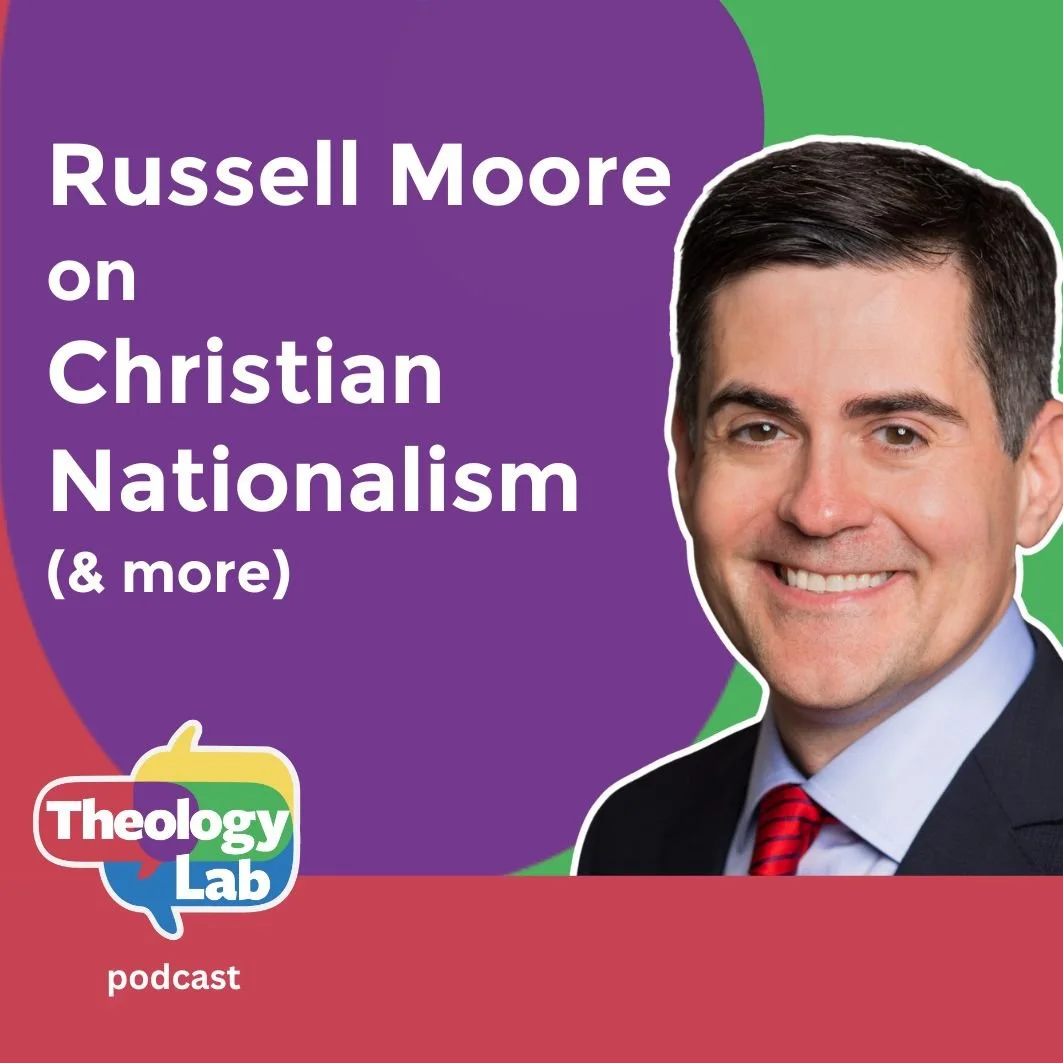
Season 1 episode: Russell Moore on Christian Nationalism, Politics, and the state of Evangelicalism (with Walter Kim, president of the National Association of Evangelicals)
Recording of the American Evangelicalism Theology Lab session from November 11, 2022 with guest, Rev. Dr. Russell Moore (Christianity Today).
In this discussion, moderated by Rev. Dr. Walter Kim (president, National Association of Evangelicals), Russell Moore shares some personal stories about his relation to faith and political engagement. Russell speaks to the looming issue of Christian Nationalism, and what it means for Christians today to maintain both integrity and faithfulness in the public sphere. In the final part of his discussion with Walter Kim, Russell speaks to the crisis that evangelicalism faces today and the possibilities for revitalization and the formation of new coalitions within the evangelical movement.
-
AI Generated Transcript (Riverside), with 2 Speakers. At the beginning of the Q and A around minute 39 the second speaker is Scott Rice:
speaker-0 (00:00)issues, I think it might be helpful for folks to get a little bit of a personal insight into your journey. So why don't you take a few moments to share something about your journey of faith and political engagement.
speaker-1 (00:14)
Well, I grew up in a Southern Baptist Church in Biloxi, Mississippi, a very warm community, taught me the Bible, taught me to love Jesus. I think often about in the account of John 10, when the crowds are coming to Jesus and they said ⁓ about Jesus, John the Baptist did no sign, but everything he told us about this man was true. And there were many things that I think my home church
got wrong, just like any of us do, but what they told me about Jesus was true. And I've come to believe that even stronger than before. I went through ⁓ a spiritual crisis when I was about 15 years old. Some of it had to do with politics because it seemed to me that the Bible Belt Christianity
maybe was just a means to an end for politics, regardless of what the politics actually were. If this was just politics with Jesus as a hood ornament on the top of it, that was deeply distressing to me. And then you add to it questions of racial injustice, you add to it the scandals that I was seeing around me in Bible Belt Christianity, I started to wonder, this all just made up?
And that was terrifying. And thankfully, I had read Chronicles of Narnia so many times as a kid that I knew the name C.S. Lewis, and I read A Mere Christianity. And it wasn't the arguments there because my problem wasn't intellectual. was the fact that C.S. Lewis was obviously in that book, not trying to market me, not trying to mobilize me.
Christianity really wasn't a means to an end. And that helped me to get through that spiritual crisis. And I was somebody who was wrestling with a call to ministry ⁓ really early on. About 12 years old, I went to my pastor and said, I think maybe God's calling me to ministry. And he said, okay, three weeks from now you'll preach. And I said, don't mean now. And he said, well, yeah, but I'm gonna teach you how to do this.
which was a horrible, it was a great experience in terms of people were very affirming and so forth. It was a terrible sermon. I know that. And I was a nervous wreck, but I sort of grappled with that call to ministry through that spiritual crisis and beyond ⁓ ended up in a political direction. So I was working for a United States congressman ⁓ and working communications director for a congressional campaign.
But the call to ministry just persisted. And so I ended up in a situation in my life where looking back, and I think most people can do this, you look back and you see all of these little, what you thought were cul-de-sacs in your life, where God was actually preparing you for something else. And so all of those streams just kind of fit together in some way to do the sort of thing that I've been doing.
speaker-0 (03:37)
Hey, Scott here. If you're enjoying this video, you can like and subscribe to Theology Lab's channel below and you'll see our latest releases and what's happening at Theology Lab right now. Also, the description and comments have a link to our podcast that features folks like David Brooks, Kristen Kobus-Dumay, and others. Enjoy the video. It's really compelling the way that God uses these personal narratives to get us to certain junctures in our lives and you've contributed a lot in this area of
understanding the intersection between faith and politics and the place of politics in a believer's life. But as I alluded to earlier, the context in which we live in is not just complicated, it's deeply, deeply contentious and perhaps even ⁓ threatening to the very essence of faith. So a lot of folks, ⁓ Christian, evangelical or not, have become disenchanted or maybe even very concerned about the conflation of
Christian identity in politics, maybe the expression of Christian nationalism, which we can develop further in a moment. ⁓ Let's take a moment to pause and what do you think it looks like for Christians to engage well with their own identity as followers of Jesus in politics?
speaker-1 (04:58)
Well, I think the first thing is getting priorities in order, which means having an understanding of the kingdom of God, my kingdom is not of this world, ⁓ having a sense of oneself. mean, one of the problems is that there's a kind of catastrophism that develops. And I noticed that even as a kid, long before these days, but as a kid, I would notice that every four years, people would say,
this is the most important presidential election of our lifetimes. And there never was a four year period where that wasn't set. so wouldn't there be some year where somebody would say, you know, this election is important, but it's not as important as the one we had last time. That never happened. It was always on the edge of catastrophe. And if things didn't go the way that they ought to this time, then everything would be lost. And that kind of ⁓
catastrophic vision is really useful ⁓ in manipulating people because what you can end up doing is saying, well, desperate times call for desperate measures. And so that means that that means that this political campaign or this political season becomes all encompassing. ⁓ And the stakes are so high that that one can set aside ⁓ moral and ethical
obligations of being a follower of Jesus because the stakes are so high. All of those things conflate. then you have the additional, what's different now, one of the things that's different now from what would have been the case in some years past is that we live in an American society where politics has become so central to a person's identity.
⁓ And so you have not just kind of the sorting of people out into red state and blue state and Republicans, Democrats and so forth, but that it becomes so close to the identity of who somebody is that when someone is challenging my political views, they're challenging me and they're challenging me existentially. And so you end up with people who
don't have a sense of, well, my political party, whatever party that is, is right on these things, but not on these things. That just almost never happens in American life right now because of ⁓ the weighting of politics in terms of identity. Being a follower of Jesus means that those priorities are shifted. And so, I see myself first as belonging to Christ. I see the kingdom of God as being ⁓
more infinitely more important than all of those things. And that doesn't just give me a way of looking at politics. It also, it recalibrates my emotional response to ⁓ politics, which is a key part of it right now. So I think often about ⁓ Jesus with Caesar's coin.
When you have ⁓ Jesus holding up Caesar's coin and saying, whose image is on this? Render to Caesar the things that are Caesar's and to God the things that are God's. We typically look at that and say, well, Jesus is saying there are some obligations to governmental powers, but there are other obligations to God. That's true. But I think the central point of that is that you have people attempting to trap Jesus in his words, the text says.
And because if Jesus said, the tax, then he's affirming these Roman occupiers are legitimate, David's throne is legitimately ⁓ empty and taken over. ⁓ Or if he had said, don't pay the tax, well, he's an insurrectionist calling people against Rome, either way. What Jesus does is say, ⁓ whose picture is on this? Okay, we'll give it back to him.
There's a very different ⁓ emotional sense about those transient realities that's able to reprioritize them. And I think right now people kind of swing from exuberance, whatever your side is, my side has won and we've definitively won, or this sense of existential ⁓ siege and resentment.
my side has lost and we're, we're, we've permanently lost and we're, we're a besieged ⁓ sort of group. And so I think, I think following Jesus undoes or ought to undo both of those things.
speaker-0 (09:59)
Russell, I wanna synthesize in order to push a particular set of questions now. So I think you did a really good job characterizing this. What I might summarize is the politics of fear, the way that fear is used to manipulate as you describe the emotions. And then this existential replacement of maybe faith and ⁓ other times or...
⁓ racial, ethnic identity with political identity as kind of the central thing. ⁓ But this whole notion of totalizing, ⁓ know, fear and ⁓ identity ⁓ in my mind, I understand why it would totalize reviews. In other words, the inability to say, well, you have this point and I can give that to you. And in fact, you actually might be better ⁓ suited in understanding this.
Why this all or nothing? Can you draw that out a little bit more? Because this seems to be the essence of a problem of ⁓ democracy. If we cannot concede points to one another, applying ways of compromising, it's not just about democracy, but this is like the history of the church too. So ⁓ I want you to draw out this whole notion of we got the fear, we got the identity thing, but why?
speaker-1 (11:10)
Yeah.
speaker-0 (11:25)
the inability to do anything but just totalize our views and it's all or nothing.
speaker-1 (11:31)
Well, I think there are a couple of reasons. One of them, I remember being very young and green in ministry and going with a pastor that I really respected to a Baptist Association meeting in our denomination. And there was a guy who kept getting up at the microphone and just wanting to fight about every little thing. And I'm just sitting there saying, what is his problem?
And my pastor said, this is somebody, he said, I know this guy. He's a bivocational pastor. He works in a job where he's bossed around and belittled all the time. He serves in a church where the people just boss him around and intimidate him. And this is the one place behind that microphone.
where he feels like he is somebody and he has a voice. And so it just comes out in anger. He said, you have that and then you have some other people for whom it's just boredom. And so that craving for controversy comes out of that sense of boredom. I think we can see that all over the place ⁓ in American life right now. That's one part of it. I think the other part of it is Amanda Ripley has a
really important book called High Conflict, where she talks about conflict in any space, whether it's in a school board, a city council, or if it's in a church, or if it's in a national sort of political moment. And she says, one of the things you have to be looking for are the conflict entrepreneurs. So these are the people for whom there's an interest in
⁓ in having people think of themselves as either superior or ⁓ threatened and besieged and to motivate that. And so I think we see a lot of conflict entrepreneurs in American life. And then you add to that ⁓ the effect of social media and not just in terms of the quarrel-sum-ness that can happen on social media, although that's a part of it.
It's the fact that once somebody has publicly committed to something, it becomes really difficult to be persuaded of anything else. ⁓ As opposed to, I the way that we all change our minds on things. We think about the things we've changed our minds on. Almost none of us changed our minds because at the end of a 20 minute argument, we said, you're right, I'm wrong, I surrender.
⁓ We don't do that. Usually what happens is you think about what it is that the other person has said. You try to imagine what it would be like to be a person who holds that position. And then you just wrestle through it and it happens over a long considered kind of process. Maybe there's a crisis that happens in your life and you reconsider something before. That's how people change.
When you're in this sort of ecosystem where there's a lack of possibility even of attention and persuasion, and then you have a loss of anything transcendent in people's lives, and then you end up with something's going to fill that void. And this kind of, it's not even fair to call it politics because it's not really politics. It's not... ⁓
sort of working together to find out solutions for the civic space. It's a sense of this is who I am. And so this is my tribe. We're good, you're bad, you must be destroyed. And that's why you end up with, I one of the things that really worries me is the dehumanizing language that ends up in the political space right now. Anytime
that you use in any history of the world, when you see human beings start to be referred to as animals, as insects, as a plague, or in a Christian context, where you have spiritual warfare ⁓ language being used for political ⁓ warfare. Well, think about what that does. mean, spiritual warfare is wrestling not with flesh and blood, but with principalities and powers.
in the heavenly places. And so when I say this conflict is spiritual warfare, and what I mean by that is you are spiritually warring against me, what am I doing? I'm suggesting that you're a demon, which means you're not redeemable, and you're not persuadable, and I'm not persuadable toward your position at all, which means that the stakes go way up.
even in issues where the stakes are not that high. And that I think is a key part of it right now, especially within the church.
speaker-0 (16:56)
Dr. Moore Russell, you've given us a lot. I'm gonna pick up on that ⁓ to transition into discussion about Christian nationalism. ⁓ But you mentioned Amanda Ripley and I wanted to note that she wrote this article, I believe it's called the Geography of Politics, which you friends at High Rock may find great interest in that because it actually has some interesting commentary to make about Cambridge, Massachusetts and the Boston area.
with respect to this high conflict and literal geography of partisanship that has developed. And a plug for the NAE, I did a podcast, had Amanda come onto my podcast, and I refer you to that because we address this specific issue at length with our work in high conflict. So a couple of resources that I thought I'd mention, given Russell, your comments about Amanda.
⁓ which I concur, very important work. ⁓ Demonization, invoking the spiritual forces. ⁓ This is kind of central to what is unfolding with this notion of nationalism. ⁓ So let's shift to this topic that is so incredibly ⁓ difficult, but it appears to me,
⁓ really critical to address because implications are quite profound, again, not only for our politics, but also for our faith. So what are some of the factors that have given rise to this notion of Christian nationalism? Maybe you can even help us to understand how you would define Christian nationalism.
speaker-1 (18:42)
I would define Christian nationalism as the use of ⁓ Christian symbols, identity, terminology as a means to an ethnic or national end. And that's something that we've seen, that has happened from time immemorial because you have always had ⁓ earthly rulers or aspiring earthly rulers
who want to use religion as a way to give themselves unquestionable authority or to give mobs of people a sense of unquestionable identity. So you can look at the way Pharaoh, for instance, would want to see himself as divine, as in touch with the Egyptian gods to use that. Nebuchadnezzar is
is using that in Babylon, Caesar is doing that, proclaiming himself to be a son of the gods and using the Roman pantheon for Caesar worship. I mean, it just goes on and on and on where people want to use ⁓ transcendent claims to make the stakes higher for whatever it is that they want to do. And so if you're looking at Christian nationalism,
There are several issues with it. mean, Christian nationalism is a threat to democracy. Yes, there's a reason why the American constitutional order is what it is, but that's not the worst part about it. Christian nationalism is a prosperity gospel for nations or ethnic groups rather than for individuals. And it is
just as dangerous, if not more so, than those prosperity gospels, because it's essentially a fertility religion. It's not the gospel of Jesus Christ. What the gospel of Jesus Christ says is that there is one God and one mediator between God and the human being, the man Christ Jesus, and that unless a person is born again, he cannot see the kingdom of God. What Christian nationalism
does is to assume that people come before God group by group and that external conformity ⁓ is what Christianity is about. Jesus explicitly says that is not the case, that you must be born again. And so the biggest problem that I have with Christian nationalism is that it's something other than the blood of Christ and the gospel of Jesus Christ.
And so I'm very concerned not only that Christian nationalism will lead people to a situation in which we don't have a functioning democracy. I am worried about that, but I'm more worried about the fact that I really believe in hell, which means that external conformity isn't enough. And as a matter of fact, external conformity
when it's posed as the gospel is even worse ⁓ than outright paganism because what it's doing is saying to you that you're fine because you're one of us as though it's coming from Jesus Christ. That's not what the gospel of Jesus Christ is.
speaker-0 (22:24)
then what is a principled approach to politics? Because we wouldn't wish to say as a follower of Jesus, ⁓ because we don't want to be ⁓ complicit with this kind of Christian nationalism, then we need to keep our faith out of the public square. Clearly, you don't believe that, given your work at the Religious Liberties Commission, nor do I, given my work at the NAE. So give us some principles.
speaker-1 (22:46)
Yeah.
speaker-0 (22:54)
to work with that helped guide what are some ways in which we actually should have our faith inform our engagement in the public square.
speaker-1 (23:04)
Well, a person's conscience is going to be shaped and formed by what it is that they love and what it is that they cling to and the beliefs that they have, the habits that they practice, all of those things. And so a person ought to come into the civic space ⁓ with a conscience that's shaped and formed. And that means for a Christian to come into the civic space
with a conscience that understands, here's how I am to act justly as a citizen. Now, we can't do is to take Simon Peter's sword when Jesus is being arrested and use and wield that as the church or as Christianity. But we
We come into the public square as people who are shaped and formed in conscience morally. So we're searching for justice and we're ⁓ seeking to relate to one another justly. So think about it, when you think about engagement in the civic space, think about it the same way you do your job. ⁓ If you are rightly,
working and serving in your job. You're not seeking to have your job turned over to your church to do the ⁓ planning for lawn maintenance or hedge fund management or whatever it is that you do. But the faith that you have shapes the way that you approach those things. And I'm not going to defraud someone. I'm not going to act in an unjust way.
That applies also to your life as ⁓ a citizen. You're seeking to do what is right as a follower of Jesus Christ. So it's really similar to what's happening. Think about it. It's very different system from the system that we're in right now. But think of when John the Baptist is preaching on the banks of the Jordan, and you have tax collectors and soldiers coming to him and saying, okay, we repent, we believe. What do we do now?
And what John does is not to give a military policy or an economic policy. Instead, he says, don't defraud people, don't ⁓ intimidate people, don't use ⁓ force for your own gain against people. There's a conscience that ought to be able to stand before God for acting justly. And there are going to be some things, just like in your personal moral life.
There are going to be some things where justice is really clearly defined. There are going to be other things where the question of what do I do about this issue isn't clearly defined, but the principles behind it are. And we may have arguments of how prudentially to get there. And then there are going to be other things where we leave it.
to one another's consciences because we don't have ⁓ a clear word on those things. Same thing applies when it comes to these decisions that we make ⁓ as people together.
speaker-0 (26:33)
Yeah, Russell, that's really helpful. I often think about that in my own work when I enter into these spheres of ⁓ public engagement, civic engagement, whether it's in the political realm or just more broadly, that we should have absolute clarity about the person of Jesus ⁓ and then clarity and commitment to our own persons as people who are ethical in our behavior and what you're describing, no matter what field you're in. ⁓ I would push further and say we should have
clarity about the moral principles and theological principles that guide us. But then when you move to policy, ⁓ the application is so varied, right? I mean, put it in the context of a church, you you may have one very clear sermon, but the application for person to person will vary quite differently. ⁓ And so you're really challenging us to think about clarity with respect to the person of Jesus, with respect to our own ethical personhood.
clarity about the moral principles, but increasing complexity and graciousness with respect to policy. How do you in policy form, much less the politics of it, which is, I wouldn't even distinguish that. You know, you have policy, but then you have, well, how does that end up in the vote and then the political discourse of compromise? And so this
speaker-1 (27:43)
Quiet.
It
can have, ⁓ I would just add it can have ⁓ complex applications. Sometimes it doesn't. mean, if your neighborhood association says, what we're going to do is to burn old ladies at the stake. so ⁓ anybody who turns 80, we're going to bring out here to the town square and burn that person at the stake. You're going to say, ⁓
No, this is a clear, very clear application that we're bringing to the table here. Then there are going to be other things where what's going on is what's important is not necessarily the end result, but how you get there. So you may have two Christians, both of whom are really motivated by James 1.27.
care for widows and orphans in their distress. They're both on the city council. One of them says, we need to raise the minimum wage to be able to help single mothers in our community be able to care for their children. The other Christian says, I'm worried that if we raise the minimum wage in our town right now, with the economic situation we're in, that the businesses will cut their hours and single moms won't be able to
take care of their children. Well, what do you have? You have people who are shaped by the exact same biblical principles and biblical conscience. They're having an argument about how best to get there. I'm not going to even interfere in that argument. Now, if a third person comes up and says, who cares about the single mothers? They should be, if they were married and living the way that they ought to be, then they wouldn't be in poverty in the first place. Let's not
worry about the losers and the takers, let's worry about the producers. That's somebody I'm going to rebuke. say the Bible speaks really clearly about the way that we're to care for the poor and that's not it. So sometimes it's at that level of ⁓ you may have completely different ⁓ understandings of what the end result is, but you're getting there the same way. And there are some issues where I would say
⁓ And this would be true with theological issues as well as social and political issues. ⁓ You can get to the right ⁓ place in the wrong way. And that's a really, really dangerous thing. What the Bible speaks about is not just the ends, it's the ways that we get there and we have to have both.
speaker-0 (30:46)
I want to pick up on one thread of what you've said that sometimes there are things that are, they're just wrong. But you know, bringing out an eight year old's ⁓ grandmother to, you know, to harm them, that's just wrong. And America has a history in which some things have been done literally like that with respect to race. are moments where things have been wrong.
And this is a segue into the notion, not simply about race, ⁓ but about the changing face of evangelicalism and the way that it has often been talked about as predominantly ⁓ a white phenomena, which by and large, in many ways, it has been with respect to its leadership. And yet we're in this moment of reshuffling, wondering what is evangelicalism right now?
⁓ as it is growing in its ethnic racial diversity, or at least having to deal with the racial history of our country and the racial diversity, ethnic diversity ⁓ of America right now. ⁓ So can you speak to this? mean, it is both a comment, a question about the disarray that you have sometimes talked about evangelicalism being in, but also about the potential for realignments.
and revitalization of evangelicalism. So kind of tackle both the disarray, but also the possible opportunity ⁓ with some fresh voices and different perspectives that seem to be arising.
speaker-1 (32:24)
Well, let me take that in two parts. Take the race part first. That has to do with the very thing that we were just talking about. mean, notice what has happened in American history, not just the persecution ⁓ of people under white supremacist premises, through human slavery, through Jim Crow, in other ways.
but also the way that when those things were done, there were always people who were wanting to cloak them in Christian terms. so ⁓ slavery has to exist because it is Christian in this perspective. Jim Crow is right, a person would say, because... And there would be all of these misuses of Scripture to prop those things up. So you have this not just...
injustice against human beings created in the image of God, which would be bad enough, you add to that the taking of the name of the Lord our God in vain in propping up unjust and evil things. Those things have gone together. Now, when you talk about Christian nationalism, what you will notice is that if in almost every case, if you peel just a little bit with Christian nationalism,
what you're going to see is race. You're going to find ⁓ claims to racial superiority ⁓ in some way or the other. That's why these Christian nationalist movements that you have ⁓ emerging all over the world are coming out of the same old blood and soil.
⁓ national and ethnic solidarity, who are the outsiders, and we define the outsiders ethnically or nationally or racially, which is just not consistent at all with the gospel of Jesus Christ. Those things are connected. Now, when you turn that over and you say, okay, what's going on in evangelicalism? I would say, first of all, there really is no such thing as evangelicalism.
And what I mean by that is evangelicalism is a descriptor where we're trying to categorize a certain group of people and it's imprecise. And so it's not a clearly identifiable thing. Now, I don't want to give up the word. And I think there are reasons to keep the word and to keep the description. And I don't think there's a better alternative to it.
but it's not a clearly identified thing. So what has happened now ⁓ is that you have this shakeup ⁓ happening within evangelical Christianity at the same time that there's a shakeup taking place in almost every institution ⁓ right now. The stability ⁓ structures are gone. I I don't know a church
that's not either tense and divided or aware that they're not and kind of on guard because they're just waiting for that to happen. I don't know a family where you don't have people who are at odds with each other or not speaking to one another in some way or the other. I all of those institutions are coming under ⁓ stress and they're being shaken up. What I think we're seeing right now within evangelical Christianity
is that we had these ⁓ coalitions and alliances and tribes that seemed really stable and really permanent. And over the events of the last decade, whether we're talking about race, whether we're talking about Christian nationalism, political idolatries of various kinds, whether we're talking about church sexual abuse or
cover up of scandals. mean, there are many issues involved here. You have a lot of those old coalitions and alliances where people are saying, thought that we ⁓ were together, but we're really not. Because it turns out that we were talking about something completely different all along. That leads to a lot of disorientation ⁓ and it leads to a lot of ⁓
disillusionment and frustration and instability and fear. But notice what God is doing in the middle of that. It's not just that some of those things are being torn down. It's that you have new ⁓ coalitions and relationships and friendships that are being formed out of it. So you just look through the storyline of Scripture, what God is always doing
is pulling a community apart in order to form a new community. And that always brings with it a great deal of disequilibrium. And I think that's what's happening right now. So I think you have a lot of people who are kind of looking across their tribes and saying, maybe we don't completely agree on a list of things, but
we actually have a lot in common and we are, ⁓ we're seeking the same goal in serving the kingdom and we can live with some of those differences on those secondary things. And there are a lot of people who are finding, ⁓ I actually, how did I make it this far without knowing about these people in my life, ⁓ followers of Jesus Christ that I just
discounted before because I thought, there's somebody else. They're in some other tribe. I think that's being shaken up in ways that could lead to some really exciting fruit in the years to come.
speaker-0 (38:52)
Thank you, Russell. ⁓ I gather we have a number of questions that have been generated by your comments. And so I want to turn things over to Scott. Russell, thank you so much. Friends, I've gotten a handful of questions. So if it's your question and you realize it's cut down, it's just that I can try to get as many questions to you, Russell, as possible. I'm going start with the first one. I'm going to say at the beginning, this is not a gotcha question, okay? But it's going to get into living.
with differences and how to try to do that best as best as possible. So you've written on some of your complementarian positions around around gender. Hiroxachurch that's coming out of a tradition that is egalitarian. So here's how to put this question two ways. How do you think evangelical Christians who hold these views can try to best understand each other? Evangelical, egalitarians, complementarians and vice versa. And then let me
But in the other way, and this is gonna come from a little bit of a personal angle. I have a wife who's in ministry is thinking about, know, it's a very difficult issue when someone on other side doesn't believe you should be in your position of ministry, right? And here we're talking about gender, but I think evangelicals and Christians are gonna be talking about these issues with human sexuality. So it applies to just a lot of areas. Your thoughts on this?
speaker-1 (40:20)
Well, I think if you look at ⁓ part of the problem is, I mean, even in the way that we're discussing the issue right now is in terms of complementarianism and egalitarianism as though these are two ⁓ self cohesive and competing.
parties because that's the way that it existed for so long in American evangelical Christianity. You're either one or the other. And if you're a complementarian, then complementarians are your people. And if you're an egalitarian, egalitarians are your people. But that's not really the case because what you end up finding is there are a lot of egalitarian evangelicals who would say, you know,
I firmly believe that God's ⁓ gifts and callings are given regardless of gender. And I think that Galatians 3.28 and other passages mean that ⁓ there's an equality in those callings. But I don't have a lot in common with people who would say Father, Son, Holy Spirit is a
bad patriarchal language. That's not who I am. You have people in sort of my background, complementarianism, who have realized, wait a minute, some of the people that we thought were trying to do faithful exegesis of 1 Timothy 2, or to maintain the catholicity of the church's teaching over 2000 years, really were
misogynists and ⁓ really were ⁓ setting up systems where there's a constant narrowing of these questions and everything starts to be seen in terms of the grid of gender and has rendered some really awful fruit with sort of cults of masculinity and the way that these arguments have been used in covering up sexual abuse, all of those things.
So what's happening is I think that you've seen a lot of people where you have somebody who might say, I think that there are some differences in calling between men and women, but mostly the Bible speaking to us as persons, followers of Jesus Christ. And I actually have more in common with a person, with this egalitarian person who might disagree with me on some of those things.
but agrees with me on the dignity of women and the value of women. And a lot of egalitarian who are saying ⁓ this particular complementarian and I might differ on exactly what the audience is intended in 1st Timothy 2, ⁓ but we're on the same page as to how we're getting there.
And so those alliances being formed and one of the things that happens, I mean, if you look at this, baptism and Lord's Supper are talked about a lot more in the New Testament than these questions, and yet we're able to coexist with one another. So that a Baptist might well think a Presbyterian or a Methodist is not baptized.
We're still able to say, we have a difference here exegetically, but we're able to work together in all of these ways. I think the same thing ⁓ applies here. And I think the danger is for both complementarians and egalitarians, I've seen it more with complementarians, but that's probably just because of the world I've lived in. Danger is a slippery slope ⁓ argument.
because there are slippery slopes, but there are slippery slopes on every side of every issue. And so if you only see the slippery slope on the other side, that usually means you're sliding down the slope on the other. And so I think when those things get put aside and people come in and say, okay, let's value one another and honestly talk about where we disagree, you'll see some people who
change their minds on things. But even when you don't, you'll have people who say, we're in the same fight here. And I think that's to the good.
speaker-0 (45:13)
Yeah, I hear that. I have to think when I hear the word slippery slope use in many different contexts, there's often a sense of fear that's behind that. That's probably that's like worth exploring. Let me let me go to a question here. These are a little bit on politics, Christian nationalism. I'm going to put together a few questions here. So this is a couple of angles. Do you see evangelicalism, evangelical theology creating a tendency towards authoritarianism? What's it look like to combat that?
Let me add on another question and you can kind of approach it as you'd like. Is Christian nationalism something that's unique to the US? Are we seeing it in other places? How do we, how do we, you've talked about Christian nationalism in our context. Do you have anything you'd want to say to it? If it's happening globally, how should Christians respond to that?
speaker-1 (46:03)
It definitely is happening globally. ⁓ And if you look at, ⁓ there's a really helpful book by Matthew Rose called, I think it's Enemies of Liberalism, ⁓ with liberalism meaning liberal democracy, ⁓ that's looking at these movements across the world. ⁓ Tobias Kramer ⁓ has written quite a bit about this too, because what you can see are these movements, especially in Europe.
where there will be leaders who are in many cases atheists and agnostics, but are mobilizing people behind Christian symbols and Christian identity, because what they mean by Christianity is our civilization, whoever our is. So when we say we're Christian, what we mean is we're German or we're French or we're Dutch. It means we're not Muslim or we're not whatever it is.
the category is to ⁓ be defined as the outsider. So that is definitely happening. It's happening in Italy, it's happening in Germany, it's happening in France, it's all over the place, around the world. ⁓ And then when it comes to this question of authoritarianism, ⁓ I think the reason that we're seeing a rise in authoritarianism is for the same reason we always do.
which is a decline in authority or a vacuum of authority. And what I mean by authority is there's a sociologist, Robert Nisbet, who used to argue when authority is eroded, what takes its place is ⁓ power. So with authority, what you have is personal or institutional credibility.
We trust one another and out of that there is a sense of credibility as opposed to I can overpower you and I can coerce you. So when Jesus teaches with authority and not as one of the scribes, it's not because Jesus is saying listen to me or I'm going to steamroll you. It's because
he has the credibility to know what he's talking about and to speak with that kind ⁓ of credibility. So when that starts to be ⁓ broken down, you end up with authoritarianism. And that's the reason why you have people who are longing for authoritarian political leaders, ⁓ often in terms of ⁓ cruelty. So that there's kind of a vicarious
infliction of cruelty and revenge upon my enemies, whoever my enemies are defined to be ⁓ in an authoritarian political space or in a church space. There's an authoritarianism in which a ⁓ pastor or group of pastors or a leader will manipulate people through intimidation and power. ⁓ I was just telling a group of people this morning,
that there are all sorts of ways to realize that you're in an authoritarian context. One of them is, in my experience, almost completely ⁓ verifiable. And that is when someone uses texts such as touch not mine anointed to refer to the leader, then
you are almost always in an authoritarian, if not a cult-like situation. And because that's using power, not using credibility. And so I think that once credibility is gone, the authoritarianism goes way, way up.
speaker-0 (50:15)
All right, Dr. Moore, wanna see if I can pose to you three, I wanna pose a game here, three, say three to four questions. You get 15 seconds to reply. You can say pass on any of them, because if it's just not fair to you to answer it in 15 seconds, then we respect that. Does that sound okay to you? All right, 15 second answer on, does, politics now function as religious faith?
speaker-1 (50:32)
Okay.
Yes.
speaker-0 (50:44)
Do want to use the other 14 seconds to explain that?
speaker-1 (50:48)
It's filling the void of transcendence or attempting to in people's lives. just, it it does, it can't do that. It disappoints.
speaker-0 (50:59)
Okay, all of these questions are coming from guests. You're gonna get one. It's gonna be totally out there, but you can take it if you want. It's not this one. We are in an age of scandals, of church scandals that are going around everywhere. How should the ordinary Christian, how can the ordinary Christian respond and call out these things in a responsible way?
speaker-1 (51:24)
⁓ I'm not sure that's fair for 15 seconds because it's going to differ in terms of context and area of responsibility.
speaker-0 (51:33)
Yeah, we have a viewer who is very impressed by your hair and wants to know what kind of product you use.
speaker-1 (51:40)
I don't know. Whatever is the other, I don't know.
speaker-0 (51:46)
Okay, we can follow up with that one on the email. And then finally, Stanley Howard says, first task of the church is to exhibit in our common life together kind of community that's possible when trust, not fear rules our lives. How is the church to form its members this way? How can it do it even amongst disagreement? You can have an extra 10 seconds for this.
speaker-1 (52:14)
Well, I think by finding those communities that have their priorities in order and that are not driven by status, because a great deal of that comes to that, selfish ambition, rivalry, kind of a social Darwinist view of seeing what the church is.
When you find those communities of people who really do know how to hold one another accountable, ⁓ how to exhibit repentance, those sorts of things, think that ⁓ tearing down a sort of the public relations model where what we want to give to the world is we're the church, we have everything together, as opposed to a reconciliation model. And I think the latter is the way to go.
speaker-0 (53:12)
Well, let me wrap up ⁓ our time with you all first. Let me just say, Walter, thank you so much for being here. We look forward to continuing our conversations with you. ⁓ Russell, thanks for being with us. I will just add one little note here. I realize in prepping for this and going and hearing your work and reading your work, I'm not coming from the SBC. I'm having conversations with folks from our church communities.
And it's coming from a different world. But I think one thing I hear from a lot of people, and I would say so for myself, is just a lot of respect for ⁓ your sense of integrity that you're calling the church towards, and particularly in some of the political decisions that you've made that have had consequences in how you exist in a community and even how you've around with the SBC and then had made hard decisions around that. we appreciate that. And thank you so much for being with us.
-
Dr. Russell Moore (Christiantiy Today) explores the intersection of faith, politics, and Christian nationalism, sharing his personal journey from cultural Christianity to a deeper, gospel-centered conviction. Influenced by C.S. Lewis, Moore critiques the fusion of Christian identity with political ideology, warning against the politics of fear, emotional extremism, and the theological error of Christian nationalism. He also comments on the evolving landscape of evangelicalism, on gender and ministry, and identity politics.
Dr. Russell Moore shares a deeply personal journey of faith, from his upbringing in a Southern Baptist church to a spiritual crisis as a teenager, which led him to question the authenticity of cultural Christianity. Influenced by C.S. Lewis, Moore found reassurance in a faith that wasn’t merely a tool for political gain.
He reflects on the dangers of conflating Christian identity with political ideology, warning against the "politics of fear" and a catastrophic mindset that manipulates believers and compromises their moral and spiritual integrity. He emphasizes the need for Christians to prioritize the Kingdom of God over partisanship, resisting emotional extremism—whether of triumph or despair—based on political outcomes.
Moore defines Christian nationalism as the use of Christian identity to serve ethnic or nationalistic goals, rather than the Gospel. He argues that it is a serious theological error, turning faith into a tribal marker rather than a transformative relationship with Christ. He likens it to a “prosperity gospel for nations,” leading not only to threats to democracy but also to eternal spiritual consequences.
Regarding principled political engagement, Moore encourages believers to bring a conscience shaped by Christian values into civic life, comparing it to ethical behavior in one's profession. He insists on clarity about Jesus, moral principles, and justice, while recognizing the complexity of policy application and the necessity of grace in disagreements.
He also addresses the changing face of evangelicalism, noting its internal disarray but also the potential for renewal through new alliances that transcend old tribal divisions. This reshuffling, he suggests, is a divine opportunity to form more authentic communities grounded in mutual respect and the pursuit of the Gospel.
On gender and ministry, Moore critiques rigid camps (complementarian vs. egalitarian), urging dialogue and mutual understanding. He highlights that people can disagree on interpretations while still valuing each other's faith and calling.
He acknowledges the global rise of Christian nationalism, emphasizing its use by political leaders (often secular) to rally identity around religion in opposition to perceived outsiders. This, he argues, is driven by a loss of true authority and an embrace of raw power and authoritarianism.
Moore concludes with a vision of the church as a community of trust and accountability, rejecting the need to project perfection and instead embracing repentance and reconciliation as its witness to the world.
Recording of the American Evangelicalism Theology Lab session from November 11, 2022 with guest, Rev. Dr. Russell Moore (Christianity Today).