

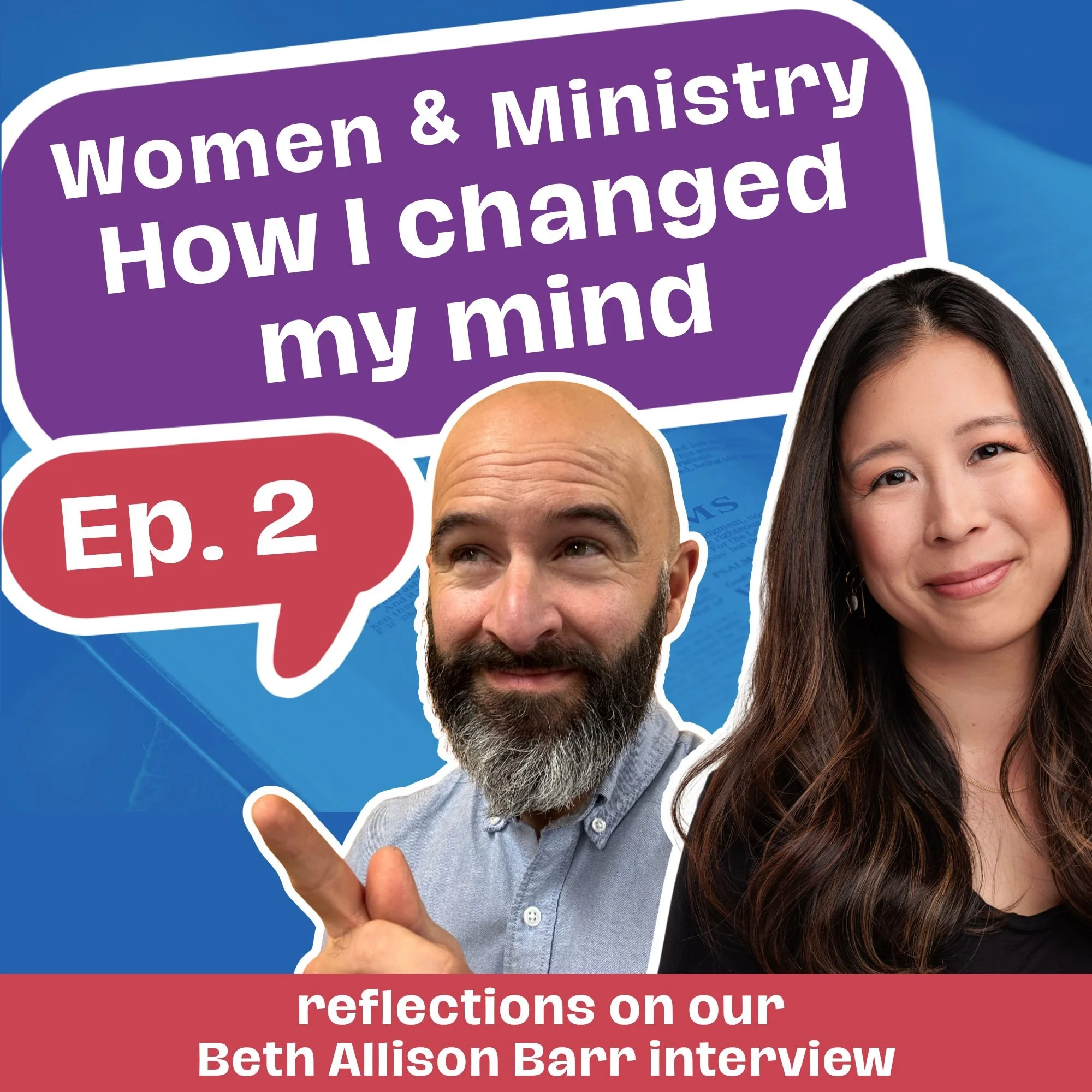
Women & Ministry: Why we changed our minds
Theology Lab’s video podcast:
December, 2025
In this Theology Lab Kristin and Scott take up a big question: When and why did we change our mind on a deeply personal topic? At one point both Kristin and Scott considered themselves theological complementarians -- the idea that women and men have specific roles within at least the sphere of the church, even if considered equal in the eyes of God -- yet, over time, they changed their minds. They would now consider themselves theological egalitarians, holding that there are not specific leadership roles in the church that are reserved exclusively for men, and that they can celebrate this reality.
But how did they go from one to the other? How did the Bible play a role in this? How did experience play a role? Their conversation draws from an interview with Beth Allison Barr and her recent book, Becoming the Pastor's Wife.
Check out Beth's book here: https://bakerbookhouse.com/products/9781587435898_becoming-the-pastors-wife
-
Greg Fung (00:00)
We have Scott Rice and Kristin Lee here. And to kick it off, what stood out to you from that conversation with Beth? What are you still thinking about afterwards?
Kristin T. Lee (00:10)
One of the things that I found very interesting was how Beth advocates for holding the tensions that exist in the Bible and not overlooking them or not trying to squash them. So for example, she says that you can't write out the household codes, but neither can you write out Deborah, the existence of Deborah, the judge. ⁓ And I think it
this measure of humility to both sides of an
argument whether it's about complementarianism or other divides that we have, if both sides can acknowledge that those tensions exist and not try to write them out, I think that we could have much more productive conversations that way
Greg Fung (00:50)
Great, how about you Scott?
Scott Rice (00:52)
So I think I have a similar reflection. think, know, and Kristin when we were setting up the questions, there was a reason we talked much. We put many questions to Beth about interpreting the Bible. And Beth,
I was pleased by how much she jumped onto those questions. my response to this question is almost, it's almost the same.
to what Kristin has said. I'll just try to add something onto it. I appreciated that Beth named honestly the contradictions.
that we find, the different voices you find about women within the Bible itself. There's just an honesty to being able to speak to that, that I feel , you know, in the tradition I've kind of come out of, wasn't didn't always feel okay to say that. I appreciated the she named, right? There's voices and then counter voices, narratives or counter narratives. It's when I read passages , 1 Timothy 2, for example, right? And I know that there are...
There are takes on that passage that want to say if you look at it in context, you have a different meaning. But you take that passage, you take these other passages, and I just begin to wonder, it feels we may be doing some kind of special pleading here. be able to say, all right, scripture can speak in a way where the kind of patriarchy of the time and the text comes through, but then there's also these other stories. And she mentioned many, she mentioned Junia.
And Phoebe, the one that is really powerful to me, right, is thinking about the resurrection of Jesus and
that he tells
female disciples who are at the tomb to go and to tell the story first. They are the first people to proclaim the gospel. I think that's just, that's really powerful.
think the part that I'm now, that it has me reflecting on is, you have these two different voices, but then what? Does that just mean they're two different?
equal options. And I don't think . That's where I think you have to do some theology and say, now I have to interpret these different voices in light of, in light of what?
think I look at that as I interpret those in light of the larger story of scripture. I interpret those, I can't get around the fact I belong to a tradition and how that tradition has understood the gospel. Which one of those
seems it's really good news, ⁓ which one lines up with experiences that I've seen? think maybe we'll be able to get into that one a little bit more. But I think I appreciate the way that Beth is able to kind of push forward this question that asks us, how do I read scripture? How do I make decisions when there's these different voices within the Bible itself?
Greg Fung (03:22)
Scott, you've hinted that not only is it in Scripture, but it's in the very traditions that certainly exist today, but also that you've been raised in, maybe for both of you, how have you actually wrestled with that theologically, the tension around complementarian, egalitarian, the role of women in the church, in the Bible. How have you personally wrestled with that over time?
Scott Rice (03:44)
I'll jump in on this one. There was a point in my life, a long period of my life, where I would have embraced complementarian.
views about gender, about a reading of the Bible. Be th Beth (Allison Barr) defines complementarianism, right? And she gives a definition in the interview itself. I'm gonna say it's a take in which women are
dependent upon men in some kind of one-way relationship, the man is not dependent upon the woman.
that's, I don't know, maybe that's helpful, or maybe it's not. ⁓ But there was a time that I would have endorsed complementarianism, and my mind...
changed on that. And I think about what that process was . Interestingly, early on, I had two key influences in my early faith life. One was a church. We actually did have, we had a woman that was a pastor, a lead pastor of our church. But at that point in my life, I was actually much more influenced by a large parachurch evangelical ministry. And...
in which they didn't really have a specific view on this, but there was a lot of complementarianism there, and I think that really formed me. But interestingly, years later, being on staff for that same ministry, I saw all of these women doing incredible work and leading and preaching.
that left an impression on me for sure, even as I probably,
would have said I was still a complementarian. And then I remember being in seminary, it was the first year, and that's where theologically I was wrestling with a lot of the things that Beth brought up in this interview. And realizing , well, this is really complicated.
I'm seeing the different voices on the topic of the role of women in the Bible itself and thinking, all right, is my mind changing?
Although I do remember once talking to a friend and just saying , and being in the midst of this, I'm ,
Is my mind changing on this? I don't know. And saying to him, , I, I'm really struggling with this. And it feels people who hold a different, maybe a more progressive view on me than this,
I really struggled with what felt a lack of clarity on their side, whereas my more conservative view had this very specific view and being pulled back and forth.
gives me some sympathy. And then I will tell you, my mind changed. There was a point in which just, think, all those impressions of how gifted women were in ministry that I had seen around me and then...
how this was way more complicated and reading the Bible and thinking theologically than I was led to believe. So I can't figure out what it was. There wasn't exactly a time, I can think of, (but) within a one or two year frame, but my mind just changed on it.
And I'm grateful for that. That's been a gift. Kristin, I'd be curious, what about your story?
Kristin T. Lee (06:30)
Yeah, I was raised to think that being obedient to Jesus meant not questioning. And I
as a kid, even through high school, just unthinkingly absorbed all the theology I was given. And part of that was a complementarian theology. The youth group I attended was affiliated with the Southern Baptist tradition. I was doing journal entries about biblical manhood and womanhood. Like I was , I wanted to be a good
So I didn't really think about it until when I started thinking more broadly about the questions that I had about my faith in college and later years. And I couldn't ignore the questions anymore. And part of that was this complementarian theology. And for me, what really changed me was in medical school, working alongside incredible female surgeons and emergency room doctors and ICU doctors and being ,
Why would you be able to put your life into the hands of a female oncologist on Monday, but then not want to hear her spiritual wisdom on a Sunday? Like there was this really jarring dissonance for me there, where it was very self-evident to me that women and men, maybe there's some differences, but really to me, not. Like I couldn't really see those differences intellectually, spiritually.
on a wisdom level, and it didn't make sense to me that women were barred from the pulpit in some traditions. So I think, and I am very intuitive person, I won't say that I was digging into scripture to try to figure this out, but it was more just a gut sensation after knowing these amazing female leaders.
Greg Fung (08:19)
It sounds in both cases, personal experience really began to shape how you engage with this theological question, which before was sort of unquestioned, an unquestioned complementarianism, whereas your lived experience forced you to kind of reevaluate that to where you both are today.
One thing I'm wondering is, what's something that you're currently in line with sort of what Beth Allison Barr was talking about? Where's some ongoing reflections or questions that you have?
in light of what she was speaking about.
Kristin T. Lee (08:52)
Something that I'm still thinking about from our conversation with Beth was that she puts forward this thesis that it's because we don't know our history that people like Al Mohler are able to say things there's this 2000 year unbroken church history where the office of pastor is limited to
something that. And she said,
He would never be able to get away with that statement unchallenged if people actually knew our history and knew that there have been women leaders in churches throughout history. history for me is really important. Knowing my personal history has become something really important to me in adulthood. And then also just knowing world history collectively, because I do think it influences how we think about really big issues racial justice or international relations if we know our history appropriately.
And one lingering question for me is how do we make sure we teach accurate history well, not only in our schools, but also in our churches?
Scott Rice (10:00)
My lingering thought is going to be Kristin's quote from earlier that, what does it look when you're taking advice from your oncologist and she's telling you about how to proceed with the diagnosis on a Monday, but on Sunday you're not open to her spiritual wisdom. That's a pretty incredible statement.
the thing I'm gonna be continuing to think about is just how far a little bit can go. I think for a lot of us, we think we say church history, it's , okay, there were some early councils, a guy named Augustine, a reformation, and then there's our church in the present.
in that very bare bones history, women, the names of women just rarely ever surface, at least in the bare bones version that.
So I think about attention, giving attention to more women. What does it look to have images and pictures around us of women from church history that can remind us? This is just something I'm thinking about on the spot, but I will say on the flip side
the laptop from which I'm recording this, have.
I have a sticker, two stickers, and one of them is of a figure ⁓ that was really important to be during graduate school. I ended up doing some studies on Robert Jenson but then intentionally next to him is Julian of Norwich. part of it is because as much as I love ⁓ Robert Jenson Julian of Norwich just spoke with, I think, a certain boldness, maybe an equal boldness to Jenson's where she still uses the male language around Father Son Spirit to talk about God, but also that Jesus is our mother and she brought motherly language.
into our talk about God. So ⁓ how much does that shape me? I don't know, but it does sit there as a little reminder about different voices that I want to be hearing and that should shape me as a follower of Jesus.
Kristin T. Lee (11:48)
It's such a great picture of a lot of the themes that Beth talked about.
Scott Rice (11:54)
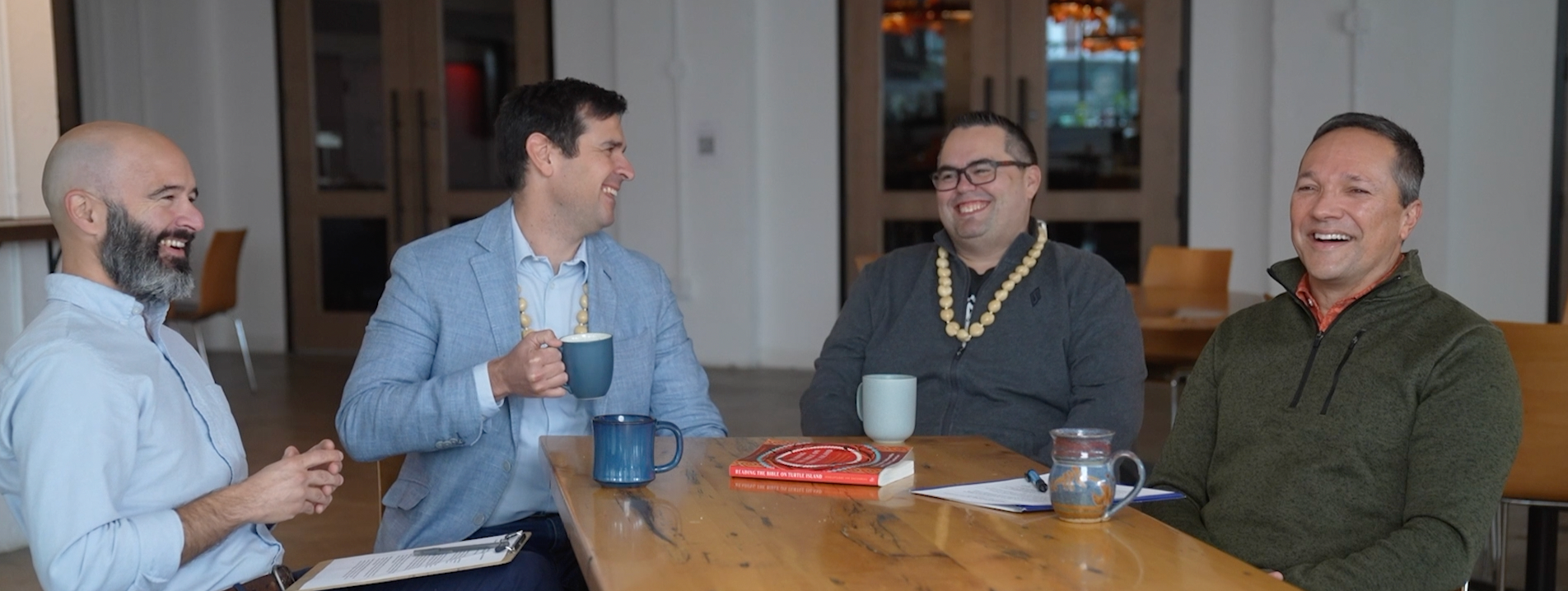
say it's good to be in the studio. I think this is the first time we've been in our online studio altogether as hosts ⁓ of Theology Lab. So I look forward to more of these conversations.
Greg Fung (12:04)
Can
Kristin T. Lee (12:05)
Same,